The Honda Prologue: Charting a New Electric Course on a Familiar Foundation
For decades, Honda has been a titan of internal combustion, a benchmark for reliability, efficiency, and thoughtful engineering. From the ubiquitous Civic to the family-hauling Pilot, the “H” badge has signified a smart, sensible automotive choice. Yet, as the industry pivots with seismic force towards electrification, Honda’s North American lineup has appeared conspicuously quiet. While competitors launched wave after wave of electric vehicles (EVs), Honda’s offerings were limited and regional. That silence has now been broken by the arrival of the 2024 Honda Prologue, an all-electric SUV that is as strategic as it is significant—a vehicle designed not just to compete, but to serve as a crucial bridge from Honda’s celebrated past to its electric future.
The name “Prologue” is no accident. It is a deliberate and candid acknowledgment of the vehicle’s role: an introduction, an opening act before the main performance. This performance will be Honda’s own proprietary EV platform, the “e:Architecture,” set to debut in the coming years. To get to that point without ceding the burgeoning EV market to rivals, Honda entered into a pragmatic and powerful partnership with a surprising collaborator: General Motors. The Prologue, therefore, is the first fruit of this alliance, a vehicle that marries Honda’s design, interior philosophy, and user experience with GM’s advanced Ultium battery and platform technology.
History and Genesis: A Tale of Two Automakers
To understand the Prologue, one must first understand the context of its creation. Honda was not a newcomer to electrification, having produced the Clarity Electric and the charming but limited-range Honda e. However, neither was a mass-market, long-range contender for the crucial North American SUV segment. Developing a ground-up EV platform is a multi-billion dollar, multi-year endeavor. Facing tightening emissions regulations and a rapidly shifting market, Honda chose collaboration over a delayed solo entry.
In 2020, Honda and General Motors announced a strategic alliance to co-develop electric vehicles. This partnership allowed Honda to leverage GM’s already-developed Ultium platform—the same highly flexible architecture underpinning vehicles like the Cadillac Lyriq, Chevrolet Blazer EV, and GMC Hummer EV. This move drastically shortened the Prologue’s development timeline, enabling Honda to bring a competitive mid-size electric SUV to market for the 2024 model year.
The Prologue is built alongside the Chevrolet Blazer EV at GM’s Ramos Arizpe plant in Mexico. While it shares its core electrical architecture, battery pack, and motors with its GM cousins, Honda was responsible for crafting a unique identity for the vehicle through distinct exterior and interior design, as well as specific suspension and steering tuning to deliver a characteristic Honda driving feel.
.
We LOVE cars & cruising around, but sometimes day trips to explore new cities are required (with family or friends) for a spice of variety in your life!
So GO explore!
Cruises & Day/Night City Tours to: Baltimore, Boston, Chicago, Marina Del Ray, New York, Niagara, Philadelphia, San Diego, San Francisco, Toronto, Washington DC, etc.:

.
Exterior and Interior Design: A Neo-Rugged Ethos
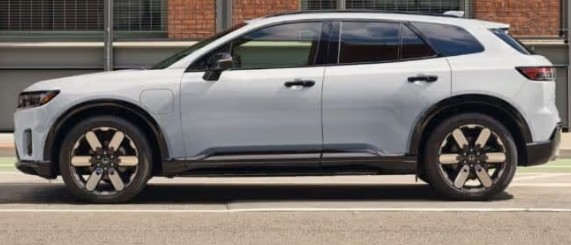
Honda designers penned the Prologue’s exterior at their Los Angeles-based design studio, coining the term “neo-rugged” to describe its aesthetic. The vehicle presents a clean, modern, and substantial profile that avoids polarizing design trends. Its dimensions place it squarely in the mid-size SUV category, with a wheelbase and overall length that are notably longer than Honda’s best-selling CR-V and more in line with the Passport.
The long 121.8-inch wheelbase, a hallmark of purpose-built EVs, pushes the wheels to the far corners, minimizing overhangs and maximizing interior volume. The front fascia is clean and grille-less, dominated by a simple black panel that houses the vehicle’s sensors, flanked by sleek, horizontal LED headlights that echo Honda’s current design language. In a notable branding shift, the rear of the vehicle eschews the traditional “H” logo in favor of the full “Honda” wordmark spelled out in a modern typeface, signaling a new era for the brand.
Inside, the Prologue feels immediately familiar to anyone who has been in a recent Honda. The design is dominated by a strong horizontal axis, creating a sense of spaciousness and clarity. Prioritizing user-friendliness, Honda has retained a healthy number of physical controls, including a traditional volume knob and hard buttons for climate functions, a welcome feature in an industry increasingly reliant on touchscreen-only interfaces.
The digital nerve center consists of two free-standing screens: an 11-inch fully digital driver instrumentation panel and an 11.3-inch central infotainment touchscreen. Critically, the Prologue comes standard with Google Built-in, which integrates Google Maps, Google Assistant, and the Google Play Store directly into the vehicle’s operating system for a seamless and intuitive user experience.
Years Produced: The Inaugural Chapter (2024 – Present)
The Honda Prologue officially launched for the 2024 model year, with the first vehicles arriving at dealerships in early 2024. As of its introduction, this is the only production year for the vehicle.
Models and Trim Levels for the 2024 Honda Prologue
For its debut year, Honda has structured the Prologue lineup into three distinct trim levels, offering a choice between front-wheel drive (FWD) and all-wheel drive (AWD) configurations on the lower trims, with the top trim being exclusively AWD. All models are powered by the same 85 kWh usable lithium-ion battery pack from the GM Ultium platform.
1. Prologue EX
The EX serves as the well-equipped entry point into the Prologue family. It is designed to offer a comprehensive suite of features without requiring buyers to step up to higher, more expensive trims.
- Powertrain Options:
- FWD: Single front-mounted motor producing 212 horsepower and 236 lb-ft of torque. EPA-estimated range of 296 miles.
- AWD: Dual motors (one front, one rear) providing all-wheel drive and a combined system output of 288 horsepower and 333 lb-ft of torque. EPA-estimated range of 281 miles.
- Key Standard Features:
- 19-inch alloy wheels
- Google Built-in with an 11.3-inch touchscreen
- 11-inch digital instrument cluster
- Wireless Apple CarPlay and Android Auto compatibility
- Wireless phone charger
- Heated front seats with 10-way power adjustment for the driver
- Dual-zone automatic climate control
- Honda Sensing® suite of safety and driver-assistive technologies (includes Collision Mitigation Braking, Road Departure Mitigation, Adaptive Cruise Control, Lane Keeping Assist, and Blind Spot Information with Cross Traffic Monitor).
2. Prologue Touring
The Touring trim represents the middle ground, adding a host of premium comfort and convenience features that many buyers in this segment expect.
- Powertrain Options:
- FWD: Single motor (212 hp). EPA-estimated range of 296 miles.
- AWD: Dual motors (288 hp). EPA-estimated range of 281 miles.
- Upgrades over EX:
- Leather-trimmed interior
- Bose premium 12-speaker audio system
- Front and rear parking sensors
- Auto-dimming rearview mirror
- Memory system for the driver’s seat and side mirrors
- Leather-wrapped steering wheel
- Power tailgate with hands-free access
3. Prologue Elite
Positioned as the flagship model, the Elite trim comes standard with all-wheel drive and includes exclusive technology, performance, and cosmetic enhancements.
- Powertrain Options:
- AWD Only: Dual motors producing 288 horsepower and 333 lb-ft of torque. Due to its larger wheels, the EPA-estimated range is slightly reduced to 273 miles.
- Upgrades over Touring:
- 21-inch machine-finished alloy wheels
- Heated and ventilated front seats
- Heated steering wheel
- Head-Up Display (HUD)
- Sport drive mode (in addition to Normal and Eco)
- 120V power outlet in the cargo area
- Illuminated front footwells and beverage holders
Charging and Ownership Experience
Recognizing that the charging experience is a major factor for EV adoption, Honda has rolled out a comprehensive strategy for Prologue owners. The vehicle’s Ultium architecture supports DC fast charging at speeds up to 155 kW, allowing it to add approximately 65 miles of range in just 10 minutes under optimal conditions.
To simplify the transition for new EV owners, Honda offers customers one of three charging packages upon purchase:
- A Level 2 Home Charging Station (11.5 kW) plus a $100 public charging credit and a $500 credit toward installation via Honda Home Electrification.
- A Portable Charging Kit (7.6 kW) plus a $300 public charging credit and a $250 credit toward installation.
- A $750 public charging credit for those who do not need a home charging solution.
This flexibility allows buyers to choose the option that best fits their lifestyle and living situation, addressing a key barrier to entry for many potential EV customers.
Future Outlook and Market Position
The Prologue enters a fiercely competitive segment, facing off against established players like the Hyundai Ioniq 5, Kia EV6, Ford Mustang Mach-E, and Volkswagen ID.4, as well as its own platform-mate, the Chevrolet Blazer EV. Its unique selling proposition lies in the trust and loyalty associated with the Honda brand. It is designed to appeal directly to the millions of existing CR-V and Pilot owners who are ready to make the switch to electric but want the reassurance of a familiar brand and dealership experience.
The Prologue’s future, as its name implies, is finite. It is the stopgap—the well-built, thoughtfully designed bridge to Honda’s independent electric future. Starting around 2026, Honda plans to launch a new series of EVs based on its own dedicated e:Architecture. These vehicles will be engineered from the ground up by Honda and will likely feature unique battery technology and software, allowing the company to fully control its electric destiny.
Interestingly, the broader collaboration with GM has already evolved. A plan for the two companies to jointly develop a range of more affordable EVs was cancelled in late 2023, with both automakers citing changing market conditions and deciding to pursue their own individual strategies for that segment. This underscores the temporary and strategic nature of the partnership that created the Prologue.
In conclusion, the 2024 Honda Prologue is far more than just another electric SUV. It is a masterclass in strategic adaptation. By leveraging GM’s robust Ultium platform, Honda has successfully launched a competitive, capable, and compelling EV without the immense delay and cost of a solo effort. It offers the space, technology, and familiar comfort that Honda buyers expect, all wrapped in a clean, modern package. While it may be a prologue to a larger, more independent story, it is a crucial and impressively well-written first chapter in Honda’s North American electric journey.