History of The Renault Trafic: A Versatile Workhorse in the Light Commercial Vehicle Arena
The Renault Trafic has long stood as a symbol of adaptability and reliability in the light commercial vehicle (LCV) market. Since its debut in the 1990s, this multi-purpose van has carved out a niche for itself as a versatile workhorse, serving businesses, families, and specialized industries. Known for its robust design, functional interior, and evolving technology, the Trafic has become a staple for transport needs, from everyday deliveries to high-capacity passenger transport. This article delves into the history of the Renault Trafic, its various models and trim levels, its evolution over generations, and what the future holds for this iconic vehicle.
A Brief History of the Renault Trafic
First Generation (1990–1998)
The Renault Trafic was introduced in 1990 as a response to growing demand for a mid-sized van that balanced commercial utility with passenger comfort. Built on a modified variant of the Renault 25 platform, the first-generation Trafic featured a straightforward design with no-nonsense functionality. It was available in short-wheelbase (SWB) and long-wheelbase (LWB) configurations, accommodating up to seven passengers in the LWB variant.
Engines at launch included a 1.6-liter gasoline unit and a 2.0-liter diesel (D7U1), later joined by a 2.5-liter SD22 diesel in 1994. The Trafic I’s simplicity and durability made it a favorite among small businesses, though it lacked the advanced features seen in modern vans. Trim levels were minimal, with options like the “Standard” and “Comfort” focusing on basic usability.
Second Generation (1998–2003)
Renault launched the second generation of the Trafic in 1998, emphasizing improved ergonomics and modernization. The van received a more angular exterior design, enhanced safety features, and a refined interior. A new 2.0-liter common-rail diesel (K4M) replaced the older engines, offering better efficiency and lower emissions. This generation also introduced a 160 PS version of the K4M, catering to customers seeking extra performance.
Trim levels evolved, with the “Express” and “Confort” grades adding basic comforts like air conditioning, powered steering, and improved seating. The Trafic II became a popular choice for delivery services, thanks to its load capacity and adaptability for conversions.
Third Generation (2003–2015)
The third Trafic saw a significant redesign in 2003, with a more spacious cabin, advanced safety technology (including ABS and traction control), and a modular interior layout. This generation was engineered to prioritize driver comfort and adaptability, with floor lengths adjustable to optimize cargo space. A new 150 PS 2.0L K4M engine became the standard, while a 190 PS variant briefly appeared for high-performance needs.
Trim levels expanded to include “Express,” “Confort,” and later “Business” and “Style” options, catering to both commercial and lifestyle-oriented buyers. The Trafic III also introduced a unique “Trafic Leisure” model, tailored for families with its extended wheelbase and enhanced passenger comforts.
Fourth Generation (2015–Present)
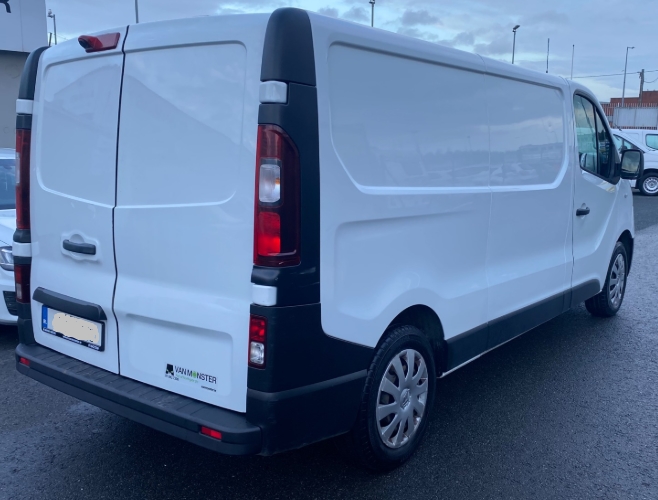
Renault unveiled the fourth-generation Trafic in 2015, marking a shift toward modernization and environmental sustainability. Designed on the all-new ModuL platform, this iteration prioritized fuel efficiency, connectivity, and driver assistance features. The van features a sleeker exterior, with LED lighting, a panoramic roof option, and aerodynamic tweaks to reduce drag.
Engine options now include a 1.5L dCi 90-130 PS and 1.6L dCi 130-150 PS diesel range, all compliant with Euro 6 emissions standards. In 2023, Renault expanded its lineup with the Trafic Hybrid, combining a 1.6L dCi engine with an electric motor for improved efficiency. This generation also supports over-the-air (OTA) software updates for infotainment and driver systems.
Trim levels are now standardized as Access, Zen, and Dynamique, reflecting a hierarchy from basic functionality to premium features. Each trim caters to distinct market segments, from fleet buyers to private owners.
.

.
Models and Trim Levels
Trim Level Breakdown
- Access
- The base trim focuses on value and essential features. It includes manual climate control, 60/40 fold-flat rear seats (SWB), and a DAB digital radio. The 1.5L dCi 90 PS engine is standard for cost-sensitive buyers.
- Zen
- Adds comfort and convenience features: automatic climate control, heated steering wheel, cruise control, and a 7-inch touchscreen with Apple CarPlay and Android Auto. The Zen trim is ideal for professionals needing tech connectivity without overpaying.
- Dynamique
- The top trim offers luxury touches like heated and ventilated front seats, a powered panoramic roof, and Renault’s “Intelligent Driver Assistance System” with lane-keeping and adaptive cruise control. The 1.6L dCi 150 PS engine is available as an upgrade.
Special Editions and Derivatives
- Trafic Hybrid (2023): A plug-in hybrid variant combining a 1.6L dCi diesel with an electric motor, delivering 135 g/km CO2 and all-electric ranges of up to 50 km.
- Trafic Van: For commercial use, available in SWB (load volume: 6.1 m³) and LWB (8.1 m³) configurations.
- Trafic Van Plus: Adds a reinforced load floor and optional refrigeration systems for transport-heavy industries.
- Trafic People Mover: The LWB version reconfigures to seat up to 9 passengers, with sliding doors and optimized legroom.
- Trafic Kangoeroo: A modular transport option for groups, often used by schools or sports teams.
- Trafic Special Purpose: Converted into ambulances, mobile shops, and even food trucks, leveraging the van’s customizable interior.
Future Outlook and Trends
Electrification and Sustainability
As global emission standards tighten, Renault is accelerating its shift toward electrification. The Trafic Hybrid is a stepping stone toward a fully electric model. Rumors suggest the Trafic E-Trafic will debut in mid-2025, sharing its battery-electric platform with the Kangoo Z.E. and Master Z.E. This move aligns with the EU’s 2035 ban on internal combustion engines and growing demand for zero-emission commercial fleets.
Autonomous and Connected Features
Future Trafics may incorporate Renault’s Drive4U system, a semi-autonomous driving platform enabling lane-keeping, self-parking, and automated highway driving. Connectivity will also evolve, with AI-powered infotainment systems learning driver preferences and integrating with smart ecosystems.
Global Market Strategy
Renault is expanding the Trafic’s appeal beyond Europe, targeting emerging markets with cost-effective variants. The van’s modular design suits diverse regional needs, from urban delivery services to suburban family transport.
Why the Trafic Stands Out
- Versatility: Its ability to adapt from a cargo van to a passenger carrier exemplifies its design brilliance.
- Cost Efficiency: Diesel and hybrid engines balance performance with fuel economy, crucial for cost-conscious fleets.
- Safety Innovation: Features like 360-degree cameras and driver monitoring systems enhance safety in both commercial and personal use.
The Renault Trafic has evolved from a simple commercial workhorse into a sophisticated, multi-functional vehicle. With each generation, Renault has refined its engineering, expanded its practicality, and embraced modern technologies. As the automotive industry moves toward electrification and autonomy, the Trafic is poised to remain a leader in the LCV segment, proving that innovation and utility can coexist. Whether hauling cargo, transporting passengers, or serving as a mobile office, the Trafic continues to redefine what a van can be.