The Kaiser Manhattan: A Comprehensive History and Overview
The Kaiser Manhattan was one of the most distinctive post-war American automobiles, produced by the Kaiser-Frazer Corporation during the early-to-mid 1950s. Known for its elegant styling, forward-thinking engineering choices, and unique positioning in the market, the Manhattan served as the premium offering in Kaiser’s lineup. While it never achieved the mass-market success of offerings from the “Big Three” automakers, it remains an important chapter in American automotive history, symbolizing both the ambition and challenges faced by independent car manufacturers in the post-World War II era.
Brief History of Kaiser-Frazer
The Kaiser-Frazer Corporation was founded in 1945 as a joint venture between industrialist Henry J. Kaiser and automobile executive Joseph W. Frazer. Their aim was to take advantage of the postwar boom and the public’s hunger for new cars after years of wartime production restrictions. Initially, the partnership brought fresh designs and innovative marketing strategies, and Kaiser-Frazer quickly became the most successful of the independent automakers in the late 1940s.
By the early 1950s, however, competition from entrenched giants like General Motors, Ford, and Chrysler began to erode the company’s market share. Kaiser needed a flagship model to stand out in a saturated market — and the Manhattan became that flagship.
.
NO MORE dead batteries with this:

.
Years Produced
The Kaiser Manhattan was produced from 1949 to 1955. It began life as the top trim level of the Kaiser lineup in 1949 and evolved into a standalone series in the early 1950s. It was positioned above the Kaiser Special, Deluxe, and other models, offering a more luxurious and stylish alternative.
Model Evolution
1949: Introduction as a Top Trim
- Positioning: The Manhattan name first appeared in 1949 as the top trim level of the Kaiser Deluxe line. It featured upgraded interior materials, additional chrome trim, and premium features aimed at buyers seeking something more upscale without stepping into the highest-priced luxury segment.
- Body Styles: The 1949 Manhattan was available primarily as a four-door sedan, with a few special body styles offered in limited numbers.
1950–1951: Refinement and Styling
- The early 1950s Manhattans retained the basic body shell of the original postwar Kaisers but received incremental styling updates. Interiors were further refined with better upholstery, two-tone color schemes, and more standard features.
- In 1951, the Manhattan became more clearly delineated as a luxury model, with exterior distinctions such as unique badging, additional chrome detailing, and more elaborate grille designs.
1952: Redesign
- The 1952 model year brought a major restyling across the Kaiser lineup, including the Manhattan. Designed under the direction of stylist Howard “Dutch” Darrin, the new body featured a lower, sleeker profile, wraparound rear window, and a more modern look.
- Manhattans benefited from high-end interior treatments, including plush fabrics, improved sound insulation, and dashboard enhancements.
- Power came from Kaiser’s dependable inline-six engine, as the company lacked the resources to develop a V8 at that time.
1953: Standalone Prestige
- By 1953, the Manhattan was firmly established as Kaiser’s flagship. The model offered exclusive paint colors, upscale trim pieces, and the most comprehensive list of standard equipment in the company’s range.
- The company also introduced the Kaiser Manhattan Club Sedan alongside the four-door sedan, giving buyers a sportier two-door option.
- The Manhattan was also one of the first cars in the U.S. to offer a factory-installed supercharger, which boosted the output of its inline-six to remain competitive with rivals’ V8s.
1954: The Supercharged Era
- The 1954 Manhattan became notable for its standard McCulloch centrifugal supercharger on all models. This was a bold move, as it made the Manhattan one of the few American cars of the era to standardize forced induction.
- The supercharger raised the 226 cubic-inch inline-six’s output to around 140 horsepower, improving performance significantly without the expense of developing a new engine.
- Styling updates were modest, focusing on grille revisions and trim changes.
1955: Final Year
- The 1955 Manhattan was the last produced in the United States. By this time, Kaiser’s U.S. operations were struggling, and the company was shifting its focus toward overseas production (notably in Argentina through Kaiser Argentina, which produced derivatives for several years afterward).
- The ‘55 model year brought minor trim tweaks but no major mechanical changes. The Manhattan bowed out as a uniquely styled, well-equipped car that couldn’t overcome the market dominance of larger automakers.
Models and Trim Levels Offered
While the Kaiser Manhattan nameplate always denoted the top trim level, over the years it was offered in several body styles and slight variations:
- Manhattan Sedan – The most common form, a four-door sedan with upscale interior and exterior finishes.
- Manhattan Club Sedan – Introduced in the early 1950s, a two-door configuration aimed at a younger or style-conscious buyer.
- Manhattan Convertible – Produced in very limited numbers, especially in the early years, offering open-air motoring with premium appointments.
- Special Editions – Certain years saw special paint schemes or interior packages exclusive to the Manhattan line, often tied to promotional efforts.
There were no sub-trim levels within the Manhattan line — the Manhattan was the top trim — but options packages could further enhance luxury, such as upgraded radios, heater/defroster units, and exterior dress-up kits.
Engineering and Performance
Powertrain
For most of its production life, the Manhattan was powered by Kaiser’s 226 cubic-inch “Supersonic” L-head inline-six engine, originally designed by Continental Motors. Early versions produced around 115 horsepower, but performance lagged behind V8-equipped competitors.
In 1954, Kaiser addressed this gap by fitting a McCulloch supercharger as standard equipment on the Manhattan. This boosted output to approximately 140 horsepower and improved acceleration, making the Manhattan more competitive without the cost and complexity of launching a new V8 engine program.
Transmission
The Manhattan was offered with either a three-speed manual transmission (with optional overdrive) or a General Motors-sourced Hydra-Matic automatic transmission, which was highly regarded for its smooth operation.
Suspension and Ride
Kaisers, including the Manhattan, were praised for their ride comfort. The suspension setup, coupled with a relatively long wheelbase, gave the car a smooth, stable feel on the road. The Manhattan’s interior insulation and quality materials further enhanced ride refinement.
Styling and Design
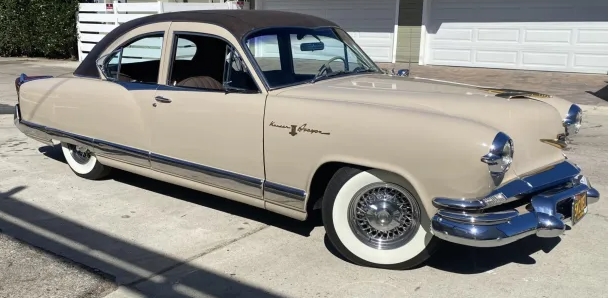
The Manhattan’s design reflected the work of Howard Darrin, who favored clean lines, graceful proportions, and distinctive details. Hallmarks of the Manhattan included:
- Sweeping chrome trim along the sides
- Wraparound rear windows (on later models)
- Two-tone paint schemes that accentuated the car’s length and curves
- Upscale interiors with patterned upholstery, chrome accents, and a well-laid-out dashboard
The Manhattan’s styling was often ahead of its time and helped it stand out from the more conservative designs of some competitors.
Market Position and Competition
The Manhattan was aimed at the upper-middle-class buyer who wanted something different from the mainstream. It competed in the same general price and size class as the Buick Special/Super, Oldsmobile 88, Chrysler Windsor, and Mercury Monterey. However, Kaiser’s limited dealer network and marketing budget made it harder to gain widespread recognition.
Sales Performance
While the Manhattan garnered praise for its styling and comfort, sales were modest. The lack of a V8 engine until the supercharged six in 1954 was a handicap in a market increasingly obsessed with horsepower. Additionally, the Big Three’s ability to undercut prices and offer more body styles and options limited the Manhattan’s appeal to niche buyers.
Legacy of the Kaiser Manhattan
Despite its relatively short production run, the Manhattan occupies an important place in automotive history. Its combination of distinctive design, innovative use of supercharging, and role as a flagship for an independent automaker make it a favorite among classic car enthusiasts today.
In the collector market, Manhattans are valued for their rarity, especially the supercharged 1954 models and the limited-production convertibles. Parts availability can be a challenge due to the car’s low production numbers, but dedicated clubs and specialists keep the legacy alive.
Future Outlook
The Kaiser Manhattan’s future lies primarily in the hands of collectors, restorers, and automotive historians. As a tangible reminder of the postwar independent automakers’ ambitions, it has increasing historical significance. While unlikely to ever be widely known outside enthusiast circles, awareness of the Manhattan is growing thanks to online communities and appearances at classic car shows.
Given its unique styling and engineering story, the Manhattan may see increased interest as collectors look beyond the more common models from the 1950s. Its rarity, especially in well-preserved or fully restored condition, ensures it will remain a sought-after niche classic.
The Kaiser Manhattan was a bold statement from a company determined to carve out its place in a competitive automotive landscape. Produced from 1949 to 1955, it offered upscale amenities, distinctive design, and — in its later years — innovative engineering with the adoption of standard supercharging. While it could not save Kaiser’s U.S. passenger car business, it left an indelible mark as a stylish, forward-looking automobile from a time when independent automakers still dared to challenge the giants of Detroit.
Collectors and enthusiasts today appreciate the Manhattan not just as a beautiful machine, but as a symbol of postwar optimism and the creative spirit of America’s automotive independents.