The Green Pit Viper: Unpacking the Myth, Might, and Madness of the Porsche 917
In the pantheon of automotive history, few machines occupy a space as hallowed and historically significant as the Porsche 917. It was a car born from a regulation sheet that read like a mathematical formula, yet it performed like a barbaric symphony of internal combustion. For decades, the 917 has stood as the ultimate “what if” scenario for racing fans: a car so dominant, so terrifyingly fast, and so culturally ubiquitous (thanks to Steve McQueen) that it almost feels like a myth. But the reality of the 917 is far more complex, more varied, and more fascinating than its Hollywood fame suggests.
To understand the 917, one must first understand the chaotic era in which it was born: the late 1960s. This was a time when racing safety was an afterthought, and power was the only metric that truly mattered.
The Genesis: A Regretful Loophole
The story of the 917 begins with the Fédération Internationale de l’Automobile (FIA) and their 1971 World Sportscar Championship regulations. The FIA, in a bid to limit speeds and costs, set a cap on engine displacement for the Group 5 “Prototype” category: 5.0 liters. However, they inadvertently left in a loophole. A manufacturer could homologate a car for Group 4 (Sports) with a smaller engine, and then equip it with a larger 5.0-liter engine for Group 5, provided they built at least 25 examples of the car.
Ferdinand Piëch, the brilliant and demanding engineer who headed Porsche’s R&D, saw this not as a limitation, but as an opportunity. Porsche was currently campaigning the 908, but Ferrari was looming with their powerful 512. To beat them, Porsche needed raw displacement and power.
The result was the 917. When it debuted at the 1969 Geneva Motor Show, it was a shock to the system. The car was essentially a 5.0-liter, air-cooled, flat-12 engine draped in a lightweight fiberglass and aluminum body. It was a homologation special built out of necessity, but it was also a masterpiece of engineering that terrified even its own drivers.
.

.
The Models and Trims: A Tale of Two Eras
While the world recognizes the 917 largely as a single entity, it actually evolved into distinct generations. In total, Porsche built 65 examples of the 917 (enough to satisfy the homologation rules), split primarily between the early “long tail” spyders and the later, aerodynamically obsessed coupes.
1. The 1969/1970 Porsche 917 (The “Short Tail” or “Pink Pig” Era)
The initial batch of 917s, constructed in 1969 and raced through 1970, are mechanically distinct from the cars that followed.
- Bodywork: These cars featured a “short tail” configuration for the spyders (open cockpit). The bodywork was minimal, and the aerodynamics were underdeveloped. The air-cooled flat-12 engine (Type 912) produced around 580 horsepower naturally aspirated, or up to 845 horsepower with a turbocharger (though turbo lag was violent).
- The Coupe (917K): Porsche quickly realized the short-tail spyder was dangerously unstable at high speeds (a lesson learned by John Wyer’s team and Jackie Stewart). To counter this, Porsche developed a closed coupe body, known as the 917K (for Kurzheck, or “short tail”—confusingly, the coupe was also sometimes called short tail, but the aerodynamic package was different). This car featured a steeply raked rear window and a whale-tail spoiler.
- The 917/10: This was a transitional model, essentially a 917K but with a slightly enlarged 5.0L engine and better aerodynamic refinements, often referred to as the “917K evolved.”
2. The 1971/1972 Porsche 917 (The “Long Tail” and Can-Am Dominance)
By 1971, the focus shifted entirely to aerodynamics and the terrifyingly fast Canadian-American Challenge Cup (Can-Am).
- The 917/20 (“The Flyswatter”): This was an experimental bridge between the spyder and the coupe. It featured a massive, wide body with a flattened nose and a huge rear wing. It was nicknamed “The Flyswatter” because it looked like it could crush anything in its path. It was too draggy for endurance racing but paved the way for the ultimate Can-Am car.
- The 917PA (Panther): This was the intermediate Can-Am car, fitted with the 5.0L flat-12. It was fast, but Porsche engineer Hans Mezger wasn’t satisfied.
- The 917/10 (Can-Am): This is a different beast entirely from the 1969 917/10. This 1971 Can-Am car featured a massive 5.4-liter (later 5.8L) flat-12 engine. It was a monster producing over 1,000 horsepower.
- The 917/30 (The Ultimate Weapon): The pinnacle of the 917 lineage. Built specifically for the 1973 Can-Am season, the 917/30 was a spyder (to save weight) equipped with a twin-turbocharged 5.4-liter flat-12. With a massive rear wing and wider bodywork, it produced between 1,100 and 1,500 horsepower depending on boost settings. It was widely considered the fastest closed-circuit racing car of all time until modern F1 and Le Mans Hypercars emerged.
Engineering: The Heart of the Beast
The defining characteristic of the 917 was its engine. The flat-12 was a masterpiece of centralization. By laying the engine low and flat, Porsche gave the car an incredibly low center of gravity. The engine was a stressed member of the chassis, meaning the wheels and suspension attached directly to the engine cases, eliminating the need for a heavy subframe.
However, the air-cooled nature of the engine posed massive challenges. At over 600hp in 1969, cooling the rear cylinders was difficult. Porsche utilized a system of “scavenger pumps” to ensure oil and air were constantly moving to prevent hot spots. Furthermore, the 917 utilized magnesium alloy cases for the crankshaft and cam boxes to save weight—a material that is notoriously difficult to machine and cast at the time.
The Racing Legacy: 1970 and 1971
The 917’s competition history is a rollercoaster.
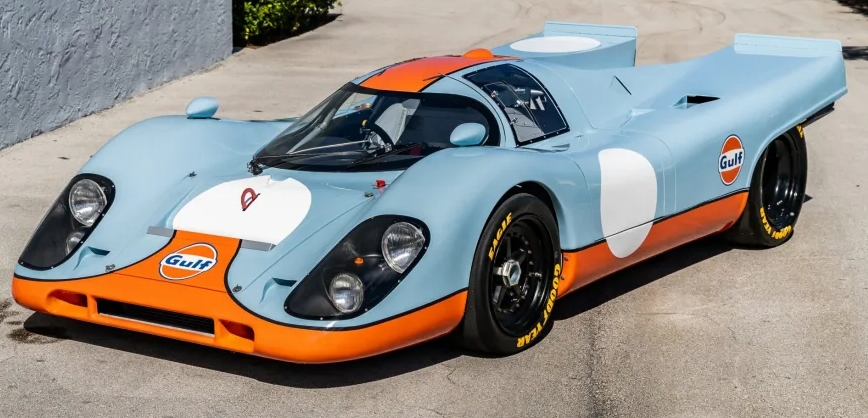
1970: The year started poorly. The short-tail 917s were fast but unstable. At the 24 Hours of Le Mans, the factory team failed to finish. However, John Wyer’s Gulf Oil-liveried private team (JWA Gulf) took the underdeveloped 917K and, through sheer ingenuity, won the 24 Hours of Le Mans with drivers Hans Herrmann and Richard Attwood. It was the 917’s first and greatest victory. Porsche also won the World Sportscar Championship that year, proving the car was a winner.
1971: This was the year of the 917K. Porsche had refined the car, and it was unstoppable. At Le Mans, the Gulf Porsche 917K of Derek Bell and Jacky Ickx obliterated the field, setting a record average speed of 138.2 mph (222 km/h)—a record that stood for 39 years. The 917K was the fastest car in the world on a circuit.
The Can-Am Domination: While the 917K ruled Le Mans, the 917/10 and 917/30 ruled North America. The Can-Am series was known as the “Unlimited” class—anything went. Porsche arrived with the 917/30, and the competition simply gave up. In 1972, the 917/30 won 8 out of 10 races. In 1973, it was even more dominant. The series eventually folded because Porsche’s dominance made it financially unviable for other manufacturers to compete. The 917/30 remains perhaps the most powerful naturally aspirated or turbocharged racing car of the analog era.
The “Other” 917s: Spies, Concepts, and Spyders
It is worth noting that not all 917s were racers. A few were converted into “street legal” prototypes, though they were anything but user-friendly.
- The 917 “Street Coupe”: Two cars were built. They featured the 917K bodywork but with lights, blinkers, and a slightly detuned engine. One was famously painted in a unique orange and purple scheme. These cars are currently owned by the Porsche museum and are valued in the tens of millions.
- The 917 Spyder (Street): A few open-top versions were also created for VIPs and testing. These were essentially the racing spyders with lights added.
The McQueen Connection: Cinema Immortality
You cannot discuss the 917 without mentioning the 1971 film Le Mans. Steve McQueen, a genuine racing driver, desperately wanted to drive the 917. The film is famous for its “seat-of-the-pants” photography. McQueen’s Gulf-liveried 917K (chassis 917/20) is perhaps the most famous racing car in movie history.
However, the reality was that McQueen was not allowed to drive the 917 at full race pace. The car was too fast, too dangerous, and too expensive. In the film’s close-up shots, it was actually McQueen’s friend and stunt driver, David Piper, driving the car at terrifying speeds. The real 917 used in the film (chassis 917/20) was famously damaged in an accident during filming—a testament to the car’s unforgiving nature.
The End of the Line
The 917’s dominance was its own undoing. By 1972, the FIA, tired of the escalating speeds and costs (and arguably tired of Porsche winning), changed the regulations. For the 1972 season, they reduced the engine displacement limit to 3.0 liters for Group 5. This effectively banned the 5.0-liter 917.
Porsche, ever the pragmatist, simply moved the 917/10 and 917/30 engines into the new Porsche 917 Can-Am car (the 917/30 was technically a 1972/73 model). But once the Can-Am series collapsed, the 917 retired.
Future Outlook: A Legend That Won’t Fade
The 917 is a car that has no future, only a past that grows more valuable with every passing year. It represents the absolute zenith of the “blue-collar” engineering philosophy: taking an air-cooled engine, intended for the humble VW Beetle and 356, and stretching it to its absolute limit to beat the world.
Today, a genuine racing 917 is worth upwards of $15 to $20 million. They rarely trade hands. The Porsche Museum in Stuttgart keeps several examples, often running them in historic demonstrations (briefly, as the magnesium parts are now considered fragile).
However, the 917’s spirit lives on. The current Porsche 963 LMDh prototype, which returned Porsche to the top class of Le Mans in 2023, bears a distinct aesthetic resemblance to the 917, particularly in its nose and rear light signature.
Conclusion
The Porsche 917 was not a polite car. It didn’t have ABS, traction control, or power steering. It was a raw, vibrating mass of metal and fire that required immense bravery just to sit in. It was born from a rulebook, evolved through aerodynamic necessity, and died because it was simply too good at its job.
From the early struggles of the short-tail spyder to the nuclear power of the 917/30, the 917 remains the definitive racing car. It is the Green Pit Viper of motorsport—cold-blooded, lethally fast, and utterly unforgettable.