Evolution of The Peugeot 403: France’s ‘Gentleman’ and the End of an Era
In the grand tapestry of automotive history, some cars are remembered for their revolutionary design, others for their blistering performance, and a few for their sheer, unyielding ubiquity. The Peugeot 403 belongs firmly in the latter category, yet it transcends mere numbers. It was a car that defined a nation’s post-war recovery, captured the public imagination through television, and became a symbol of unassuming, diligent service. For over a decade, the 403 was Peugeot’s steadfast workhorse—a handsome, reliable, and fundamentally decent automobile that became known affectionately in its native France as ‘Le Gentleman.’
A Car for a New France: The Genesis of the 403
By the early 1950s, Peugeot was a respected, but conservative, manufacturer. Its pre-war lineup had been solid but uninspired. To compete in a rapidly modernizing world, the company knew it needed a completely new design, one that could appeal to a growing middle class and be exported successfully. The project, designated Type 161, was ambitious. Peugeot collaborated with two of Italy’s most prestigious design houses: Pininfarina for the body and Fiat for the engineering of its overhead-cylinder head.
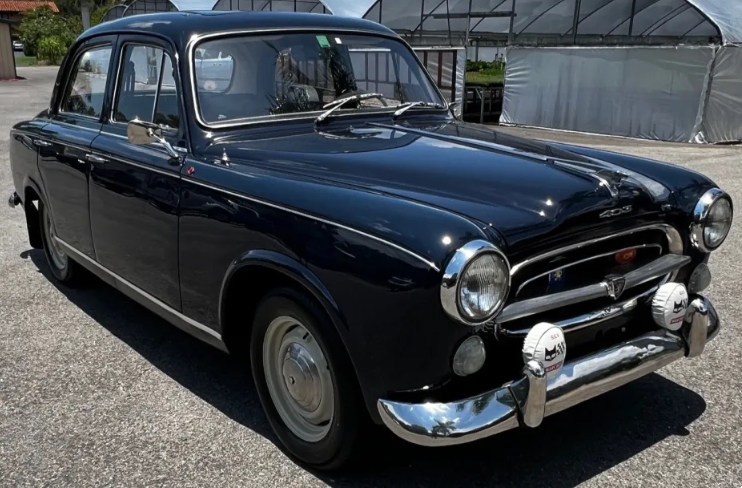
The result, unveiled at the Paris Salon in October 1955, was the 403. It was a revelation. Styled by Pininfarina, the car possessed a timeless, understated elegance. Its lines were clean and flowing, with a distinctive “barchetta” style front end, a gracefully sloping rear window, and a chrome grille that gave it a confident, friendly face. It was a world away from the staid designs of its predecessors and competitors. The 403 was handsome without being flamboyant—a perfect fit for the burgeoning professional class of 1950s France.
At its launch, the 403 was offered as a four-door sedan, a vehicle designed for comfort and practicality. It was powered by a new 1.5-liter (1468cc) “siamese” inline-four engine. This design, where cylinder bores were placed side-by-side without water passages between them, was a cost-effective way to build a compact engine. It produced a respectable 45 horsepower (DIN), giving the car a top speed of around 125 km/h (78 mph)—perfectly adequate for the era’s roads.
The 403 was an immediate success. It was praised for its comfortable ride, thanks to its independent front suspension with torsion bars and coil springs at the rear, and for its quiet, refined engine. It was a car that felt more expensive than it was, a hallmark of Peugeot’s philosophy.
.

.
The Evolving Family: Models, Trims, and Variants
The 403’s long production run saw a steady evolution, with new models and trim levels introduced to cater to different tastes and needs.
1. The Berline (Sedan): The Core Model (1955-1966) The four-door sedan was the backbone of the 403 range. Over its life, it received several updates:
- Early Models (1955-1958): Characterized by their large, single circular headlamps, two-tone paint options, and simple interiors.
- 1958 Facelift: A significant update saw the introduction of quad headlamps (two on each side), which gave the car a more modern and wider appearance. The rear window was also changed from a flat piece of glass to a more curved, wraparound design on the “Commerciale” estate, and the interior was refreshed.
- Interior and Trim Levels: The 403 was typically offered in two main trim levels:
- Base/Luxe: The standard model, featuring a cloth or basic vinyl interior, a simple dashboard, and essential features.
- Super/Luxe Décor: This was the more upscale option. It included a two-tone paint scheme (often with a contrasting roof), chrome trim accents, a more premium interior fabric, a tachometer, and a heater as standard. This trim truly earned the car its “Gentleman” moniker.
2. The Commerciale (Estate/Wagon): The Workhorse (1956-1966) Launched a year after the sedan, the Commerciale estate was an instant hit with tradesmen, farmers, and families. It shared the sedan’s front-end design but featured a large, practical rear cargo area. Its party piece was the ingenious “Clips” tailgate. The rear windows and tailgate could be opened independently. The side windows folded down, the top half of the tailgate hinged upwards, and the bottom half folded down like a pickup truck bed, creating a versatile and accessible loading space. This made it exceptionally useful and set a standard for estate cars for years.
3. The Cabriolet: The Style Icon (1956-1963) For those who wanted open-air motoring with the 403’s Pininfarina style, the Cabriolet was the answer. Based on the sedan’s mechanicals, it was a handsome and well-made four-seater convertible. It featured a neatly folding fabric roof and a minimalist rear deck. The interior was often more luxurious, with leather seats and a wood-rimmed steering wheel. While not a sports car, it was a chic and desirable model that added a touch of glamour to the range.
4. The Diesel Revolution (1959-1967) In 1959, Peugeot introduced a diesel variant, the 403D. This was a pioneering move for a mainstream family car. The 1.8-liter (1767cc) XLD engine produced a modest 40 horsepower but delivered fantastic fuel economy and, crucially, massive torque. The 403D was slow to accelerate and had a low top speed, but it was incredibly robust and economical, making it a favorite for high-mileage drivers, taxi fleets, and businesses. It was available as both a sedan and a Commerciale estate.
5. The 403 Familiale (1958-1963) For larger families, Peugeot offered the Familiale, a seven-seater variant. It was based on the Commerciale estate but featured a raised roofline and three rows of forward-facing seats. It was a true people-mover long before the term was coined, offering a pragmatic solution for large families and institutions.
6. The 403 “1500” (1960-1962) In the final years of production, a special high-performance version was briefly offered. Known as the “1500,” it was based on the US-spec 403, which had to meet American horsepower taxes. It used a twin-choke carburetor, a higher compression ratio, and a different camshaft to boost output to 65 horsepower. This was the 403 at its most spirited, capable of reaching 145 km/h (90 mph).
The Pop Culture Phenomenon: Columbo and the Indestructible Peugeot
It is impossible to discuss the Peugeot 403 without mentioning its most famous, albeit fictional, owner: Lieutenant Columbo. When the classic TV detective series debuted in 1971, its creators needed a car that reflected the character’s personality: rumpled, unassuming, and tenacious. A brand-new American car was out of the question. They chose a used, olive-green 1959 Peugeot 403 Cabriolet.
The car was a stroke of genius. It was instantly recognizable, quirky, and perfectly suited to the rain-soaked streets of Los Angeles. Over the course of the series, Columbo’s Peugeot became as much a character as the detective himself. The show famously never showed how the car was started, leading to urban legends that Columbo had a special, hidden ignition switch. In reality, the production team used a simple, unseen push-button starter.
The association with Columbo cemented the 403’s image in the global consciousness. It transformed the car from a humble French family sedan into a symbol of dogged persistence and quiet intelligence. To this day, surviving 403s, particularly the green cabriolets, are sought-after collector’s items by fans of the show.
The End of the Road and a Lasting Legacy
By the early 1960s, the automotive landscape was changing again. New, more modern rivals like the Ford Cortina were emerging, and the 403, despite its updates, was beginning to show its age. Production of the sedan and cabriolet ceased in 1966, with the Commerciale and diesel models continuing for another year.
The 403’s direct successor was the 404, which launched in 1960. The 404 was a more aerodynamic and technically advanced car, but it shared the 403’s core values: reliability, understated style by Pininfarina, and practicality. The 403 had laid the groundwork, establishing Peugeot as a brand that could produce sophisticated, durable, and globally competitive cars.
The 403’s legacy is immense. It was Peugeot’s first post-war million-seller, with over 1.3 million units built. It was instrumental in establishing the brand’s reputation for bulletproof engineering that would be fully realized with the legendary 205 and 405 models.
The 403 Today: A Gentleman’s Classic
Today, the Peugeot 403 is a cherished classic. Its simple mechanics and robust construction mean that many are still roadworthy. The lack of complex electronics makes them relatively straightforward to maintain for dedicated owners.
Finding a good example is becoming more difficult, as many succumbed to rust and neglect. The 403 Commerciale is particularly prized for its usability and unique styling, while the Cabriolet, thanks to its Columbo connection, commands a premium. Restored examples are valued for their timeless Pininfarina lines and their role in automotive history.
The future for the 403 is bright within the classic car community. It represents a bygone era of simple, honest motoring. It is not a supercar, but a car with soul—a “Gentleman” that offers style, history, and a tangible connection to the optimistic dawn of post-war Europe. For the owner, a 403 is more than just a car; it’s a piece of rolling history, forever linked to a classic TV detective and the enduring appeal of French pragmatism.