The American-British Paradox: The Unlikely Evolution of the Nash Metropolitan
In the grand, chrome-draped tapestry of American automotive history, the 1950s are often remembered for the triumph of “bigger is better.” It was an era of tailfins, rocket-ship styling, and engines that measured their displacement in cubic inches. Yet, weaving through this highway of excess was a plucky, unconventional little car that looked more like a smiling cartoon character than a land yacht. This was the Nash Metropolitan, a vehicle that defied convention, crossed oceans, and became a beloved icon of a bygone era. It was, as its slogan boldly declared, “America’s first 1/2 size car,” but its story is a fascinating tale of international cooperation, economic necessity, and a prescient glimpse into a future that American automakers would take decades to embrace.
A Problem, A Partner, and a Prototype
The Metropolitan’s origin story begins not in a Detroit boardroom, but with a simple problem. George Mason, the president of Nash-Kelvinator Corporation, was a forward-thinking executive who recognized that the American market was not a monolith. While his company produced full-sized cars, he saw a growing need for a second, more economical vehicle for suburban families. He envisioned a small, lightweight “community car” for short trips to the store or for use by teenagers, one that could be easily stored in a garage already occupied by a larger family sedan.
Around the same time, across the Atlantic, the British Motor Corporation (BMC) was facing a different challenge. With the lucrative export market to the United States, they needed a car that was uniquely suited to American tastes and, crucially, could be sold at a price point competitive with American compact cars. They had the engineering and production capacity, but needed a partner to navigate the complexities of the American market and distribution.
The two giants found each other in 1953. Mason and BMC’s Sir Leonard Lord struck a deal. BMC, through its subsidiary Austin, would develop a new small car, which would be sold in the UK and other markets as the Austin A40 Farina. Nash would import this car, unbadged and with some minor modifications, as its own ultra-compact model.
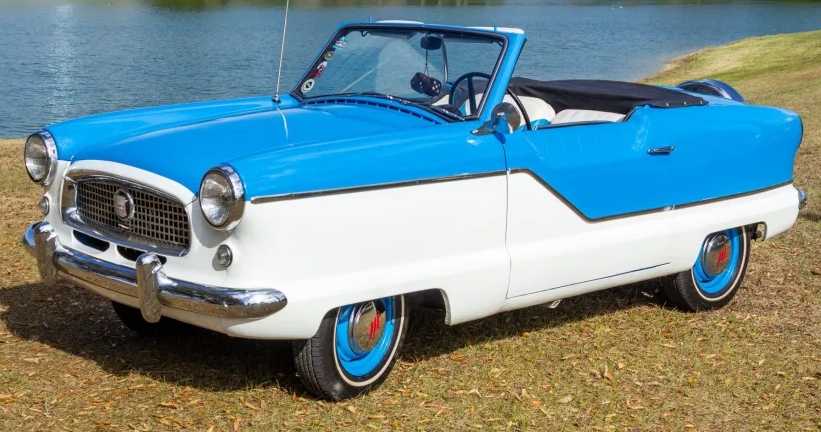
Initial prototypes, developed by the legendary Italian designer Pininfarina, were charming but too European in feel for the American market. Mason, a master of marketing, knew he needed a body style that appealed to American sensibilities. He tasked his own design team at Nash, led by Bill Mitchell, to create a new body for the Austin mechanicals. The result, unveiled in 1954, was a triumph of styling over engineering. The Metropolitan, with its high-roofed, “bathtub” shape, wrap-around rear glass, and friendly face, was undeniably cute. It was a car that didn’t take itself seriously, and that was precisely its charm.
.
NO MORE dead batteries with this:

.
The Nash Metropolitan (1954-1957): An American Original
The first Nash Metropolitans arrived in showrooms in the fall of 1954 as 1955 models. It was sold exclusively through Nash dealerships and was marketed as the “Nash Metropolitan.” Crucially, it was not sold as an Austin in the US, a distinction that was vital for its American identity.
First Generation (1955-1957)
The car was powered by a 1.2-liter (1200cc) Austin B-Series overhead-valve four-cylinder engine, producing a modest 42 horsepower. This was paired with a four-speed manual transmission (a three-speed automatic was an option from 1956). While its top speed was around 75 mph, its 0-60 time was measured in “eventually.” However, its fuel economy was exceptional, often exceeding 35 mpg—staggering numbers for the era.
Models and Trim Levels:
Initially, the trim levels were simple and focused on the body style.
- Two-Door Convertible (Model D100): This was the hero model. With its pint-sized chrome bumperettes, single windshield wiper, and charming lines, it was positioned as a fun, youthful runabout. The interior was spartan, with leather-look upholstery and a body-colored dashboard.
- Two-Door Hardtop (Model D200): For 1955, Nash also offered a “Sport Coupe,” a hardtop with a removable roof panel. This model was intended to give the car a “wider” appeal, but it was heavier and more expensive.
The first model year was a success, with over 28,000 units sold. For 1956, some minor changes were made, most notably the addition of a driver-side door mirror (previously it was a single, centrally mounted mirror on the convertible, or none at all). A “Super” trim level was introduced, which added amenities like a clock, a heater, and a two-tone paint option.
The final year for the Nash-badged Metropolitan, 1957, brought the most significant change: the introduction of the Four-Door Sedan (Model D300). It was a unique “panoramic” hardtop sedan with rear-hinged “suicide” rear doors, making it incredibly easy for passengers to enter and exit the tiny cabin. This model was an attempt to broaden the car’s appeal to small families, but its awkward proportions and the fact that it was based on a design created for a two-door car made it less cohesive. By 1957, Nash had merged with Hudson to form the American Motors Corporation (AMC), and George Mason’s vision for a small car line was being superseded by the new Rambler compact, which was based on a pre-merger Hudson design.
The Metropolitan (1957-1962): An AMC Brand
After the formation of AMC, the Metropolitan was briefly sold as an “AMC Metropolitan” before being spun off into its own marque. From 1958 to 1960, the car was simply badged as “Metropolitan,” and it was sold through a new, independent network of dealers. This period saw the most significant styling changes and the introduction of the car’s most iconic engine.
Second Generation (1959-1962)
For 1959, the Metropolitan received a major facelift. The friendly, rounded front end was replaced by a more angular look with a split grille and large, innocent-looking headlights that looked like googly eyes. The rear also got a new, more squared-off treatment. The interior was redesigned with a more modern, full-width dashboard.
Models and Trim Levels:
The lineup was simplified to a single body style: the two-door convertible.
- Standard (1959-1960): This model retained the 1200cc Austin engine.
- “1500” (1961-1962): This is the model that made the Metropolitan a legend. The original 1200cc engine was replaced by a larger, more powerful 1.5-liter (1489cc) engine from the American-made Rambler American. This engine produced 55 horsepower, a significant 13-hp jump. It also came with a new front suspension design that improved handling. The “1500” was faster, more tractable, and better suited to American highway driving. It also featured a new “power pack” option, which included a manual gearbox with an overdrive unit, allowing for more relaxed cruising.
To capitalize on its newfound fame, a special “Sport” model was offered in 1961 and 1962. Based on the 1500, it added sporty appointments like hardtop-style side trim, a center console, and bucket seats. Two-tone paint was a popular option.
The Decline and Final Curtain
Despite its popularity and critical acclaim, the Metropolitan’s days were numbered. By the early 1960s, the American market was shifting again. The economy was booming, and the space race fueled a desire for performance and size. The compact Rambler American, which shared its engine with the Metropolitan, was itself growing larger. The little two-seater was becoming an anachronism.
Furthermore, the 1959 trade agreement that allowed up to 150,000 cars a year to be imported duty-free was nearing its end. The cost of importing the car from England was set to rise, making it impossible to compete with domestic models.
Production slowed dramatically in its final years. After selling a total of over 230,000 units in its eight-year run, the last Metropolitan rolled off the line in October 1961 (sold as a 1962 model). There was no direct successor.
Legacy and Outlook
The Nash Metropolitan was a brilliant, if flawed, experiment. It was a car born of compromise, marrying British engineering with American style. It was criticized for its high price (it cost nearly as much as a much larger Ford Fairlane), its underpowered engine (in its first iteration), and its lack of features like roll-up windows on early models (they were replaced by side curtains). But these quirks were part of its character.
Today, the Metropolitan is celebrated as a cult classic. Its space-efficient design and cheerful aesthetic make it a favorite at classic car shows. It is a testament to a time when automakers were willing to take risks. It proved that a car didn’t need to be large to be desirable and that there was a market for an “allison” — a small, efficient runabout.
Looking back, the Metropolitan was a trailblazer. It was a precursor to the small, fuel-efficient cars that would flood the American market during the oil crises of the 1970s. It was a forerunner to modern city cars like the Mini, Fiat 500, and Smart Fortwo. While the Metropolitan itself was not a massive financial blockbuster for AMC, its spirit and success helped validate the idea of a sub-compact in the American mind, a segment that AMC would later fill with the Gremlin and Pacer. The little car that crossed an ocean to become America’s “half-size” hero was, in many ways, ahead of its time.