Evolution of The Mazda GLC: How a Humble Hatchback Forged the DNA of a Driving Legend
In the grand tapestry of automotive history, some vehicles achieve immortality through raw power or avant-garde design. Others, like the Mazda GLC, earn their place through quiet competence, clever engineering, and a profound influence on the cars that followed. For the North American market, the Mazda GLC (Great Little Car) was the brand’s first concerted foray into the fuel-efficient, front-wheel-drive hatchback segment—a tiny but vital player in the wake of the 1979 oil crisis. While it may be largely forgotten today, the GLC was a pivotal model for Mazda. It was the testing ground for engineering philosophies that would eventually blossom into the iconic MX-5 Miata and the brand’s celebrated “Jinba Ittai” (horse and rider as one) driving ethos.
This article explores the complete history of the Mazda GLC, detailing its origins, its brief but impactful run, its various trims, and its enduring legacy.
A Post-Crisis Conception: The Need for a “Great Little Car”
To understand the GLC, one must first understand the automotive landscape of the late 1970s. The 1973 oil crisis had decimated the sales of large, V8-powered American cars, and a second crisis in 1979 only intensified consumer demand for small, frugal vehicles. Japanese manufacturers like Toyota, Datsun (now Nissan), and Honda were already making significant inroads with models like the Corolla, 510, and Civic.
Mazda, at the time, was still primarily known for the rotary engine. While the RX-7 was a cult favorite, its fuel consumption was a liability in the new market reality. The company’s existing subcompact, the 323 (known as the GLC in some markets), was a rear-wheel-drive design that was becoming dated. Mazda needed a modern, efficient, and practical front-wheel-drive replacement to compete globally.
The result was the third-generation 323, launched in Japan in May 1980. For export to North America, Australia, and other key markets, it was christened the “GLC,” an acronym for “Great Little Car.” The name was a direct and unpretentious marketing slogan that perfectly captured the car’s mission.
.
THIS is GOOD stuff if your car is in need:

.
First Generation (1981-1985): The Arrival of a New Paradigm
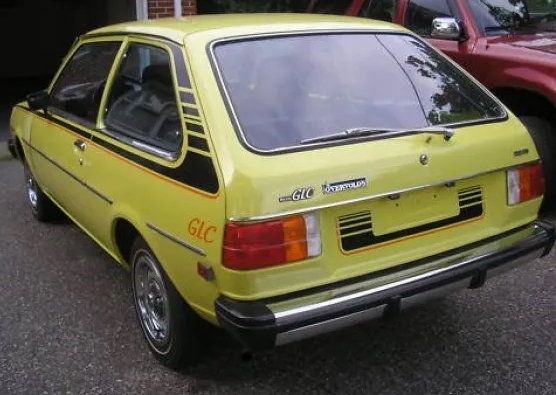
The Mazda GLC arrived in the United States for the 1981 model year. It was a clean, aerodynamically styled three-door hatchback, a significant departure from its boxy, rear-wheel-drive predecessor.
Powertrain and Engineering
At the heart of the GLC was a brand-new 1.3-liter (1298cc) four-cylinder engine, designated the E1. This was an overhead cam (SOHC), 8-valve engine that featured Mazda’s new “Astonishingly Quiet” (AE) design, which used a counter-rotating balance shaft to virtually eliminate vibration. This was a sophisticated feature for such an economical car and a precursor to the engineering refinement Mazda would become known for.
The GLC was offered with two transmission choices:
- Four-Speed Manual: The base transmission, designed for maximum fuel economy.
- Three-Speed Automatic: An optional unit that was less efficient but catered to the growing number of drivers who preferred the convenience of an automatic.
The engine produced a modest 60 horsepower at 5,500 rpm and 69 lb-ft of torque at 4,000 rpm. While not powerful, its low curb weight (around 1,950 lbs for the manual) made the GLC surprisingly nimble and adequate for city driving. The primary focus was, however, on fuel efficiency, with the manual transmission model achieving a stellar 35 mpg in the city and 41 mpg on the highway.
Chassis and Suspension
The GLC’s chassis was a significant leap forward. It featured a front-wheel-drive layout with a transverse engine. The suspension was a MacPherson strut setup at the front and a then-modern semi-independent torsion beam axle at the rear. This provided a good balance of ride comfort, handling stability, and packaging efficiency. Disc brakes were fitted to the front wheels, with drums at the rear—a standard configuration for the class.
Trim Levels and Models (North America)
For its initial years, the North American market was straightforward, reflecting the car’s value-oriented positioning.
- GLC Base: The standard model, which was already very well-equipped for its time. It included a fold-flat rear seat, a rear window defroster, a digital clock, and an AM radio. Vinyl upholstery was standard.
- GLC “Sport” / “Custom”: In 1982, Mazda introduced a slightly more upscale trim, often referred to as the “Sport” or “Custom” model depending on the dealer or brochure. This version added amenities like cloth upholstery, a tachometer, a four-speaker AM/FM stereo radio, and often styled steel wheels with bright trim rings or optional aluminum alloy wheels.
In 1983, the GLC received a minor facelift. The most noticeable change was the replacement of the previous rectangular headlights with new, aerodynamic flush-mounted composite headlamps, which gave the car a more modern, integrated look. A rear spoiler was also added to some models, enhancing the hatchback’s sporty profile.
By 1984 and 1985, the GLC was aging but remained a consistent seller. Its core value proposition—unbeatable economy and surprising durability—kept it relevant until a replacement was ready.
The End of an Era and the GLC’s Spiritual Successor
The Mazda GLC was produced in North America until the 1985 model year. After that, it was replaced by the front-wheel-drive 323 Hatchback, which was a larger, more powerful, and more refined vehicle. The GLC nameplate was retired in the US, but the 323 continued to evolve, eventually leading to the popular Protegé line.
However, the GLC’s true legacy lies not in its direct replacement, but in what it represented for Mazda’s engineering culture. The GLC project was instrumental in fostering a company-wide obsession with lightweight, balanced, and driver-focused vehicles. The experience gained in designing a nimble, front-wheel-drive chassis and a responsive 1.3-liter engine directly informed the development of a much more famous car.
In 1989, Mazda launched the MX-5 Miata. The Miata’s creator, Takao Kijima, deliberately chose a 1.6-liter engine that was an enlarged derivative of the GLC’s E1 unit. The Miata’s chassis tuning, its focus on low weight, and its “Jinba Ittai” handling philosophy were all spiritual descendants of the principles that made the GLC a “Great Little Car.” Kenichi Yamamoto, the father of the RX-7 and a key figure in the Miata’s development, championed the idea that a car didn’t need massive power to be fun—it needed balance and a connection between driver and machine. The GLC was one of the first modern Mazdas to prove that concept on a mass scale.
The Global GLC: A Different Name, The Same Car
It is important to note that the GLC was a global platform. In most of the world, including its home market of Japan and in Europe, the car was sold simply as the Mazda 323 or Mazda GLC 323. The model generation code for this car was BD. This was the first of many 323 generations, a nameplate that would go on to have a long and successful life, spawning everything from basic sedans to the high-performance, all-wheel-drive 323 GTX and GT-X rally homologation specials in the 1980s.
The GLC in the Modern Era: A Future Outlook
Does the Mazda GLC have a future? As a nameplate, it is extremely unlikely to ever return. The automotive world has moved on from the simple, three-door hatchback concept of the early 1980s. Today’s market is dominated by crossovers, SUVs, and highly complex, tech-laden vehicles.
However, if we look beyond the name, the GLC’s spirit is arguably more alive at Mazda today than it has been in decades.
- The Mazda2 and Mazda3 Hatchback: The spiritual successors to the GLC in Mazda’s modern lineup are the Mazda2 (in markets where it is sold) and the base-model Mazda3 Hatchback. These vehicles prioritize efficient packaging, excellent fuel economy (especially with Skyactiv-G engines), and a “fun-to-drive” character that sets them apart from their competitors. The current Mazda3, in particular, is celebrated for its handling dynamics and premium feel in a compact package—directly in line with the GLC’s ethos.
- Skyactiv Technology and Lightweighting: Mazda’s current engineering mantra, “Skyactiv,” is about achieving the perfect balance of efficiency, emissions, and driving pleasure. A core component of this is radical weight reduction and chassis rigidity. This is the modern application of the GLC’s original mission: do more with less. The focus on a responsive, naturally-aspirated engine and a chassis that communicates with the driver is a direct through-line from the GLC to the current CX-5, CX-50, and Mazda3.
- The Cult Following: As with many classic Japanese cars from the “golden era” of the 1980s, the GLC is slowly gaining a small but dedicated following in the classic car scene. Enthusiasts are drawn to its simplicity, light weight, and the potential for engine swaps and restomods. Finding a clean, unmodified GLC today is a challenge, as most were used up and recycled due to their economy-car status. But those that remain are cherished as honest, well-engineered classics that represent a crucial turning point for Mazda.
Conclusion
The Mazda GLC was not a flashy car. It had no turbocharger, no extravagant body kit, and no legendary racing pedigree. It was, however, one of the most important cars in Mazda’s history. It was the vehicle that successfully navigated the company into the front-wheel-drive era and proved that Mazda could build a small car that was not only efficient and reliable but also possessed a spark of driving joy.
The GLC was the humble seed from which Mazda’s modern identity grew. It demonstrated that a car could be a “Great Little Car” not just by being economical, but by being clever, well-made, and engaging. Every time a modern Mazda driver enjoys the crisp response of their Skyactiv engine or the planted confidence of their chassis, they are experiencing a refined echo of the humble GLC’s groundbreaking promise.