The Third Row Ascendancy: A Chronicle of the MG Hector Plus
In the bustling, hyper-competitive landscape of the Indian automotive market, few nameplates have sparked as much conversation, debate, and commercial success as the MG Hector. Launched in 2019, it was the “Hector,” India’s first internet-connected SUV, that set the stage. But it was the introduction of its three-row sibling, the MG Hector Plus, that truly cemented the brand’s commitment to capturing the burgeoning family market. The Hector Plus was not merely a stretched version of its sibling; it was a strategic evolution aimed squarely at buyers who needed more than just five seats.
This article chronicles the life, evolution, and future of the MG Hector Plus, tracing its journey from a 6-seater premium utility vehicle to a facelifted 7-seater family hauler.
Part I: The Genesis (2020) — The 6-Seater Proposition
History and Context When MG Motor India entered the market in 2019, the Hector was an instant hit, boasting a massive footprint, a feature-rich cabin, and the “Internet Inside” tagline. However, the Indian market has an insatiable appetite for space. While the Hector was spacious, it was strictly a 5-seater. Competitors like the Toyota Innova Crysta were dominating the family MPV/UV space, though they lacked the butch SUV styling many desired.
MG spotted a gap. They needed a vehicle that offered the luxury of captain seats, the road presence of an SUV, and the utility of a people-mover.
Launch and Initial Models In January 2020, MG unveiled the Hector Plus at the Auto Expo. It officially went on sale shortly after. The initial strategy was clear: position the Hector Plus as a premium, 6-seater alternative.
Body Style and Dimensions The Hector Plus initially featured a length of 4,720 mm—about 40 mm longer than the standard Hector—largely due to a redesigned rear overhang and a new bumper. This allowed for the accommodation of a third row.
Trim Levels (2020 Launch) The Hector Plus was launched in three primary trim levels, available with specific engine-transmission combinations:
- Super: The entry-level premium trim.
- Smart: The mid-spec, feature-heavy trim.
- Sharp: The top-of-the-line, fully-loaded variant.
Engine Options
- 2.0L Diesel: A 2.0-litre turbo-diesel engine (168 bhp / 350 Nm) sourced from FCA (Fiat Chrysler Automobiles), paired with a 6-speed manual transmission. This was the workhorse engine.
- 1.5L Turbo-Petrol: A 1.5-litre turbocharged petrol engine (141 bhp / 250 Nm).
- Transmissions: 6-speed manual or a CVT (Continuously Variable Transmission).
- Hybrid ( Mild Hybrid): Initially, the petrol engine was also offered with a 48V mild-hybrid system (MHEV) for improved fuel efficiency, though this was later discontinued in the facelift.
The 6-Seat Layout The defining feature of the initial Hector Plus was the captain seats in the second row. These were not just seats; they were individual thrones with armrests, offering a walk-in function (tumble mechanism) to access the third row.
.
THIS is GOOD stuff if your car is in need:

.
Part II: The Shift in Strategy (Mid-2020 to 2021)
As sales figures began to trickle in, MG realized that while the 6-seater concept was premium, the Indian market still had a practical need for a 7-seater configuration. Families of 5+ members, or those who occasionally needed to carry an extra person, found the Hector Plus restrictive because it was permanently locked into a 6-seater layout (at least in the top trims).
The Introduction of 7-Seater Capability In mid-2020, MG introduced a bench seat option for the second row in the lower trims (specifically the Super trim), allowing for a 2+3+2 layout. This was a crucial pivot. The Hector Plus could now be ordered as a 6-seater (captain seats) or a 7-seater (bench seat), making it a direct competitor to the Toyota Innova Crysta and the Mahindra XUV500 (which was only 5-seater at the time, later replaced by the XUV700).
Updates in 2021 In 2021, MG made minor updates to the Hector lineup.
- Smart Petrol: An automatic variant was introduced in the Smart trim to democratize the convenience of an automatic gearbox.
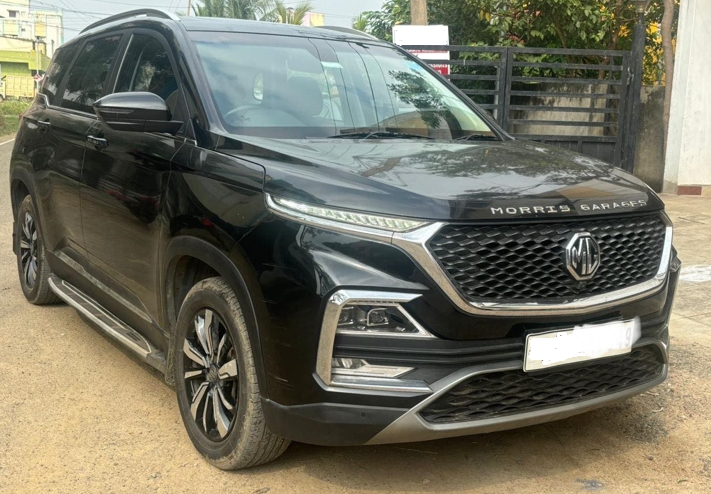
- Visual Changes: The Hector Plus received a slightly revised front grille (diamond layout) to differentiate it further from the standard Hector, which had a perforated chrome mesh.
Part III: The Big Banging Facelift (2023) — A Total Overhaul
By late 2022, the Hector and Hector Plus were looking slightly dated compared to newer entrants like the Tata Safari facelift and the Mahindra XUV700. MG responded with a massive mid-life facelift in January 2023. This wasn’t just a nip and tuck; it was a complete reimagining.
Exterior Evolution The 2023 Hector Plus adopted the “Vision H” concept design language.
- Front: The most noticeable change was the “Hector” wordmark replacing the MG logo on the grille—a first for the brand globally. The headlamps were now split, with the main DRLs sitting high on the bonnet line, giving it a very wide, imposing stance.
- Rear: The tail lamps were connected by a dark chrome strip (smoked effect), replacing the earlier clear lens units.
- Wheels: New dual-tone 18-inch alloy wheels added to the premium feel.
Interior and Technology The interior saw a dramatic upgrade.
- The Screen: The Hector Plus continued with the massive 14-inch portrait-oriented touchscreen, but the software was upgraded. It now ran on MG’s iSmart system with a better UI and 5G compatibility.
- ADAS: The facelift introduced Level 2 Advanced Driver Assistance Systems (ADAS). This included features like Forward Collision Warning, Autonomous Emergency Braking, Lane Keep Assist, and Smart Cruise Control.
- Ventilated Seats: A much-requested feature finally made its way to the front seats.
- Safety: The build quality was improved, and the car achieved a 5-star safety rating at the Global NCAP crash tests (updated protocol), boosting its credibility significantly.
Trim Levels (Post-2023 Facelift) MG streamlined the variants into a more intuitive hierarchy:
- Style: The new entry-level variant. It was positioned to offer a massive screen and essential features at an aggressive price point. Initially offered only with the diesel manual.
- Pro: The mid-spec variant, replacing the old ‘Super’ and acting as the bridge to luxury.
- Sharp: The top-spec variant, featuring the ADAS suite, panoramic sunroof, and premium upholstery.
The Removal of the Diesel In a bold move, MG discontinued the 2.0L Diesel engine with the facelift in 2023. The Hector Plus became a petrol-only lineup (plus the mild hybrid, which was also phased out later). This was a risk, as diesel was still popular in this segment. However, MG bet on the refined 1.5L Turbo Petrol and the introduction of a CVT automatic to woo buyers.
Part IV: Year-by-Year Evolution Summary (2020-2024)
To visualize the journey, here is a breakdown of the key changes by year:
2020:
- Launch: Hector Plus introduced.
- Config: Strictly 6-seater initially (Captain seats).
- Engines: 2.0L Diesel (Manual only), 1.5L Petrol (Manual/CVT), 1.5L Petrol Hybrid (Manual/CVT).
- Trims: Super, Smart, Sharp.
2021:
- Update: Introduction of 7-seater option (bench seat) in lower trims.
- Additions: Smart Petrol Automatic added.
- Styling: Front grille tweaked slightly.
2022:
- No major changes: This was a stable year, focusing on feature retention to match the competition. However, sales dipped slightly as the design began to age.
2023 (January):
- The Facelift: Hector Plus receives a complete redesign.
- Tech: Introduction of 14-inch screen, Level 2 ADAS, 5G connectivity, Ventilated Seats.
- Trim Update: Style, Pro, Sharp.
- Powertrain: Diesel engine axed. Hybrid system axed. Petrol Manual and CVT remain.
2024 (April):
- Minor Update: MG discontinued the Smart trim variants to streamline the lineup, leaving the Style, Pro, and Sharp as the primary choices.
Part V: Market Position and Rivals
The Hector Plus occupies a unique space. It is larger than compact SUVs like the Creta or Seltos but more stylish and accessible than full-blown MPVs like the Kia Carnival (which is much more expensive).
Primary Rivals:
- Mahindra XUV700: The fiercest rival. The XUV700 offers more power (turbo-petrol) and AWD, but the Hector Plus counters with better mileage (in petrol), a more premium cabin feel, and a softer ride.
- Tata Safari: The Safari is the direct 7-seater rival. While the Safari handles better and has a diesel engine, the Hector Plus fights back with a much larger touchscreen, better rear-seat comfort (in 6-seater mode), and ADAS.
- Toyota Innova Hycross: While more of an MPV, the hybrid Innova offers incredible reliability and fuel economy, eating into the Hector’s potential buyer pool who prioritize practicality over looks.
Part VI: Future Outlook
As we move deeper into the decade, the future of the MG Hector Plus looks promising, albeit with necessary adaptations.
1. The Electric Frontier The most significant question regarding the future of the Hector Plus is electrification. MG has already established itself as a leader in the EV space with the ZS EV and the Comet. It is highly probable that MG will introduce an all-electric version of the Hector Plus. With the “Wuling Starlight” (a sister concern of MG) showcasing large electric MPVs, the technology is available. An electric Hector Plus would likely feature a 50-60 kWh battery pack, offering a range of roughly 400-450 km, directly challenging a potential electric XUV700 or an electric Safari.
2. Hybridization Return Given the market’s hesitation towards the diesel-less Hector, MG might reintroduce a strong hybrid system (like the one used in the Innova Hycross) to offer high fuel economy without the range anxiety of an EV.
3. Autonomous Tech MG is part of the SAIC group, which has extensive R&D in autonomous driving. We can expect future iterations of the Hector Plus to move beyond Level 2 ADAS to Level 2+ or Level 3, depending on Indian regulations.
4. Design Philosophy The “Vision H” language is here to stay. Future updates will likely focus on software updates (OTA) and interior material quality rather than drastic exterior changes for the next 2-3 years.
Conclusion
The MG Hector Plus has evolved from a simple stretch-limo version of the Hector into a sophisticated, tech-laden family vehicle that defines the “SUV-MPV” hybrid category. It navigated the transition from being a diesel-guzzling brute to a petrol-powered, tech-savvy cruiser. While it has faced stiff competition from the XUV700 and Safari, its unique selling proposition remains its massive cabin experience, the “Internet Inside” connectivity, and the versatility of the 6/7-seater configurations.
As MG looks toward an electric future, the Hector Plus stands as a testament to the brand’s agility. It is a vehicle that understood the Indian consumer’s pulse—offering space, status, and safety—and adapted its formula year after year to stay relevant. For the large Indian family that wants an SUV without compromising on features or seating capacity, the Hector Plus has proven to be a formidable and enduring choice.