The Trifecta Realized: The Full History of the Porsche 918 Spyder
In the annals of automotive history, certain vehicles transcend their mechanical purpose to become cultural artifacts—pivotal moments where engineering audacity meets the shifting zeitgeist. The Porsche 918 Spyder is one such vehicle. Born from a lineage of rebellion against the established order of the hypercar, the 918 did not just compete; it fundamentally rewrote the rules of what a supercar could be. It was the moment the internal combustion engine made peace with the electric motor, proving that sustainability and savagery were not mutually exclusive concepts. To understand the 918 is to understand the final, glorious crescendo of a specific era of automotive excellence, a brief but brilliant flash of brilliance that will likely be remembered as one of the last great analog-digital hybrids of the ICE age.
The Genesis: From Concept to Reality
The story of the 918 Spyder cannot be told without acknowledging the Porsche 911 GT3 R Hybrid concept of 2010. This experimental racer, nicknamed the “Green Monster,” served as a rolling laboratory for Porsche’s hybrid endurance ambitions. It utilized a flywheel battery to store energy recovered under braking, which was then unleashed via two electric motors on the front axle. The success and data gleaned from the Nürburgring racetrack proved that hybrid technology wasn’t just for fuel economy; it was the future of performance.
At the same time, the hypercar landscape was dominated by the Bugatti Veyron and the McLaren F1. Porsche, a brand built on precision and driver engagement, felt the Veyron was too heavy and the F1 too impractical for daily life. They envisioned a car that could be a Track weapon, a Grand Tourer, and an urban cruiser all in one.
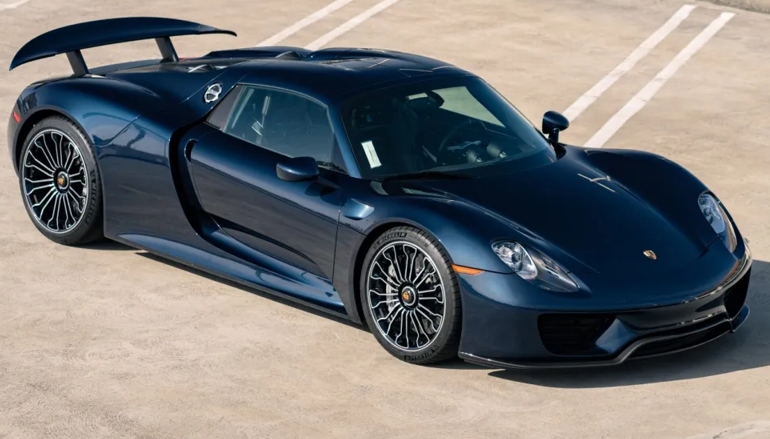
This vision was crystallized in the Porsche 918 Spyder concept, unveiled at the 2010 Geneva Motor Show. The reaction was immediate and overwhelming. With its “reversed” side-pods (an homage to the 1970 Porsche 917 race car) and a design that looked like it was slicing through the air even while standing still, the concept was a hit. Porsche took the unprecedented step of putting the car into production before the show ended, offering a pre-production slot to customers who placed a deposit immediately. The green light was given, and the engineering teams were tasked with creating a production car that delivered on the concept’s outrageous promise.
.
THIS might be a great place to get your new car from!
Or for those who are into the “car flipping” business, here’s an excellent resource for you!

.
The Architecture: A Symphony of Engineering
The 918 Spyder was built on a bespoke monocoque chassis made of carbon-fiber-reinforced polymer (CFRP), a material previously reserved for Le Mans prototypes and Formula 1 cars. This lightweight yet immensely rigid tub served as the foundation for a powertrain that was, at the time, the most advanced in the world.
At its heart was a naturally aspirated 4.6-liter V8 engine, codenamed the PA9A. This unit was a direct descendant of the 5.2-liter V10 found in the Porsche RS Spyder LMP2 race car. In its road-going trim, it produced 608 horsepower and screamed to an intoxicating 9,000 rpm. Unlike the 911’s engine, which sits behind the rear axle, the 918’s V8 was positioned mid-ship, directly ahead of the rear wheels, providing near-perfect weight distribution.
Complementing this combustion engine were two electric motors. One was mounted on the front axle, providing 129 horsepower and enabling front-wheel drive and torque vectoring. The second motor was integrated directly into the transmission housing at the rear, adding another 127 horsepower. The combined output was staggering: 887 horsepower and 944 lb-ft of torque.
Power was sent to the wheels via a proprietary 7-speed PDK (Porsche Doppelkupplung) dual-clutch transmission. This gearbox was developed specifically for the 918 and was one of the most robust units ever fitted to a road car, designed to handle the instantaneous torque of the electric motors and the high-revving fury of the V8.
The energy for the electric motors was stored in a 6.8 kWh liquid-cooled lithium-ion battery pack. This wasn’t just a glorified starter battery; it allowed for a claimed all-electric range of approximately 12 miles (19 km)—enough for silent, zero-emission trips through a city center or out of a suburban garage without waking the neighbors.
The Models and Trim Levels: A Singular Vision
One of the most remarkable aspects of the Porsche 918 Spyder’s production run (June 2013 to June 2015) is its purity. Unlike its contemporary, the Ferrari LaFerrari, which had a single “XX” track-only evolution, and the McLaren P1, which received a “GTR” variant, the 918 Spyder had only one form: the 918 Spyder.
However, Porsche offered an immense breadth of customization through its “Weissach” package and a vast “Porsche Exclusive Manufaktur” program, allowing each of the 918 units to feel unique. This is where the “trim levels” of the 918 are found—not in distinct production models, but in the factory-backed options that fundamentally altered the car’s character.
1. The Standard 918 Spyder: This is the baseline model that all 918s share. It comes with a black interior, cloth seat inserts, and standard magnesium roof panels. The suspension is tuned for a balance of road comfort and track performance. It features the “top pipes”—exhaust pipes that exit high up on the rear deck, just below the air intakes. This design was not just for show; it reduced backpressure to allow the V8 to breathe freely at high rpm and visually signaled the car’s race-bred DNA.
2. The Weissach Package: This is the most significant and desirable option, turning the 918 from a hypercar into a barely street-legal Racer. Named after Porsche’s motorsport development division, the Weissach package was a lightweighting and aerodynamic enhancement suite. It cost approximately $84,000 over the base price and included:
- Weight Reduction: Over 40 kg (88 lbs) was saved by replacing standard components with race-spec parts. The roof and rear spoiler were made of exposed carbon fiber, the chassis components were titanium, and the magnesium wheels were forged by BBS. The interior lost much of its sound deadening and carpeting, and customers could opt for lightweight bucket seats made of carbon fiber.
- Aerodynamic Enhancements: A larger, hydraulically actuated carbon-fiber rear wing, a revised front diffuser, and flaps on the underbody were added to increase downforce significantly.
- Gurney Flap: A small, black lip on the rear wing that further increases high-speed stability.
- Colors: The Weissach package cars featured distinctive accent colors on the wheels, brake calipers, and body decals, often in “Martini” racing stripes, “Guards Red,” or “Lime Green.”
- Suspension: The PASM (Porsche Active Suspension Management) was recalibrated for a lower, stiffer setup.
In short, the Weissach package was the 918’s “Track Attack” mode, making it the ultimate weapon for a track day while retaining its road legality.
3. Porsche Exclusive Manufaktur Finishes: While not a trim level in itself, this program allowed for near-infinite personalization. Buyers could choose from:
- Full-Painted Exterior: The standard car has exposed carbon fiber elements. Buyers could choose to have these parts, like the side skirts and rear spoiler, painted to match the body color for a more monolithic look.
- Interior Stitching and Materials: Leather could be extended to every conceivable surface, including the headliner and dashboard. Custom stitching patterns, colors, and embroidery were available.
- Bare Carbon Fiber: A full exposed carbon-fiber body was a rare and expensive option that showcased the car’s technical construction.
A total of 918 units were built, and every single one was sold out before production began. One of the most famous examples is the “Aetna” car, a one-off commissioned by a collector that features a livery inspired by the 1970 917K Le Mans winner.
The Weissach Record: A Legend Forged at the ‘Ring
The ultimate validation of the 918’s design philosophy came on September 18, 2013. With test driver Markus Winkelhock at the helm, a 918 Spyder equipped with the optional Weissach package lapped the Nürburgring Nordschleife in a staggering 6 minutes and 57 seconds. This was the first road-legal production car to break the 7-minute barrier on the legendary track. The record was a masterstroke of marketing and engineering proof. It decisively demonstrated that the hybrid powertrain was not a compromise but a competitive advantage. The instant torque from the electric motors filled in the gaps in the V8’s powerband, providing explosive acceleration out of corners, while the sophisticated aerodynamics kept the car glued to the tarmac at speeds exceeding 200 mph.
The Driving Experience: Dr. Jekyll and Mr. Hyde
To drive a 918 Spyder is to experience a vehicle with a split personality. In “Hybrid” mode, the car can start silently and run on pure electric power. It is docile, smooth, and perfect for navigating traffic. The steering is light, and the ride is compliant.
But press the “Sport” or “Race” button on the steering wheel, and the transformation is instantaneous. The V8 roars to life with a mechanical, metallic snarl that builds to a crescendo as it approaches its 9,000 rpm redline. The “top pipes” scream directly behind the driver’s head, creating a visceral, unfiltered acoustic experience unmatched by any turbocharged car. The acceleration is brutal yet linear, pinning you to the seat with a relentless force that feels like it will never end.
The handling is telepathic. The rear-axle steering, a first for a production Porsche, turns the rear wheels slightly opposite to the front at low speeds for maneuverability and in the same direction at high speeds for stability. Combined with the torque vectoring from the front electric motor, the 918 can rotate with an agility that defies its 3,800-pound curb weight. It feels less like a car and more like an extension of your own nervous system.
Conclusion and Future Outlook
Production of the 918 Spyder ended in June 2015, the final act in Porsche’s “Trifecta” (alongside the Carrera GT and 959). The initial price was around $845,000, but with production long finished, the car has become a blue-chip collectible. Good examples now trade for well over $1.5 million, with pristine, low-mileage Weissach cars commanding even more.
What does the future hold for the 918 Spyder? It will not depreciate. It stands as the high-water mark for the naturally aspirated, hybrid hypercar. It represents a fleeting moment in history before the industry pivoted fully towards full electrification. It proved that an electric motor could enhance, not dilute, the soul of a performance car.
The 918 Spyder’s legacy is secure. It is the bridge between the analog past and the electric future. It is a testament to Porsche’s engineering philosophy: that performance and efficiency can coexist, that a car can be both a pragmatic daily driver and a world-beating track weapon. For the few hundred owners who have the keys to one, the 918 is not just a car; it is a rolling piece of history—the perfect synthesis of man, machine, and the future, all in one breathtaking package.