The Jewel of the Samurai: History of the Isuzu Vehicross
In the pantheon of automotive history, there are the household names—the Ford F-150, the Toyota Corolla, the Porsche 911. But there are also the ghosts; the vehicles that burned brightly for a fleeting moment, defied convention, and then vanished, leaving behind only a whisper of tire smoke and the nostalgia of a select few enthusiasts. Among these rare specters, few are as cherished, or as misunderstood, as the vehicle that redefined the concept of the “soft-roader” before the term even existed: the Isuzu Vehicross.
Produced for a mere six years, from 1993 to 1999, the Vehicross was not merely a car; it was a design statement, a technological experiment, and for a brief time, the crown jewel of Isuzu’s global lineup. It was a vehicle that refused to be categorized, sitting uncomfortably, and gloriously, between a sports coupe and a mountain goat.
The Genesis: A Rally-Inspired Concept (1991–1993)
To understand the Vehicross, one must look to the brutal, mud-splattered world of Group B rally racing. By the late 1980s, Isuzu had established a formidable reputation in the World Rally Championship with the Isuzu Rally Pajero (known elsewhere as the Montero). The engineers in Japan, led by a young designer named Koichi Oshima, wanted to distill that rally DNA into a road-legal consumer vehicle.
The result was the Vehicross Concept, debuted at the 1991 Tokyo Motor Show. It was a shock to the system. Based on the rugged, body-on-frame chassis of the Isuzu Rodeo, the concept featured a radically short overhang, 16-inch aluminum wheels, and a distinctive “trapezoidal” styling language that made it look like a stealth aircraft on stilts. The reaction was polarized, but undeniably strong. Isuzu, sensing an opportunity to capture the burgeoning “lifestyle” market, greenlit the production version.
.
THIS might be a great place to get your new car from!
Or for those who are into the “car flipping” business, here’s an excellent resource for you!

.
First Generation (1993–1997): The Widebody Era
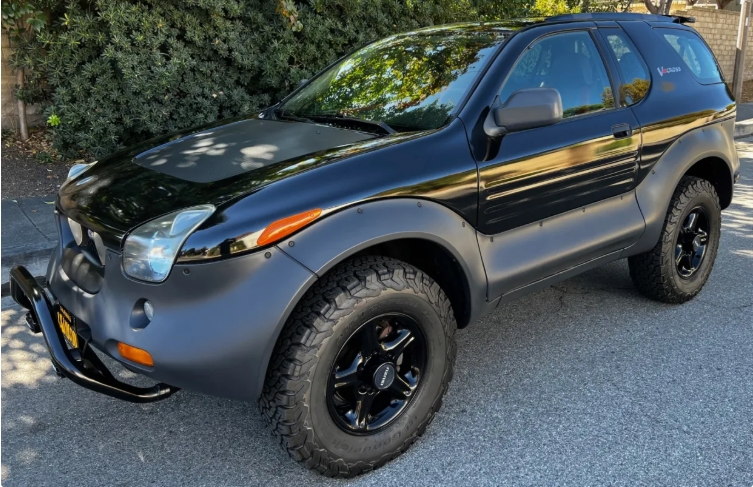
In October 1993, the Isuzu Vehicross went on sale in Japan. It was an instant cult classic. The exterior design was defined by its “widebody” arches, which Isuzu dubbed “Muscle Bracing.” These weren’t just flares; they were structural additions that housed the suspension, giving the vehicle an aggressive, planted stance.
The Engine and Powertrain At the heart of the First Generation Vehicross was the 3.2L V6 6VD1 engine, producing 140 horsepower and 190 lb-ft of torque. While modest by today’s standards, it was a torque-heavy unit designed for low-end grunt. It was paired with either a 4-speed automatic transmission or a rare 5-speed manual. Crucially, the Vehicross featured Isuzu’s “Super-Select” 4WD system. This allowed drivers to shift from rear-wheel drive to full-time 4WD on the fly, a feature usually reserved for heavy-duty SUVs.
Trim Levels and Models (1993–1997) The Japanese market was treated to a complex hierarchy of trims that emphasized luxury over utility:
- XG: The base model. Still well-equipped by 90s standards, featuring cloth seats, power windows, and the V6 engine.
- LS: The luxury step-up. Added air conditioning (a premium option on the XG), a premium audio system, and color-matched bumpers.
- Z-Edition: The sport flagship. The Z-Edition distinguished itself with monochrome paint (often silver or white), aggressive 16-inch mesh alloy wheels, and a stiffer suspension setup. It was the “street racer” version of the Vehicross.
- V-Limited: A rare, short-wheelbase variant produced in limited numbers (approx. 300 units) to celebrate the Vehicross’s success. It featured a distinct hard convertible top and is today the most valuable version.
In 1995, Isuzu released a subtle update known as the Type S. This added a rear spoiler, slightly different interior fabrics, and a “rally-tuned” suspension designed to handle Japanese mountain roads with precision.
The Expansion: The American Debut (1997–1999)
While the Vehicross was a darling in Japan, Isuzu executives hesitated to bring it to the United States, fearing it was too niche. However, following the success of the Isuzu Trooper and the booming SUV market, Isuzu North America imported the Vehicross for the 1997 model year.
This marked the beginning of the Second Generation (1997–1999). To suit American tastes and regulations, changes were made:
- The Powertrain Upgrade: The 3.2L engine was bored out to a 3.5L V6, pushing output to 215 horsepower. This transformed the Vehicross from a plucky crawler into a surprisingly quick vehicle (0-60 mph in under 9 seconds).
- Safety: The American models received a new dual-point airbag system and heavy-duty side-impact beams.
- Trim Levels (US Market):
- Base: A single, well-appointed trim that essentially mirrored the Japanese LS specification.
- Sport Utility: A unique US-only designation that added roof rails, tow hooks, and a skid plate package for those who actually intended to take the chrome-wheeled off-roader into the dirt.
The 1999 “Final Edition” By 1999, sales were dwindling. The market had moved toward larger, family-oriented SUVs like the Explorer and Highlander, leaving the Vehicross without a clear buyer. Isuzu ceased production in August 1999.
To mark the end, they released the 1999 Vehicross Final Edition. Only 1,000 were made for the US market. Painted exclusively in “Solar Flare” Pearl or “Black Cherry,” these models featured:
- 17-inch “Dicing” alloy wheels (borrowed from the Honda Passport/Rodeo).
- A commemorative dash plaque.
- Cruise control and a sunroof as standard (previously optional).
- Monochromatic body cladding (the first time the cladding was body-colored rather than black on US models).
The Driving Experience: Why It Was Special
The Vehicross remains unique because it possessed a split personality. On pavement, the independent front suspension and live rear axle (with a Panhard rod) provided a ride that was surprisingly compliant, yet held corners flat due to the wide track.
Off-road, the approach and departure angles were phenomenal. The short overhangs meant you could climb steep ledges without scraping the bumper. The Super-Select 4WD system, combined with a locking rear differential, meant the Vehicross could tackle trails that would stop a Jeep Wrangler in its tracks—yet it did so in leather seats with the radio blasting.
The End of the Road and Legacy
The cancellation of the Vehicross in 1999 was part of a larger retrenchment by Isuzu. Facing stiff competition from Japanese rivals and a refusal to update the aging Rodeo platform, Isuzu pulled out of the passenger car market entirely in the US within a few years, focusing solely on commercial trucks.
Why the Vehicross Matters Today, the Vehicross is a highly sought-after “future classic.” Its scarcity (only roughly 5,500 were sold in the US) and unique styling have preserved its value. It was a vehicle built without compromise, a square peg in a round hole.
It represents the last gasp of Isuzu’s ambition—the moment they tried to prove that a rugged, reliable Japanese truck maker could also build something with the soul of a sports car. The Vehicross remains a testament to the idea that utility doesn’t have to be boring, and that sometimes, the best vehicles are the ones that don’t make sense to anyone but the people who drive them.