The Union of Mirth and Motors: A Comprehensive History of the AMC Alliance
In the annals of automotive history, few partnerships were as unconventional, fraught with tension, and ultimately as influential as the joint venture between American Motors Corporation (AMC) and France’s Renault. Born from the necessities of survival in the mid-1970s, the AMC Alliance was more than just a car; it was a bold gamble, a cultural exchange on four wheels, and the vehicle that would steer AMC into its final, dramatic decade. Its story is a fascinating tale of transatlantic engineering, badge-identical twins, and the eventual disappearance of two automotive giants.
The Genesis: A Struggle for Survival
By the mid-1970s, American Motors was in its familiar position of a scrappy underdog fighting for relevance. While its Jeep division was a powerhouse of off-road capability, the company’s passenger car lineup was aging and struggling to compete with the flood of smaller, more fuel-efficient imports from Japan and Germany. The compact Hornet and compact-sized Pacer were not the answer to the burgeoning fuel crisis and the demand for truly small, economical cars.
Meanwhile, across the Atlantic, Renault was looking for a secure foothold in the lucrative but notoriously difficult American market. The company had previously attempted to sell its own vehicles in the U.S. with limited success, facing challenges with reliability and dealer networks. A partnership with a well-established, albeit struggling, American manufacturer presented the perfect opportunity.
In 1979, the two companies signed a historic agreement. Renault acquired a 22.5% stake in AMC, injecting much-needed capital. In return, AMC would build and market a version of Renault’s new mid-size “9” model in the United States, providing Renault with a domestic manufacturing base and an established distribution network. The result was the AMC Alliance.
.
THIS might be a great place to get your new car from!
Or for those who are into the “car flipping” business, here’s an excellent resource for you!

.
The 1983-1987 AMC Alliance: The First Generation
The car that rolled off AMC’s Kenosha, Wisconsin, assembly line in 1982 for the 1983 model year was a clean-sheet design from Renault, but it was thoroughly re-engineered for American tastes and regulations. Codenamed X30, the first-generation Alliance was a significant departure from the boxy American cars of the era. Its sleek, aerodynamic “three-box” design, penned by Renault’s Robert Opron, featured flowing lines, flush-mounted glass, and a distinctive, modern look.
Underpinnings and Engineering
The Alliance was built on the Renault 9 platform, a front-wheel-drive chassis with a transverse engine. Power came from a 1.4-liter (1397cc) “Cléon-Fonte” SOHC four-cylinder engine, an evolution of a design that had powered Renaults for years. This engine, which featured an aluminum head and cast-iron block, produced a modest 64 horsepower. While not powerful, it was designed for fuel economy and reliability.
A key Americanization was the incorporation of the “Commuter Chassis Package,” a system developed by AMC. This package added reinforced body mounts, heavier-duty shocks and springs, and other enhancements to cope with the rougher roads and heavier loads typical of American use. An automatic transmission, a three-speed unit sourced from Renault’s own parts bin (the BA/6 gearcase), was available as an option.
Trim Levels and Models
The AMC Alliance was offered in three distinct trim levels, each adding a layer of features and comfort:
- Alliance: (Base) – This was the entry-point. Despite its base status, it was relatively well-equipped for the early 1980s. Standard features included a four-speed manual transmission, a tachometer, an AM radio, a quartz clock, a rear window defroster, and dual chrome-trimmed mirrors. The base model was denoted simply as the “Alliance.”
- Alliance L (for “Luxe”): – The mid-range model added significant comfort and convenience features. It included everything from the base model, plus dual paint stripes, power steering, a four-spoke sport steering wheel, deluxe wheel covers, cloth and vinyl bench seating, and courtesy lights. The “L” trim was often considered the “sweet spot” in the lineup, offering the most value.
- Alliance PL (for “Plus Luxe”): – The top-of-the-line Alliance was the PL. This trim level elevated the car with premium appointments, including air conditioning, an AM/FM stereo radio, full cloth upholstery, a center armrest for the front bench seat, and even more deluxe wheel covers. It was designed to be a comfortable, stylish, and economical alternative to domestic sedans like the Ford Fairmont or Chevrolet Citation.
The Coupe and the GTA
The Alliance sedan was soon joined by a stylish two-door coupe. The Alliance Coupe shared the same front-wheel-drive platform and 1.4-liter engine but featured a sleeker, semi-fastback roofline. It was marketed as a sportier alternative and was offered in the same L and PL trim designations.
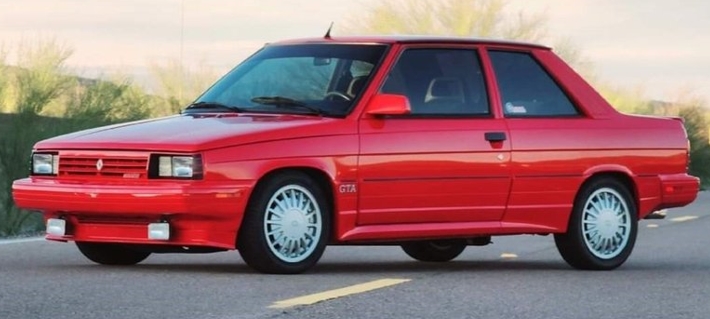
However, the most sought-after version of the first-generation Alliance was the AMC Alliance GTA. Introduced in 1985, the GTA was the performance-oriented “halo car” of the family. The “GTA” moniker stood for “Grand Touring American,” a clever play on the popular Porsche 928 slogan of the time.
The GTA’s key feature was its engine. While still a 1.4-liter, the GTA received a version of the engine with a twin-choke Weber carburetor and a higher-lift camshaft, boosting output to a much more respectable 85-88 horsepower. The exterior was distinguished by blacked-out trim, specific “GTA” decals, a subtle rear spoiler, and iconic 15-inch “Snowflake” alloy wheels. Inside, it featured a standard five-speed manual transmission, a leather-wrapped steering wheel, and bolstered sport seats. The GTA was the Alliance at its most potent and popular, and it remains the most desirable model to collectors today.
The 1987-1988 Renault Premier: A Brief Rebranding
In 1987, the “Renault” brand was officially re-introduced to the American market, and the Alliance sedan and coupe were re-badged as the Renault Premier for the 1988 model year. This was a transitional move, designed to prepare American consumers for the arrival of the fully-fledged Renault 25, which never came.
The Premier was virtually identical to the 1987 Alliance PL. The key difference was purely cosmetic: the front grille, hood ornament, and steering wheel hub were changed to feature the Renault “diamond” logo instead of the AMC “a” emblem. Mechanically, it was the same car. Only one model year of the Premier was sold, with production ending in June 1987.
The Second Generation: The 1987-1995 “Eagle” Premier
The original Alliance platform was becoming dated, and a replacement was needed. This is where the story takes its most complex and fascinating turn. By 1985, the Renault-AMC partnership was facing new pressures. Chrysler Corporation, under the aggressive leadership of Lee Iacocca, saw an opportunity to acquire a ready-made line of modern, front-wheel-drive cars and a factory to build them.
In 1987, Chrysler purchased American Motors Corporation. The Renault-AMC deal was re-negotiated. Renault would retain a minority stake in the new Chrysler-Eagle Premier (and Medallion) venture, and production of the new platform would continue at the Brampton, Ontario, assembly plant. The result was the second-generation “Alliance,” which was sold not as an AMC, but as the Eagle Premier.
Introduced for the 1988 model year, the Eagle Premier (codenamed X34) was a completely different car. It was a larger, more powerful, and far more modern vehicle.
- Engineering and Design: The Premier was based on the Renault 25 platform, a large, stylish fastback sedan. It featured a more sophisticated long-wheelbase chassis, a fully independent suspension, and a choice of two engines. The base engine was a 2.2-liter (2165cc) four-cylinder, producing 110 horsepower. The optional engine was a 3.0-liter (2975cc) Mitsubishi-sourced V6, which delivered a smooth 150 horsepower.
- Trim Levels: The Eagle Premier was offered in three trim levels:
- Base: The entry model with a 4-speed automatic transmission, AM/FM stereo, and cloth seats.
- DL (Deluxe): The mid-grade trim, adding features like power windows, locks, and mirrors, a trip computer, and upgraded interior trim.
- ES (Executive Sedan): The top-tier model, which included the V6 engine as standard, along with leather upholstery, a sunroof, and a premium sound system.
The Eagle Premier was a critically acclaimed car, praised for its excellent handling, comfortable ride, and powerful engines. However, it was a product of an awkward corporate transition. The “Eagle” brand itself was new and confusing to consumers, and the Premier was sold for only a few model years (1988-1992) before Chrysler discontinued it, replacing it with the Dodge Intrepid, a vehicle developed under Chrysler’s new “Cab Forward” design philosophy.
The Alliance nameplate lived on in a final, humble form: the Eagle Premier sedan was re-badged as the Eagle Premier station wagon for the 1992 and 1993 model years. This wagon was a restyled version of the previous Renault 25 estate, produced in limited numbers for fleet use and the rental market before the entire Premier line was phased out in 1995.
The All-Terrain: A Unique Niche
No discussion of the Alliance is complete without mentioning the AMC/Renault All-Terrain (or All-Terrain Wagon). Produced for the 1984 and 1985 model years, this was essentially an Alliance 4-Door Wagon (a model not offered in the U.S. but sold in Europe as the Renault 11) that had been modified by Hurst to be a “soft-roader.”
The All-Terrain featured ruggedized black plastic body cladding, unique wheels, and a slightly raised suspension. It was marketed as a car that could handle dirt roads and light trails, bridging the gap between a passenger car and a 4×4. It was a quirky and unique vehicle that perfectly captured the adventurous spirit of the 1980s “all-road” craze, though it was short-lived.
Legacy and Conclusion
The AMC Alliance was a car of dual identities. The first-generation (1983-1987) was a competent, stylish, and economical compact that sold well, helping to keep AMC afloat and providing Chrysler with a modern platform to build upon. The second-generation (1987-1995, under the Eagle banner) was a sophisticated, large sedan that was critically praised but ultimately failed to find a mass audience due to its confusing brand identity and the rapid integration into the Chrysler family.
The true legacy of the Alliance lies in what it represented. It was the bridge between AMC’s independent life and its absorption into a corporate giant. It was the car that brought front-wheel-drive, European engineering, and sophisticated styling to the heart of the American automotive mainstream. And it served as a crucial stepping stone for Chrysler, which used the Renault-derived platform and the Brampton plant as a cornerstone for its successful LH platform vehicles—the Dodge Intrepid, Chrysler Concorde, and Eagle Vision—that would define the 1990s for the company.
Today, the AMC Alliance and its Eagle Premier siblings are remembered as curious but important footnotes in automotive history—a brief, often-misunderstood “union” that, for a short time, produced some of the most interesting and forward-thinking cars on American roads.