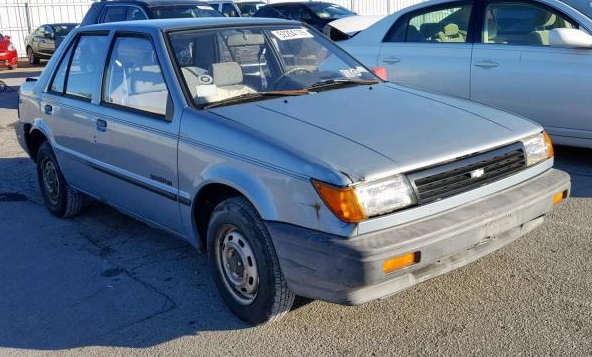
The Geo Spectrum: An Unlikely American Soldier in the Compact Car Wars
The automotive landscape of the late 1980s and early 1990s was undergoing a seismic shift. American consumers, weary of the boxy, underpowered sedans produced by the domestic “Big Three,” were increasingly looking toward Japanese imports for reliability, fuel efficiency, and build quality. Honda Civic, Toyota Corolla, and Nissan Sentra were dominating the subcompact market.
General Motors (GM), facing a shrinking market share in the small car segment, needed a quick and effective solution. They could not redesign and retool American factories fast enough to compete. The answer was “badge engineering” on a global scale. Under the newly formed Geo division, GM imported rebadged versions of Suzuki models to sell through Chevrolet dealerships.
While the Geo Metro and Tracker are perhaps the most remembered vehicles from this era, the Geo Spectrum played a crucial, albeit short-lived, role in bridging the gap between American dealership networks and Japanese engineering. This is the factual history of the Geo Spectrum, detailing its origins, models, trim levels, and its place in automotive history.
The Genesis: Importing Excellence
The Geo Spectrum was not originally a General Motors creation. It was, in fact, a rebadged Suzuki Swift (specifically the second generation, known as the Suzuki Swift/Suzuki Cultus in global markets). By the late 1980s, GM realized that partnering with Japanese manufacturers was the most cost-effective way to offer a competitive small car.
Suzuki, a manufacturer known for building motorcycles and small, efficient vehicles, provided the platform. The Suzuki Swift was already a hit in international markets for its lightweight chassis, spirited handling, and excellent fuel economy. GM took this platform, made minor adjustments for US safety standards, and launched it under the Geo Spectrum name in 1989.
Unlike the Geo Metro (which was a rebadged Suzuki Swift/IGNIS), the Spectrum was slightly larger, offering more interior room and a more sophisticated suspension setup. It was positioned as a sportier, more refined alternative to the boxy Metro, aiming directly at the Honda Civic and Ford Escort.
.
THIS might be a great place to get your new car from!
Or for those who are into the “car flipping” business, here’s an excellent resource for you!

.
Model Years and Evolution (1989–1993)
The Geo Spectrum had a brief production run in the United States, lasting only five model years. Throughout this time, the vehicle remained largely unchanged mechanically, but the trim levels and availability shifted significantly.
1989: The Debut
The Geo Spectrum was introduced in the spring of 1989 as a 1990 model year vehicle. It arrived as a four-door sedan only, replacing the Chevrolet Spectrum (which was a rebadged Isuzu I-Mark). The Spectrum was designed to offer the space of a compact car with the price point of an economy subcompact.
Trims Offered in 1989:
- Base: The entry-level model.
- LS: The upscale trim level.
Engine and Transmission:
- Engine: 1.3L Suzuki G13A carbureted inline-4 cylinder.
- Horsepower: 70 hp @ 5,600 rpm.
- Torque: 76 lb-ft @ 4,000 rpm.
- Transmission:
- 5-speed manual (standard).
- 3-speed automatic (optional on LS).
Notable Features: The 1989 Spectrum featured a MacPherson strut front suspension and a torsion beam rear suspension. This setup provided a surprisingly agile ride, earning it praise from automotive journalists who noted that the Spectrum handled corners better than many of its contemporaries. The interior was simple but functional, featuring high-mounted shift levers (for the manual transmission) to maximize cabin space.
1990: Minor Refinements
For the 1990 model year, the Spectrum carried over largely unchanged. However, GM began to streamline the Geo lineup. The Spectrum remained distinct from the Metro by offering more standard features and a slightly larger footprint.
Trims Offered in 1990:
- Base: Equipped with basic amenities including a vinyl bench seat, manual windows, and steel wheels with hubcaps.
- LS: Upgraded with cloth seats, a center console (optional), and upgraded trim.
Engine and Transmission:
- The powertrain remained identical to the 1989 model (1.3L carbureted engine).
- The 3-speed automatic remained the only automatic option, which was becoming dated compared to the 4-speed automatics offered by Honda and Toyota.
1991: The Shift to Fuel Injection
The most significant change in the Spectrum’s lifecycle occurred in 1991. To meet tightening emissions standards and improve drivability, GM switched from a carbureted engine to electronic fuel injection (EFI). This updated the engine to the Suzuki G13B specification.
Trims Offered in 1991:
- Base: Continued as the budget option.
- LS: Remained the top-tier trim, now featuring standard dual side mirrors and upgraded interior fabrics.
Engine and Transmission:
- Engine: 1.3L Suzuki G13B EFI inline-4 cylinder.
- Horsepower: Increased to 79 hp @ 6,000 rpm.
- Torque: 81 lb-ft @ 4,500 rpm.
- Transmission:
- 5-speed manual.
- 3-speed automatic.
Performance Note: The introduction of fuel injection was a welcome upgrade. It not only improved fuel economy slightly but also smoothed out the power delivery. The Spectrum was now capable of 0-60 mph times in the low 10-second range, making it one of the quickest cars in its class for the price.
1992: Peak Refinement
By 1992, the subcompact market was becoming increasingly competitive. The Honda Civic was undergoing a major redesign, and the Ford Escort was gaining popularity. The Geo Spectrum remained competitive on price but began to show its age in terms of interior technology and safety features.
Trims Offered in 1992:
- Base: Standard features included a tachometer (a rarity in base models of the time), rear window defroster, and side-impact door beams.
- LS: Added a passenger-side vanity mirror, upgraded sound insulation, and alloy wheels (optional).
Engine and Transmission:
- Engine: 1.3L EFI (unchanged from 1991).
- Transmission:
- 5-speed manual.
- 3-speed automatic (though by this time, the 3-speed was considered a major drawback against competitors’ 4-speed units).
Color Options: GM offered a vibrant palette for the Spectrum, distinguishing it from the conservative colors of American sedans. Popular colors included “Bright Red,” “Island Blue,” and “Forest Green.”
1993: The Final Year
The 1993 model year marked the end of the Geo Spectrum. Sales had been declining due to the lack of updates and the increasing competition. GM decided to discontinue the Spectrum rather than invest in a redesign, focusing instead on the Geo Metro and the recently introduced Geo Prizm (a rebadged Toyota Corolla).
Trims Offered in 1993:
- Base: Minimalist and very affordable.
- LS: The final edition offered limited cosmetic changes, mostly badging.
Engine and Transmission:
- Engine: 1.3L EFI.
- Transmission: 5-speed manual / 3-speed automatic.
Discontinuation: Production of the Geo Spectrum ceased in late 1993. It was not directly replaced; rather, the Geo Prizm assumed the role of the division’s compact sedan offering, while the Metro handled the subcompact segment.
Technical Specifications Overview
Throughout its five-year run, the Geo Spectrum shared a common architecture. Understanding these specs helps explain why the car was appreciated by enthusiasts despite its economy car status.
- Chassis: Unibody construction.
- Drivetrain: Front-engine, Front-wheel drive (FWD).
- Weight: Approximately 2,050 to 2,150 lbs (depending on trim and transmission). This lightweight nature contributed significantly to its nimble handling.
- Brakes:
- Front: Ventilated disc brakes (standard on all trims).
- Rear: Drum brakes.
- Fuel Economy:
- Manual: ~27 mpg city / 36 mpg highway.
- Automatic: ~25 mpg city / 33 mpg highway.
Market Position and Competitors
When the Geo Spectrum was launched in 1989, it slotted into a crowded market. Its primary competitors included:
- Honda Civic: The benchmark for the class. The Civic offered better build quality and a more refined engine, but the Spectrum was significantly cheaper.
- Toyota Corolla: Reliable and spacious, but often considered bland to drive. The Spectrum offered a sportier alternative.
- Ford Escort: A domestic rival. The Escort offered similar space but generally lacked the spirited driving dynamics of the Suzuki-built Spectrum.
- Chevrolet Cavalier: While sold alongside the Spectrum at Chevy dealerships, the Cavalier was a larger compact car. The Spectrum offered better fuel economy and reliability ratings.
The Spectrum’s unique selling proposition was value. It offered a Japanese-engineered powertrain and suspension for a price that undercut almost every competitor.
The “Suzuki” Connection
One of the most fascinating aspects of the Geo Spectrum is its Suzuki DNA. In many international markets, the car was sold as the Suzuki Swift. This global platform meant that parts were widely available and often interchangeable with other Suzuki models.
Enthusiasts often modified Geo Spectrums using parts from the Suzuki Swift GTI (a performance variant sold in Europe and Canada). While the US-spec Spectrum was detuned for emissions and economy, the underlying chassis was capable of handling significantly more power. This made the Spectrum a cult favorite among budget racers and hobbyists in the early 2000s.
Ownership Experience and Reliability
For the average consumer in the early 90s, the Geo Spectrum was a pragmatic choice.
Pros:
- Reliability: The Suzuki engines were known for their longevity. It was not uncommon to see Spectrums exceeding 150,000 miles with only basic maintenance.
- Ease of Repair: The engine bay was spacious (relative to the car’s size), and the carbureted (and later EFI) systems were simple to troubleshoot.
- Visibility: The upright design and large glass areas provided excellent visibility, a safety feature often compromised in modern vehicles.
Cons:
- Rust: Like many small cars of the era, the Spectrum was prone to rust, particularly in the rear wheel arches and rocker panels.
- Interior Quality: While durable, the plastics used in the dashboard and door panels were hard and prone to rattling.
- Transmission: The 3-speed automatic was a major weak point, making the car feel sluggish at highway speeds due to low gear ratios.
The End of an Era: Geo Becomes Chevrolet
By 1997, GM decided to dissolve the Geo brand entirely. The marketing experiment of a “sub-brand” dedicated to imports had run its course. The vehicles were rebranded under Chevrolet.
However, the Spectrum did not make this transition. It was discontinued in 1993 and faded from the Chevrolet lineup. Its legacy was carried on by the Geo Prizm (later Chevrolet Prizm), which continued to sell well until the early 2000s.
Future Outlook and Legacy
Today, the Geo Spectrum is a footnote in automotive history, a rare sight on American roads. Most succumbed to rust or were scrapped during the “Cash for Clunkers” program in 2009. However, its legacy persists in the automotive community.
Collectibility: While not yet a mainstream classic, clean, low-mileage Geo Spectrums are becoming sought after by enthusiasts of “budget classics” and JDM (Japanese Domestic Market) history. Finding a rust-free example with a manual transmission is increasingly difficult.
Influence on Modern GM: The philosophy behind the Spectrum—importing reliable, efficient platforms to fill gaps in the lineup—has influenced modern GM strategies. While GM no longer sells Geo-badged cars, their current lineup of small crossovers and electric vehicles utilizes global platforms (developed in partnership with partners like SAIC and Honda) to maximize efficiency, a direct descendant of the logic used in 1989.
Conclusion
The Geo Spectrum (1989–1993) was a vehicle born of necessity and executed with pragmatism. It was an American soldier fighting a war of economics, armed with a Japanese engine and chassis. It offered American drivers a glimpse of what a small car could be: reliable, efficient, and surprisingly fun to drive.
Though its run was short, the Spectrum helped solidify the reputation of Suzuki engines in the US market and paved the way for the later success of the Geo Metro and Tracker. It remains a testament to an era when car manufacturers looked beyond borders to build the best possible product for the consumer, regardless of whose badge was on the grille. For the few remaining survivors, the Spectrum remains a reliable, nostalgic reminder of the early days of the global auto industry.