The Grand Tourer’s Swan Song: How the 1997–2004 Buick Regal GS Redefined an American Icon
In the pantheon of American automotive history, few transitions were as abrupt or as culturally significant as that of the Buick Regal. For decades, the Regal had been a quintessential symbol of middle-aged luxury—a “gentleman’s cruiser” defined by soft suspension, plush velour, and a hood long enough to house a small block V8. It was the car of your grandfather, built for soaking up highway miles at a sedate pace.
Then came 1997.
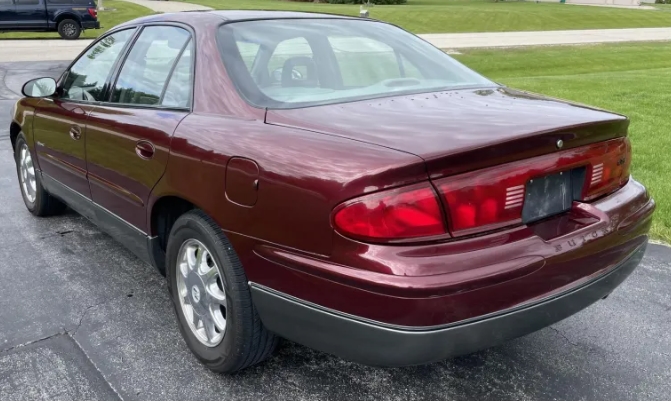
The 1997 model year ushered in the Regal’s fourth generation (coded the W-body, Phase II), and with it, a seismic shift in Buick’s philosophy. The rounded, nostalgic curves of the early ’90s were replaced by a sharper, aerodynamic silhouette. More importantly, under the hood, a revolution was brewing. The days of the wheezing V6 and slow-shifting automatics were ending, replaced by a high-tech, forced-induction powertrain that would turn the Regal GS into a genuine sleeper for the next seven years.
The Arrival of the GS (1997–1999)
Upon the launch of the fourth-generation Regal in late 1996, Buick offered a tiered lineup: the base, the Limited, and the performance-oriented GS. While the base and Limited trims utilized a naturally aspirated 3.8-liter V6 producing a respectable 200 horsepower, the GS was the halo car of the lineup.
The heart of the early GS (1997–1999) was the legendary L67 V6 engine. This 3.8-liter pushrod V8 architecture (despite being a V6) was paired with an Eaton M90 supercharger, generating 6 pounds of boost. Out of the box, it produced 240 horsepower and 280 lb-ft of torque—impressive numbers for the late ’90s.
However, there was a catch. For these years, the GS was available only with a 4-speed automatic transmission (the 4T65-E). Purists who wanted a manual gearbox were left wanting, though the automatic was robust and featured a “performance mode” that held gears longer.
1997 Model Year Highlights:
- Engine: Supercharged 3.8L V6 (L67).
- Transmission: 4-speed automatic.
- Suspension: Computer Ride Control (CRC), which utilized real-time damping shocks to adjust to road conditions.
- Trim Specifics: The GS featured a body-colored grille (rather than chrome), monochrome exterior accents, and 16-inch aluminum wheels. Inside, bolstered bucket seats were standard, a departure from the bench seats found in lower trims.
1998–1999 Refinements: Buick made minor aesthetic tweaks during these years. The interior received upgraded audio systems, and the exterior saw slight revisions to the taillamp clusters. Mechanically, the GS remained largely unchanged, but it solidified its reputation as a highway cruiser that could outrun many contemporary sports cars. In 1999, the GS celebrated Buick’s 95th anniversary with a special badge, though the powertrain remained the same.
.
THIS might be a great place to get your new car from!
Or for those who are into the “car flipping” business, here’s an excellent resource for you!

.
The Supercharged Era Matures (2000–2003)
The turn of the millennium brought a significant facelift to the Regal lineup. In 2000, the Regal shed its traditional boxy demeanor for a smoother, more streamlined look. The headlights became composite and flush, the grille was reshaped, and the overall profile became more coupe-like, despite retaining four doors.
While the exterior changes were subtle, the engine received a substantial upgrade. In 2000, GM increased the compression ratio and updated the cylinder heads on the L67 engine. The result was a jump in output from 240 hp to 245 hp and torque from 280 lb-ft to 285 lb-ft. This made the Regal GS one of the most powerful front-wheel-drive sedans in America at the time.
2000–2003 Trim Levels and Options: During this era, the Regal lineup was simplified into three distinct tiers:
- Regal (Base): 3.8L NA V6, cloth interior, standard suspension.
- Regal LS: Upgraded audio, alloy wheels, cruise control, and the naturally aspirated V6.
- Regal GS: The performance king. Supercharged V6, performance suspension, monochrome paint scheme, and premium interior.
The 2002 “GSX” and Performance Packages: Buick occasionally offered “performance handling packages” for the GS. While not a distinct trim level in the VIN coding, these packages (often dealer-installed or specific to certain production runs) included stiffer springs, larger 17-inch polished aluminum wheels, and higher-performance Goodyear Eagle RS-A tires. In 2002, a limited run of “GSX” appearance packages was offered, paying homage to the classic GSX muscle car. This package added a rear spoiler, specific badging, and distinct 17-inch wheels, further separating the GS from the standard Regal.
The “Daytona” Edition (2003): In 2003, Buick released a limited run of Regal GS “Daytona” editions to celebrate the car’s racing heritage (referencing the Daytona 500). Only 1,050 units were produced. These cars featured a unique “Daytona Blue” paint, custom badging, and a charcoal gray leather interior with blue accents. Mechanically, they remained identical to the standard GS, but their rarity has made them highly collectible today.
The Final Chapter: 2004
The 2004 model year marked the end of the fourth-generation Regal in North America (though production continued briefly for fleet sales). By this time, the automotive landscape had changed. Crossovers were rising, and the Regal’s aging W-body platform was nearing the end of its lifecycle.
Despite being the final year, the 2004 Regal GS is often considered the peak of the breed. The specs remained the same as the 2000–2003 models: 245 hp and 285 lb-ft of torque. However, build quality and refinement were at their highest point.
Key 2004 Specs:
- 0-60 mph: Approximately 6.5 to 6.7 seconds.
- Quarter Mile: Low 14-second range.
- Fuel Economy: 18 mpg city / 27 mpg highway (respectable for a 3,600-lb supercharged sedan).
The “GXP” Transition and the Return to Roots
It is worth noting the brief interlude of the Regal GXP (2005), which bridged the gap between the classic GS and the future. Although the fourth-generation body style ended in 2004, the Regal nameplate continued on the same platform for 2005 with a significant update: the introduction of the LS4 V8 engine (5.3 liters) in the GXP trim. This was the first and only time a V8 powered the Regal.
However, the focus of this article, the 1997–2004 GS, remains distinct for its unique character. Unlike the V8 GXP, the GS relied on the inline-bank V6 and forced induction, offering a torque-rich experience with less nose-heavy weight distribution than a V8 would have provided.
Technical Legacy and Engineering
The longevity of the 1997–2004 Regal GS is a testament to its engineering. The 3800 Series II and III engines are widely regarded as some of the most reliable V6 engines ever produced by General Motors. The supercharger design (roots-type) is inherently durable, and the iron block provided a solid foundation for high mileage.
The suspension, utilizing GM’s “Real Time Damping” (RSS), was sophisticated for its time. By using electromagnetically controlled shocks, the car could stiffen or soften its dampers in milliseconds. While the Regal GS was front-wheel drive and weighed over 3,600 lbs, this system allowed it to corner flatly, defying its “land yacht” reputation.
Current Outlook and Future Value
As of 2024, the 1997–2004 Buick Regal GS has firmly entered the “modern classic” arena. For years, these cars were overlooked, dismissed as “grandpa cars” or unreliable high-mileage commuters. However, the enthusiast community—particularly those in the GM and “G-Body” communities—has rediscovered them.
Market Status:
- Entry Level: High-mileage (150k+ miles) examples can still be found for $2,000–$4,000, making them an incredible bargain for performance.
- Collector Grade: Low-mileage, unmodified examples, particularly the 1997-1999 “early” supercharged models or the 2003 Daytona editions, are appreciating. Prices range from $8,000 to $15,000 for pristine survivors.
- Modifiability: The L67 engine is a favorite for modification. With simple upgrades like a smaller pulley for the supercharger, a cold air intake, and a performance tune, owners can easily push the horsepower to 300+ hp without opening the engine.
Future Outlook: The 1997–2004 Regal GS is poised for a slow but steady rise in value. As the demographic that grew up watching these cars compete in “Stoplight Grudge Matches” in the late ’90s begins to look for project cars, the Regal GS offers a unique blend of nostalgia, practicality (it seats four adults comfortably), and surprising speed. Unlike the homologated sports cars of the era (like the Mitsubishi Eclipse or Ford Mustang GT), the Regal GS offers a “sleeper” aesthetic that is increasingly rare in a world of aggressive aero kits and neon paint jobs.
Conclusion
The Buick Regal GS (1997–2004) represents a specific, fleeting moment in automotive history where a traditional American luxury brand decided to play the performance game—and won. It was a car that defied expectations, packing the heart of a muscle car into the body of a touring sedan.
While production ended two decades ago, the legacy of the supercharged 3800 engine lives on. The Regal GS proved that you didn’t need rear-wheel drive to have fun, and you didn’t need a manual transmission to build a legend. For those seeking a piece of American iron that offers comfort, class, and a surprising kick of boost, the fourth-generation Regal GS remains one of the best-kept secrets on the road today.