The Silken Sledgehammer: How the Bentley Turbo R Redefined the Modern Grand Tourer
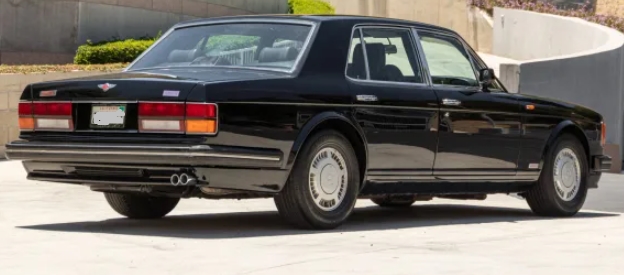
In the annals of automotive history, few vehicles represent such a stark turning point as the Bentley Turbo R. Introduced in 1985, it was a car that did not merely update a legacy; it shattered the porcelain tea set of British luxury and replaced it with a tumbler of single malt and a set of running shoes. For decades prior, Bentley had been content to build coachbuilt variations on Rolls-Royce chassis—stately, silent machines prioritizing isolation from the road. The Turbo R, however, proved that luxury and dynamic capability were not mutually exclusive. It was the genesis of the “flying bedstead,” a vehicle that combined the hushed opulence of a British drawing room with the visceral thrust of a muscle car.
The Context: Waking a Sleeping Giant
To understand the Turbo R, one must appreciate the dormant era it emerged from. By the early 1980s, the classic Bentley range—the Mulsanne, the T-series, and the Corniche—were mechanically identical to their Rolls-Royce counterparts. They were heavy, slow-steering, and soft-sprung, designed to glide over imperfections rather than conquer corners. The “R” in Turbo R stood for “Roadholding,” a word that had rarely been associated with the Crewe factory.
The catalyst for this change was the 1982 Bentley Mulsanne Turbo. While it possessed impressive straight-line speed thanks to a Garrett turbocharger, it suffered from severe “turbo lag” and treacherous handling characteristics when the boost finally arrived. The chassis could not cope with the 479 lb-ft of torque. John Blunschi, the product planning manager at the time, championed a radical solution: stiffen the suspension, fit wider tires, and tune the car to handle as well as it accelerated.
.
THIS might be a great place to get your new car from!
Or for those who are into the “car flipping” business, here’s an excellent resource for you!

.
The Birth of the Turbo R (1985–1987)
The Bentley Turbo R was officially unveiled at the Geneva Motor Show in March 1985. Visually, it differed subtly from the Mulsanne Turbo, most notably sporting a new, more aggressive grille and unique 15-inch alloy wheels shod with Michelin TRX tires—a departure from the standard cross-ply tires of the era.
Under the bonnet lay the legendary 6.75-liter (412 cu in) OHV V8, turbocharged and intercooled. In this initial iteration, the engine produced 325 bhp (242 kW) and a staggering 480 lb-ft of torque. While 325 horsepower may seem modest by modern standards, in a car weighing over 2.5 tons, it provided effortless, wafting acceleration. The 0–60 mph time was dispatched in roughly 7.5 seconds, with a top speed approaching 140 mph—extraordinary figures for a luxury saloon in the mid-80s.
The true innovation, however, was the suspension. The Turbo R utilized a computer-controlled active ride height system (the Electronic Ride Control) and gas-filled shock absorbers. It featured thicker anti-roll bars and a wider track. The result was a car that could corner with less than 0.8 g of lateral force, a massive improvement over its predecessor. The turbo lag was still present but manageable; the power delivery was described as a “tsunami” of torque rather than a sudden jerk.
The Mid-Year Update (1987–1992)
By 1987, Bentley had addressed the turbo lag issue. The earlier models used a complex fuel management system that hesitated before delivering full boost. The revised Turbo R featured a Bosch MK-Motronic fuel injection system. This not only smoothed the power delivery but also increased output slightly to 325 bhp (though torque remained the same).
This period also saw the introduction of the Bentley Turbo R Long Wheelbase (LWB). While technically a separate model line, the LWB Turbo R shared the Turbo R’s mechanical underpinnings but offered the increased rear legroom previously reserved for the Rolls-Royce Silver Spirit. It became a favorite among chauffeurs and heads of state who wanted performance but needed the space of a limousine.
In the late 1980s, market trends shifted toward the “high-tech” interior. Bentley introduced the Turbo R “Mulliner” specification. Named after the historic coachbuilder (then an in-house division), these trims featured more aggressive exterior color schemes, bespoke pinstriping, and sumptuous leather interiors with walnut veneers. While not a distinct mechanical model, the Mulliner trim became the flagship specification for the Turbo R.
The Digital Era and the Sport Standard (1992–1995)
In 1992, the Turbo R received its most significant mechanical update since launch. The engine was fitted with a new, more efficient Garrett T4 turbocharger and a revised wastegate. This boosted power to 385 bhp (287 kW) and torque to 553 lb-ft. The 0–60 mph time dropped to 6.3 seconds, making it one of the fastest sedans in the world.
Interior technology also leaped forward. The traditional analog dials were replaced by a digital instrument cluster, featuring a “traffic light” rev gauge (Green, Amber, Red). The climate control became automatic, and the seats featured memory functions.
In 1994, to broaden the appeal of the Turbo R and lower the entry price slightly, Bentley introduced the Turbo R Sport. This was a slightly de-contented version of the Turbo R, retaining the 385 bhp engine but stripping away some of the heavy soundproofing and luxury appointments. It featured unique 17-inch wheels, a stiffer suspension setting, and a more driver-focused interior. It was aimed at the “owner-driver” market rather than the chauffeur-driven clientele.
The Final Evolution: The Turbo RT (1996–1997)
As the 1990s progressed, the market demanded modernization. The Rolls-Royce and Bentley brands were preparing to separate (though they would not officially split until 1998). The Turbo R, by now 11 years old in design, needed a swansong.
Enter the Bentley Turbo RT in 1996. The RT was essentially a heavily revised Turbo R, serving as the final iteration of the 6.75-liter V8 turbo before the all-new “Arnage” platform arrived. The RT featured a redesigned front end with a lower, wider bumper and distinct two-tone headlamps, moving away from the classic quad lamps to a more modern aesthetic.
The engine in the RT was the pinnacle of the L-series V8. Output was raised to 400 bhp (298 kW) and 616 lb-ft of torque. This was achieved through improved breathing, higher boost pressure, and a strengthened crankshaft. The RT also boasted an improved active suspension system that could adjust damping in milliseconds.
Visually, the RT was distinguished by its unique 18-inch, 12-spoke alloy wheels and a subtle rear decklid spoiler. Inside, the “electronic” theme continued with touch-screen controls for the climate and audio systems—revolutionary for a car based on 1970s architecture.
The Turbo RT was produced for only two years, from 1996 to 1997, with approximately 250 units built. It marked the end of an era—the end of the “Hooper” era of coachbuilding and the beginning of the modern, BMW-influenced Bentley.
Technical Analysis: The Heart of the Beast
Throughout its 12-year production run, the Turbo R and its derivatives shared a common mechanical DNA that is legendary among enthusiasts:
- Engine: The L-series V8 is one of the longest-running production V8s in history. Displacing 6.75 liters, it is an iron block with aluminum heads. The Turbo R iterations featured low-pressure turbocharging (typically 5–7 psi) to ensure durability and linear power delivery.
- Transmission: All Turbo R models utilized a General Motors 4L80-E four-speed automatic transmission. While a heavy-duty unit, it was chosen for its reliability and ability to handle the massive torque.
- Chassis: The chassis was a box-section ladder frame, distinct from the monocoque construction of the contemporary Rolls-Royce Silver Spirit. This frame allowed for the easy construction of coachbuilt bodies (like the limousines) and provided immense rigidity, crucial for the handling improvements of the Turbo R.
The Turbo R in Culture
The Bentley Turbo R quickly became the car of choice for the “Nouveau Riche” of the 1980s and 90s. It appeared in films like The Bodyguard (driven by Kevin Costner) and GoldenEye (briefly appearing as a luxury vehicle).
However, its reputation was not without controversy. The 1990s Turbo R was notoriously difficult to maintain. The complex suspension systems were prone to leaks, and the aluminum body panels were susceptible to corrosion if not cared for. Yet, for those who could afford the upkeep, it offered a driving experience like no other: the silence of a Rolls-Royce at cruising speed, followed by the howl of the turbo and the surge of torque when the pedal was pushed.
Future Outlook and Legacy
Today, the Bentley Turbo R is enjoying a renaissance among collectors. For decades, it was overshadowed by the classic Rolls-Royce Silver Shadow or the later Bentley Arnage. However, modern enthusiasts are rediscovering the Turbo R as the ultimate “sleeper.” It is a car that offers the classic Bentley aesthetic—chrome, wood, and leather—paired with genuine supercar performance (for its time).
Market Outlook:
- The Turbo R (1985–1992): These are currently the most affordable entry points into classic Bentley ownership. Prices range from $20,000 to $40,000 for good examples. They are becoming increasingly popular as “first classic” cars for younger enthusiasts.
- The Turbo R Sport and Late Models (1993–1995): As these are the most driveable and powerful of the R series, their values are beginning to climb, particularly well-maintained, low-mileage examples.
- The Turbo RT (1996–1997): As the rarest and fastest of the line, the RT is already a collector’s item. Prices are solid and likely to appreciate as the Arnage generation becomes more commonplace.
The Turbo R remains the bridge between the old world of coachbuilding and the modern era of performance luxury. It proved that a grand tourer need not be a barge. Without the Turbo R, there would be no Bentley Continental GT, no Flying Spur, and no Bentayga. It was the car that taught Bentley how to dance, and in doing so, it saved the brand from irrelevance.
Conclusion
The Bentley Turbo R was produced from 1985 through 1997, serving as the backbone of the Crewe factory for over a decade. It evolved from a laggy, soft sedan into a 400 bhp, active-suspension grand tourer. Whether in standard form, the long-wheelbase limousine, the sporty Mulliner spec, or the final Turbo RT, the lineage remains consistent: quiet, terrifying speed wrapped in the finest leather money could buy.
It was a car that defied physics, suspended disbelief, and redefined what it meant to be a Bentley. It was, and remains, the Silken Sledgehammer.