The New Class: How the BMW 1500 Saved a Legend and Forged a Future
In the automotive history books, there are pivot points—moments where a manufacturer teeters on the edge of irrelevance or bankruptcy before pulling back with a product that redefines its identity. For BMW, that moment occurred in the mid-1950s. Following the end of World War II, the Bavarian Motor Works had survived by producing pots, pans, and the tiny Isetta bubble car. Their larger sedans, the “Baroque Angels” (501 and 502), were beautiful but heavy, expensive to build, and ill-suited for the economic reality of post-war Germany.
By 1959, BMW was in dire straits, with the German government suggesting a merger with rival Daimler-Benz. The rescue came in the form of a daring design study and a new production philosophy: the Neue Klasse (New Class). While the entire New Class range is celebrated, the car that truly ignited the sales charts and the enthusiast’s heart was the BMW 1500.
This is the story of the BMW 1500: the car that birthed the modern sports sedan.
The Genesis (1960–1961)
The story of the 1500 began in September 1961 at the Frankfurt Motor Show (IAA). BMW unveiled two prototypes that shocked the industry. They were compact, crisp, and utterly modern. The public reaction was immediate; BMW collected over 25,000 deposits before a single car was delivered to a customer.
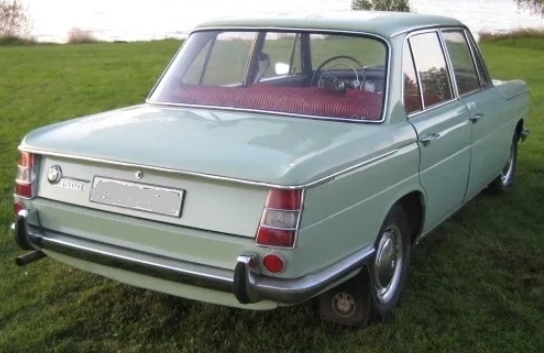
It is important to note a production distinction: The earliest cars, built from late 1961 into early 1962, are technically designated the BMW 1500 N (New Class). These vehicles hold a special place in history as the direct link between the old era and the new. However, from a model year perspective, the 1500 was offered continuously from 1962 to 1964.
The Model and Trim Levels (1962–1964)
Unlike modern BMWs, which can have a dizzying array of trim levels (M Sport, Luxury Line, etc.), the 1500 was offered in a very streamlined configuration. BMW was focused on efficiency and reliability.
- Standard Sedan: The sole body style was a four-door sedan. There was no coupe, wagon, or convertible variant of the 1500 (those would come later with the 1600 and 2000).
- Trim/Options: There were essentially two “trim” levels in the modern sense: Base and Deluxe (Sonderausführung).
- The Base model came with rubber floor mats, a horn on the steering wheel rim (rather than the center), and black window surrounds.
- The Deluxe trim added carpeting, a horn hub (center of the steering wheel), chrome window surrounds, and a two-spoke steering wheel.
- Special Bodywork: A small number of chassis were sold to coachbuilders, most notably Baur and Karmann, who fitted two-door coupe bodies. These are highly collectible today but were not factory models per se.
Specifications The 1500 was powered by BMW’s first new generation of four-cylinder engines, designated the M10.
- Engine: 1.5-liter (1499cc) inline-four
- Power: 80 hp (59 kW) at 5,500 rpm
- Transmission: 4-speed manual (column shift for early models, floor shift for later; though floor shift became standard). A ZF 3-speed automatic became available later as an option.
- Performance: Top speed was approx. 145 km/h (90 mph), with a 0–100 km/h time of about 15 seconds.
- Fuel System: Single Solex carburetor.
The design was penned by Giovanni Michelotti. It featured a slim “Hofmeister Kink” in the C-pillar, a distinctive grille with vertical “kidneys,” and a formal roofline. It looked more expensive than it was, a key to its success.
.
THIS might be a great place to get your new car from!
Or for those who are into the “car flipping” business, here’s an excellent resource for you!

.
The Transition: 1500 to 1600 (1964–1966)
The 1500 was a smash hit, selling over 150,000 units in its short life. However, enthusiasts and the market began to demand more power. In 1964, BMW phased out the 1500, replacing it with the BMW 1600.
While often grouped together, the 1600 was technically a distinct model (though visually nearly identical) due to its engine displacement increase to 1.6 liters (1573cc). This increased power to 85 hp.
However, the “1500” designation did not disappear immediately. During the transition period, BMW sold the 1500 Ti.
The 1500 Ti (1964–1965) The “Ti” stands for Turismo Internazionale. This was the sporty outlier of the family.
- Engine: 1.5-liter (same as the standard 1500)
- Power: Increased to 90 hp (66 kW) via a dual Solex carburetor setup.
- Distinguishing Features: It featured a matte black finish on the hood and trunk, sport seats, and a sport steering wheel.
- Legacy: The Ti was the first true “sport” model in the BMW lineup. It bridged the gap between the standard 1500 and the upcoming legendary 1800 TI/SA. Production numbers were lower, making it a rare find today.
By late 1965, the genuine 1500 model (1.5L) was officially discontinued in favor of the 1600, though in some export markets, the nameplates were used interchangeably for a short period.
Engineering and “The Driving Machine”
The BMW 1500 was not the fastest car on the road, but it handled better than almost anything in its class. It established the blueprint for the modern BMW:
- Longitudinal Engine Mounting: The engine was mounted front-to-back (north-south) rather than transversely, allowing for a better weight distribution and the use of a rear-wheel-drive system.
- Independent Suspension: It featured MacPherson struts at the front and a semi-trailing arm setup at the rear. This gave it stability and agility that surprised owners used to the swing-axle dynamics of older cars.
- Safety: The 1500 featured a safety steering column, a rigid passenger cell, and crumple zones—concepts developed by BMW engineer Alfred Böhrer long before they were industry standards.
Market Impact and Competition
When the BMW 1500 launched, its primary rival was the Mercedes-Benz “Fintail” (W110). While the Mercedes was robust and safe, the 1500 felt lighter, more nimble, and more stylish.
In 1964, the introduction of the BMW 1800 (2.0L engine) further cemented this reputation. The 1800 was the upscale sibling to the 1500/1600. While the 1800 was the “Car of the Year” in 1964, the 1500 remained the volume seller. It offered a perfect balance of economy and performance. It was the “Goldilocks” car: not too big like the 1800, not as tiny as the rear-engined Ford Taunus or Opel Kadett.
Future Outlook: The 1500 as a Classic
Today, the BMW 1500 is considered the “Founding Father” of the BMW 3 Series. Without the success of the 1500, the legendary 2002 turbo and the E30 M3 would likely never have existed.
Current Status: Finding a genuine 1500 (1962–1964) is increasingly difficult. Many were worn out and scrapped in the 1970s and 80s. In the classic car market, it sits in the shadow of its more famous siblings, the 1800 and the 2002. However, prices are rising.
What to Look For: For prospective buyers, the 1500 offers a purer, lighter experience than the larger-engined variants.
- Rust: The Achilles’ heel of these cars. Check the floor pans, rockers, spare tire well, and suspension towers.
- Engine Parts: The M10 engine is robust, and parts are still available through BMW Classic and aftermarket suppliers, as this engine block was used in various forms until the 1980s (including in the Mini Cooper S and Lotus Elan).
- Authenticity: The 1500 is distinct for its single Solex carburetor and lack of the “Hofmeister Kink” chrome trim found on later 1600 models.
Investment Potential: While a pristine 1500 might command $40,000 to $60,000 (far less than a 2002), its value is steady. It appeals to the serious historian rather than just the weekend cruiser. As the “New Class” cars gain recognition for their design purity, the 1500 is expected to appreciate. It represents the exact moment BMW shifted from a manufacturer of luxury barges to a creator of sporty sedans.
Conclusion
The BMW 1500 was produced for a brief window—roughly three years—but its legacy is permanent. It was the car that taught the world that a sedan could be practical, safe, and exhilarating to drive all at once.
When you see a modern BMW 3 Series taking a corner with precision, you are witnessing the ghost of the 1500. It was the car that saved BMW from becoming a footnote in automotive history and wrote the first chapter of the ultimate driving machine. For collectors and enthusiasts, the 1500 isn’t just an old car; it is the genesis of a legend.