The Last of the Breed: A Comprehensive History of the Alfa Romeo Spider Duetto (1966–1993)
The Open Road and the “Coffee Pot”
In the pantheon of automotive design, few shapes are as instantly recognizable as the Alfa Romeo Spider. For nearly three decades, this Italian roadster defined the concept of la dolce vita—the sweet life—offering a blend of style, accessible performance, and mechanical purity that few competitors could match. While often affectionately referred to by enthusiasts as the “Duetto,” a name derived from its debut model, the Spider underwent several significant evolutions, facelifts, and engineering changes throughout its long production life.
This article traces the lineage of the Alfa Romeo Spider from its Pininfarina debut in 1966 through its final production year in 1993, detailing every model, trim level, and mechanical evolution that shaped this automotive icon.
Phase I: The “Duetto” and the Round Tail (1966–1969)
The story begins at the 1966 Turin Motor Show. Alfa Romeo sought a successor to the Giulia Spider, and Pininfarina designer Battista “Pinin” Farina presented a radical departure from the previous car’s boxy lines. The result was the Alfa Romeo 1600 Spider.
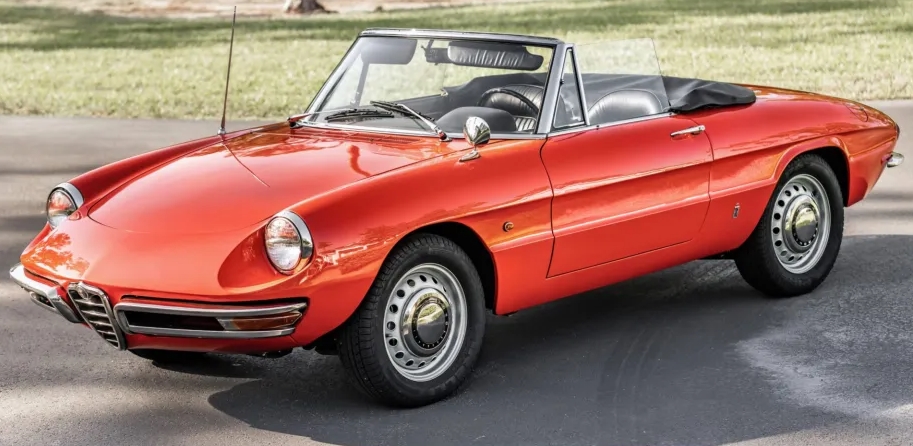
The “Duetto” (1966–1967) Officially, the car was simply the Alfa Romeo Spider, but the press and public quickly dubbed it the “Duetto” (duet), a reference to the collaborative harmony between Alfa Romeo and Pininfarina. However, rumors suggest the name was also a playful nod to the “Oto” (eight) in Fiat’s rival Dino 206/246, though Alfa’s engine was a four-cylinder.
- Model Code: AR 105.24
- Engine: 1570cc Twin-Cam Inline-4 (Bialbero)
- Power: 106 hp @ 6,000 rpm
- Top Speed: Approx. 115 mph
- Distinguishing Features: The “Duetto” featured a distinctive “coffin-nose” hood, a chrome bumper overrider at the rear, and a small, chrome driver-side mirror. The interior was spartan, featuring a wood-rimmed steering wheel and twin gauges.
The “Round Tail” (1967–1969) In late 1967, Alfa Romeo made minor changes to the rear of the car, creating the “Coda Tronca” (Round Tail) or “Ottocavo.” This model is often considered the purest iteration of the Duetto design.
- Model Code: AR 105.24
- Distinguishing Features: The rear chrome bumper overrider was removed, replaced by a black rubber buffer. The trunk lid was reshaped to create a smoother, rounded rear end. The interior received a slightly updated dashboard with a tachometer featuring a 6,000 rpm redline.
Phase II: The “Pausa” or “Scaglione” (1970–1982)
By 1970, safety regulations in the United States (the Spider’s largest export market) demanded higher, sturdier bumpers and improved crash protection. Furthermore, the original Duetto design was criticized for a lack of luggage space. Pininfarina designer Leonardo Fioravanti was tasked with a significant redesign, resulting in the “Spider 2000.”
This generation is often referred to as the “Pausa” (Pause) or “Scaglione” (Step) due to the abrupt, squared-off trunk line that contrasted with the flowing curves of the front. While less romantic than the Duetto, this was the longest-running and most commercially successful version.
The Spider 2000 (1970–1974)
- Model Codes: AR 105.26 (US), AR 105.25 (Rest of World)
- Engine: 1962cc Twin-Cam Inline-4
- Power: 132 hp (US) / 120 hp (ROW) @ 6,000 rpm
- Distinguishing Features: Large, rubber-covered bumpers (often with overriders), a distinct “step” in the trunk lid, and a new dashboard with a center console. The rear lights were rectangular.
The Spider 2000 Veloce (1974–1982) In 1974, the model received a facelift and a new name: “Veloce” (Fast). This era coincided with the 1973 oil crisis, which forced Alfa Romeo to lean heavily on the US market for survival.
- Model Codes: AR 115.01 (1974–1976), AR 115.05 (1976–1979), AR 115.25 (1979–1982)
- Engine: 1962cc Twin-Cam (updated for emissions)
- Power: Dropped from 132 hp to 115 hp (US spec) due to catalytic converters and emission controls.
- Distinguishing Features:
- 1974–1976: Introduction of the “Veloce” badge. The front turn signals moved from the bumper to the valence panel. Black rubber bumpers became larger.
- 1976–1979: The “Graduate” model was introduced (see below), but the Veloce remained the performance trim. The engine compression ratio was lowered to accommodate unleaded fuel.
- 1979–1982: The “Abarth” version was introduced (see below). The Veloce continued with standard 14-inch wheels and a rear spoiler.
The Spider Graduate (1977–1982) Named after the movie The Graduate (which famously featured the Duetto), this was the entry-level trim designed to keep sales volume up during economic hardship.
- Model Code: AR 115.05
- Engine: 1962cc Twin-Cam
- Power: 115 hp (US)
- Distinguishing Features: De-contented to lower the price. It lacked the rear spoiler, had smaller 14-inch steel wheels (often with hubcaps), and a simplified interior. It was mechanically similar to the Veloce but visually more subdued.
The Spider Quadrifoglio Verde (1979–1982) In Europe, the “Quadrifoglio Verde” (Green Four-Leaf Clover) replaced the Veloce as the sporty trim level.
- Engine: 1962cc Twin-Cam
- Distinguishing Features: Specific green paint options, green cloth interior, and often a front spoiler and rear decklid spoiler. It featured the “Sport” package with upgraded suspension.
The Spider Abarth (1979–1982) The crown jewel of the Scaglione era was the Abarth. Developed in collaboration with Abarth (then a subsidiary of Fiat), this was a limited-production, homologation special built to compete in Group 4 and Group 5 racing.
- Model Code: AR 115.25
- Engine: 1995cc Twin-Cam with dry-sump lubrication (later 2100cc for Group 5).
- Power: 127 hp (road legal) / 200+ hp (race spec)
- Distinguishing Features: Fiberglass front spoiler and rear decklid (to save weight), 15-inch Cromodora alloy wheels, limited-slip differential, and a distinctive “Abarth” badge on the grille. Only 1,050 road-going Abarths were produced, making them highly collectible today.
Phase III: The “Aerodinamica” or “Coda di Tronco” (1983–1993)
By the early 1980s, the Scaglione design was looking dated, and safety regulations were becoming even stricter. Pininfarina was commissioned for a final major overhaul, resulting in the “Spider 2000” (often called the “Coda di Tronco” or “Cut Tail” in the US, and “Aerodinamica” in Europe).
This model featured a redesigned rear end with integrated bumpers and a more aerodynamic profile. It was built on the updated Alfa Romeo 33 platform.
The Spider 2000 (1983–1990)
- Model Code: AR 115.35 (US), AR 115.33 (Europe)
- Engine: 1962cc Twin-Cam (updated with electronic ignition)
- Power: 115 hp (US) / 120 hp (Europe) @ 6,000 rpm
- Distinguishing Features:
- Integrated rubber bumpers (color-coded or black).
- “Step-front” headlights (flush with the bonnet).
- Central high-mounted brake light (US).
- Interior updates: Recaro seats became an option, and the dashboard was updated with a digital clock (on some trims).
The Spider 1600 (1986–1990) To combat rising prices and emissions regulations, a smaller engine was introduced in some markets.
- Engine: 1570cc Twin-Cam
- Power: 105 hp
- Availability: Primarily Europe and specific export markets. It offered lower tax brackets for displacement but retained the sporty character.
The Spider 3.0 V6 (1990–1993) In the final years, Alfa Romeo sought to give the aging chassis a final burst of power. The 2.0-liter four-cylinder was supplemented by a V6 option in Europe.
- Engine: 2959cc Alfa Romeo V6 (Busso)
- Power: 192 hp
- Performance: 0-60 mph in approx. 7.5 seconds; top speed of 137 mph.
- Distinguishing Features: Distinctive bonnet bulge to clear the V6, 15-inch alloy wheels, and a “V6” badge. This is the rarest and most powerful road-going Spider.
The Spider 2.0 Twin Spark (1992–1993) For the final production year, the 1600 and 2000 engines were replaced by the modern Twin Spark engine.
- Engine: 1962cc Twin Spark (16-valve)
- Power: 129 hp
- Significance: This engine featured variable valve timing and was a precursor to the technology used in the modern Alfa Romeo 155 and 164.
Technical Evolution and Engineering
Throughout its life, the Spider remained remarkably consistent in its core architecture, yet evolved significantly in detail.
Chassis The Spider utilized a unibody construction derived from the Alfa Romeo Giulia sedan. It was a semi-monocoque design with a front subframe for the engine and suspension. While rigid for a convertible of its era, by the 1980s, chassis flex was noticeable, particularly in the “Aerodinamica” models. Later models (1985+) received minor structural reinforcements.
Suspension The Spider featured Alfa’s classic double-wishbone front suspension and a live rear axle with coil springs (early models) or semi-trailing arms (later models). The “Veloce” and “Abarth” trims received stiffer springs and shocks, along with thicker anti-roll bars.
Brakes
- 1966–1974: Disc brakes all around (often inboard at the rear for the Duetto/Round Tail).
- 1974–1993: Outboard discs all around for easier maintenance and better cooling.
Transmissions All Spiders were 5-speed manual transmissions (ZF or Alfa Romeo branded). The shifter linkage was a strong point, offering a mechanical, precise feel. In the US market, a 3-speed automatic was briefly offered in the late 1970s on the Graduate model, but it was unpopular and quickly discontinued.
.
MANY auto lovers not only spend time in their garages to tinker on their autos, but have other projects going on in there as well. Wood working is a popular pastime for the creative type of individual. Not sure what to make next? Or thinking about getting into this kind of hobby? There’s lots of possibilities… Here’s some of them…

.
Market Impact and Cultural Legacy
The Alfa Romeo Spider was never the fastest car in its price range—Porsches were quicker—and it wasn’t the most reliable. However, it succeeded because of its character.
The “Hollywood” Effect The Spider’s fame was cemented by pop culture. The 1966 Duetto appeared in The Graduate, symbolizing youthful rebellion. In the 1980s, the “Coda di Tronco” appeared in The Gumball Rally and Miami Vice, becoming a symbol of yuppie aspiration and Italian style.
Sales The Spider was a vital export car for Alfa Romeo. In the 1970s and 80s, the US market accounted for a significant portion of sales. The “Graduate” model was specifically priced to appeal to young professionals, keeping the brand accessible.
Reliability and Quirks The Spider was a “maintenance-heavy” vehicle. The twin-cam engines required frequent valve adjustments (every 6,000 miles), and the electrical systems (especially Lucas components on early US models) were notoriously temperamental. Rust was also a major enemy, particularly in the rear wheel arches and sills. However, for enthusiasts, this was part of the ownership experience—a hands-on relationship with the machine.
The End of an Era and Future Outlook
By 1990, the Spider was 24 years old. While the chassis was dated, the demand remained surprisingly high. Alfa Romeo considered a replacement based on the Tipo 33 platform, but the costs were prohibitive.
The Final Years (1990–1993) Production of the “Coda di Tronco” continued in limited numbers, primarily for European markets, while the US market received the final 1991 models. The 1992 Twin Spark was the last iteration, sold mostly in Europe.
Production officially ceased in 1993. The final car, a red 2.0 Twin Spark, rolled off the line at the Pininfarina factory in San Giorgio Canavese. By then, over 120,000 Spiders had been built.
Successor: The Alfa Romeo GTV (1995) The Spider nameplate went dormant until 1995 when Alfa Romeo launched the GTV and Spider (916 series). While technically a Spider, the 916 was a completely different car—front-wheel drive, with a glass rear window and a complex multi-link rear suspension. It lacked the simple charm of the Duetto lineage.
Current Market Status Today, the Alfa Romeo Spider (1966–1993) is a blue-chip classic.
- Duetto/Round Tail: Highly sought after, often exceeding $60,000 for pristine examples.
- Scaglione (1970–1982): The most common, offering the best value. Prices range from $20,000 to $40,000 depending on condition and trim (Abarths command premiums).
- Coda di Tronco (1983–1993): Gaining appreciation. The V6 models are particularly desirable.
Future Outlook The future of the Duetto lineage is bright. As modern cars become heavier and more digitized, the analog experience of the Spider—its mechanical noise, unassisted steering (on early models), and open-air driving—becomes increasingly valuable. The simplicity of the design makes it highly restorable; parts availability remains surprisingly robust through specialist suppliers.
The Spider represents the end of the “pure” Alfa Romeo era. It was built before the brand’s merger with Fiat fully standardized production, before electronic driver aids, and before the focus shifted entirely to practicality. It was a car built for the joy of driving, a rolling sculpture that captured the essence of Italian automotive design.
For the foreseeable future, the Alfa Romeo Spider will remain a staple at concours events, weekend car shows, and winding coastal roads, proving that while the production line stopped in 1993, the “sweet life” never truly ends.