The AMC Ambassador’s Journey: How American Motors’ Flagship Evolved from Nash Luxury to the “Longer” Family Car
The Rebel with a Cause
In the annals of American automotive history, few companies were as audacious as American Motors Corporation (AMC). Born from the merger of Nash-Kelvinator and Hudson in 1954, AMC was the David to the Detroit Goliaths (GM, Ford, and Chrysler). While the “Big Three” relied on planned obsolescence and annual model changes, AMC focused on economy, durability, and niche innovation.
However, AMC still needed a presence in the full-size car market. They couldn’t compete with the sheer scale of a Chevrolet Bel Air or a Ford Galaxie, so they took a different approach. They created a car that was slightly smaller than the full-size giants but offered more luxury and standard features. This car was the Ambassador.
Produced from 1957 through 1974, the Ambassador was AMC’s longest-running nameplate and its most luxurious offering. It was a vehicle that constantly reinvented itself—starting as a premium compact, evolving into a “middle-class” cruiser, and finally ending its life as a long-wheelbase family car. This is the story of the AMC Ambassador, a history of adaptation, survival, and eventual extinction.
Phase I: The Compact Luxury Pioneer (1957–1964)
The Nash Ambassador (1957–1958) The Ambassador nameplate actually predates AMC itself. In 1957, Nash introduced the “Nash Ambassador 600” (and later just the Ambassador). While the “600” moniker suggested a 600-mile range on a single tank of gas, the car was actually a compact by American standards.
Based on the Nash Rambler platform, the Ambassador was essentially a stretched Rambler. It featured a 108-inch wheelbase (4 inches longer than the standard Rambler) and offered a level of trim and luxury that was unheard of in the compact segment. It was available only as a four-door sedan or a convertible.
Under the hood was a 250-cubic-inch “Typhoon” inline-six engine, producing 125 horsepower. While not a muscle car, it was adequate for the lightweight chassis. The interior was pure Nash: featuring the famous “Aeroflow” ventilation system and optional “Bedford Cord” upholstery. The 1957 models were distinct for their “self-adjusting” drum brakes and unit-body construction, which offered a quiet, solid ride.
The Rambler Ambassador (1959–1960) Following the 1957 merger that formed AMC, the branding shifted. For 1959, the car was renamed the “Rambler Ambassador.” It remained on the compact Rambler platform but continued to be the top-tier trim level.
The 1959 model year saw a significant styling update. The car adopted a more modern look with a lower roofline and improved visibility. It was still available only as a four-door sedan or convertible. The engine remained the reliable 250ci inline-six, but the focus was on luxury. Power steering, power brakes, and a push-button radio were standard or heavily optioned.
The “Gen-Am” Ambassador (1961–1964) In 1961, AMC made a bold decision that defined the Ambassador’s next phase. While the Rambler American became the true compact (riding on a 100-inch wheelbase), the Ambassador moved to a new mid-size platform.
This generation, often referred to by enthusiasts as the “Classic” body style, featured a 108-inch wheelbase. It was larger than a Ford Falcon or Chevy Nova but smaller than a full-size Chevy. This positioned the Ambassador in a unique “intermediate” class.
- 1961–1962: These years featured the “Airflyte” design, characterized by a distinct notchback roofline and a prominent chrome grille. The Ambassador was now a four-door sedan, station wagon, or convertible. It was the only convertible in the compact/mid-size class, a niche AMC defended fiercely.
- 1963–1964: A major redesign introduced a sleeker, more squared-off look. The grille became more vertical, and the rear window angle changed. The interior was upgraded with higher-quality materials, including deep-dish bucket seats in the convertible models. The engine options expanded to include a 1964 “Typhoon” high-performance inline-six (145 hp) and, for the first time, a V8 option—the 287ci V8 borrowed from the larger Rambler Classic.
By 1964, the Ambassador was firmly established as the “gentleman’s Rambler”—a quiet, comfortable, and efficient car for the professional who didn’t want the flash of a Cadillac but demanded more refinement than a Chevy Bel Air.
.
THIS might be a great place to get your new car from!
Or for those who are into the “car flipping” business, here’s an excellent resource for you!

.
Phase II: The Big Car Era (1965–1968)
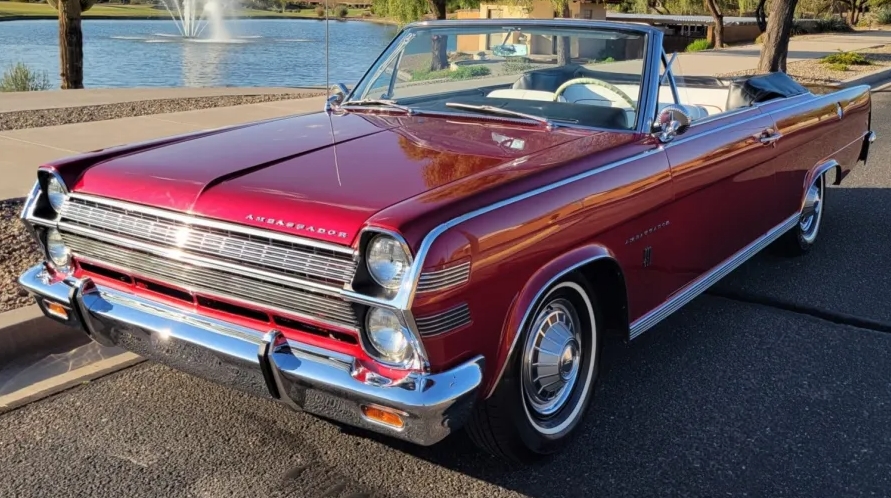
The 400 Series (1965–1966) In 1965, AMC decided to exit the compact market with the Ambassador and push it into the full-size segment. The car was renamed the “Rambler Ambassador 400” (and later just the Ambassador 400).
The wheelbase was stretched to 112 inches, and the car grew significantly in length and width. It was now a direct competitor to the Ford LTD, Chevrolet Caprice, and Plymouth Fury. The styling was boxy and conservative, featuring a squared-off roofline that maximized interior headroom.
Trim levels were simplified into the 400 and the 400 Deluxe. The Deluxe added more brightwork, upgraded upholstery (often vinyl or cloth), and a more ornate grille. Engine choices were robust:
- Standard: 155 hp 232ci inline-six.
- Optional: 198 hp 287ci V8 or the new 327ci V8 (250 hp), which was AMC’s answer to the Corvette engine’s torque.
The DPL Series (1966–1968) In late 1966, AMC introduced the DPL (DeLuxe Package) trim level to replace the 400 Deluxe. The DPL was the luxury king of the AMC lineup.
The 1967 model year brought a facelift with a new cross-hair grille and revised tail lights. The DPL featured unique badging, wheel covers, and a standard vinyl roof. The interior was lavish for an AMC, featuring reclining “Strato” bucket seats with a center console, wood-grain dash accents, and deep-pile carpeting.
The 1968 model year was the final year for this body style. It saw minor cosmetic changes, including new side marker lights (a federal requirement) and a revised grille. Despite being a full-size car, the Ambassador retained a reputation for good fuel economy thanks to the efficient straight-six engine, which remained a popular choice over the V8.
Phase III: The “Longer” Car (1969–1974)
The 1969 Redesign For 1969, AMC unveiled a completely new Ambassador. This was the car that truly defined the model’s legacy as a “longer” alternative to the standard family car.
The new Ambassador sat on a massive 118-inch wheelbase—6 inches longer than the previous model and significantly longer than the mid-size Rambler Classic. The body was entirely new, featuring a semi-fastback roofline and a distinctive “loop” front bumper (a design that would be adopted by the Gremlin and Hornet later).
The trim levels for 1969 were:
- Base: A no-frills full-size sedan.
- DPL: The luxury trim, featuring bucket seats, console, and extra chrome.
- SST: A new “Super Sport Touring” trim that replaced the DPL for a brief time, focusing on a sportier look with aggressive badging and mag-style wheels.
The 1970–1974 “Big Ambassadors” The 1970 model year brought a significant change: the introduction of the AMX trim level to the Ambassador line. For the first time, AMC’s luxury car could be had with high-performance options.
- The Ambassador SST (1970–1972): This trim focused on comfort and style. It featured a unique roofline with a “flying buttress” design (glass roof section extending into the rear pillar). The SST was available as a 4-door sedan or a wagon.
- The Ambassador AMX (1970–1974): This was the crown jewel. While the standalone AMX sports car was discontinued, the AMX name lived on as a high-performance package for the Ambassador. It included the powerful 360ci V8 (later 401ci), heavy-duty suspension, dual exhausts, and aggressive styling cues like hood scoops (non-functional on later years), blackout trim, and mag-style wheels. The AMX trim was available on both the SST and the DPL models.
The 1972–1974 Facelifts In 1972, the Ambassador received a new front end with a prominent “crosshair” grille and federally mandated 5-mph bumpers. The interior was updated with a new instrument panel and improved ventilation.
- 1973: Another bumper update (5-mph impact standards increased) resulted in a larger, more rubbery front bumper. The AMX package was still available, though emissions controls were beginning to sap power.
- 1974: The final year. The Ambassador received a massive, vertical-bar grille and new tail lights. The AMX package was still offered, making the 1974 Ambassador AMX one of the last true muscle-style cars of the era, powered by the 401ci V8 (though output was rated at a modest 220 hp due to emissions equipment).
The Wagon Legacy Throughout the 1969–1974 era, the Ambassador wagon (specifically the SST and DPL wagons) was a standout. It offered a massive cargo area and optional three-row seating. It was one of the few wagons that could be ordered with the 401 V8 and four-speed manual transmission (though the automatic was far more common).
Why the Ambassador Mattered
The Ambassador was a unique vehicle because it defied categorization. It wasn’t quite full-size (it was narrower and lighter than a Chevy Caprice), but it wasn’t mid-size either (it was longer than a Ford Torino).
Strengths:
- Ride Quality: The “Controlled Ride” suspension system used on the 1969–1974 models was praised by critics for absorbing bumps better than many larger domestic cars.
- Standard Features: AMC always loaded the Ambassador with features that were optional on other cars. Power steering, disc brakes, and air conditioning were often standard or easily optioned.
- Engine Reliability: The AMC inline-six (232/258ci) is legendary for its durability. The V8s (304, 360, 401) were torquey and responsive.
Weaknesses:
- Size Perception: By the early 1970s, the Ambassador was physically large. In an era of rising gas prices (1973 Oil Crisis), consumers began to view it as a gas guzzler, even though the six-cylinder models were relatively efficient.
- Brand Identity: The “Rambler” name was associated with economy. When AMC dropped “Rambler” from the Ambassador’s name in 1968, the car struggled to establish a new identity as a luxury vehicle against established players like Buick and Oldsmobile.
The End of the Line
By 1974, the automotive landscape had shifted dramatically. The government mandated catalytic converters, unleaded gasoline, and massive bumpers. Fuel prices were volatile. The large, heavy Ambassador was becoming an anachronism.
AMC was also in financial trouble. The company had invested heavily in the new “Gremlin” subcompact and the “Hornet” compact. The full-size market was shrinking, and AMC couldn’t afford to develop a new generation of large cars.
Production of the AMC Ambassador ceased in December 1974. There was no direct successor. The factory space and resources were reallocated to the Renault alliance, which would produce the AMC Concord (a reworked Hornet) as a “luxury compact” in 1978.
The Ambassador nameplate disappeared, marking the end of AMC’s attempt to compete in the full-size luxury market.
Future Outlook: The Ambassador Today
Today, the AMC Ambassador is a cult classic. It is rarely seen at mainstream car shows but is cherished by AMC enthusiasts and collectors of “orphan cars” (vehicles from defunct manufacturers).
Collectibility:
- The Convertibles (1957–1964): These are the most valuable. The 1957 Nash Ambassador convertible and the 1963–1964 Rambler Ambassador convertibles are rare and command high prices at auction.
- The 1970–1974 Ambassador AMX: These are gaining popularity as “sleepers.” With the 401 V8, they are capable of impressive performance. The 1970 “loop bumper” models are particularly desirable.
- The “Brougham” Era: The 1965–1968 models are less valuable but are sought after by restorers who appreciate the “underdog” status of the car.
The Market: The Ambassador fits perfectly into the growing “Malaise Era” car hobby. As interest grows in 1970s American cars that were overshadowed by their more famous muscle car counterparts, the Ambassador AMX is being rediscovered. It represents the final chapter of American Motors’ independence—a car that tried to be everything to everyone (luxury, performance, economy) and succeeded for nearly two decades.
Conclusion The AMC Ambassador was a testament to American Motors’ ingenuity. It started as a compact luxury car, evolved into a mid-size cruiser, and finished its life as a full-family hauler with muscle car DNA. It was never the best-selling car in America, but it carved out a distinct niche for the pragmatic buyer who wanted luxury without the excess of the Big Three. Though the brand is gone, the Ambassador’s journey remains a fascinating chapter in the story of the American automobile.