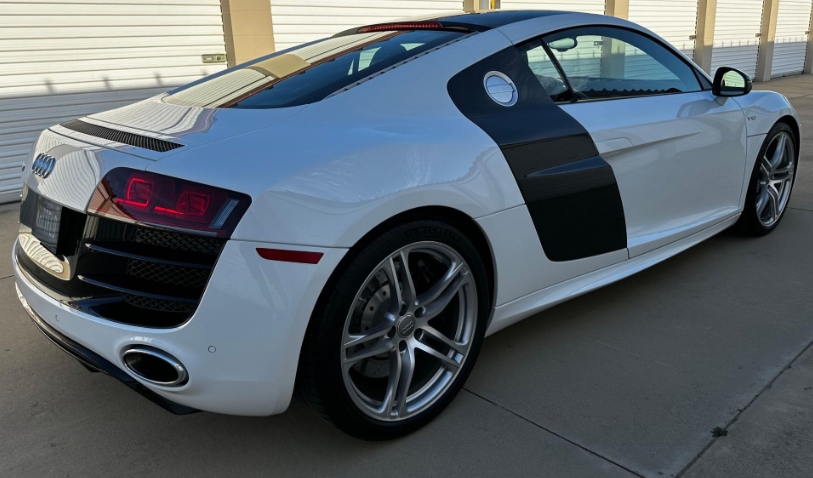
The Vorsprung durch Technik Supercar: The History of the Audi R8
When the automotive world looks back at the first two decades of the 21st century, few vehicles will have made as significant an impact as the Audi R8. Before 2006, the concept of a daily-drivable, all-weather supercar was largely an oxymoron. While the Porsche 911 offered practicality, it lacked the exotic mid-engine layout. The Nissan GT-R offered performance but lacked the bespoke luxury. Enter the Audi R8, a vehicle that bridged the gap between the racetrack and the highway, bringing Le Mans-winning technology to the street with Teutonic reliability.
For nearly 17 years, the R8 served as the halo car for Audi’s “Vorsprung durch Technik” (Advancement through Technology) slogan. It was the car that proved aluminum spaceframe construction could be lightweight and rigid, and that a high-revving naturally aspirated engine was still the purest way to experience speed. This is the definitive history of the Audi R8, tracing its evolution from the LMP-inspired concept to the roaring V10 final edition.
The Genesis: From Concept to Reality (2003–2006)
The story of the R8 begins not on the road, but on the tarmac of Le Mans. In the early 2000s, Audi dominated the 24 Hours of Le Mans with the R8 Prototype (LMP). This race car, powered by a turbocharged V8 TFSI engine, was a technological marvel. Audi’s designers and engineers, led by then-Head of Design Walter de’Silva, saw an opportunity to translate this racing pedigree into a road car.
In 2003, Audi unveiled the Audi Le Mans quattro concept at the Frankfurt Motor Show. It was a stunning revelation: a mid-engine, two-seater coupe with scissor doors and a 500-horsepower V10 engine. The public reaction was overwhelmingly positive, and Audi quickly greenlit the project for production.
On December 11, 2006, the production version of the Audi R8 was unveiled at the Paris Motor Show. Based heavily on the Lamborghini Gallardo (both were under the Volkswagen Group umbrella), the R8 shared its wheelbase and engine architecture but possessed a distinct personality. It utilized Audi’s legendary quattro all-wheel-drive system and featured a lightweight aluminum spaceframe (ASF) construction.
.
RepairSurge Online Repair Manuals Replace Bulky Books With Reliable Digital Information!
Faster And Cheaper Than Traditional Printed Manuals, Users Get Instant Access To The Repair Information They Need For Any Car, Truck, Van or SUV:
.
Generation I: The V8 Era (2007–2015)
The first-generation R8 (Typ 42) entered production in 2007 and hit markets in 2008. It was an immediate sensation, famously appearing in Iron Man as Tony Stark’s daily driver, cementing its pop-culture status.
The Engine Lineup: Initially, the R8 was offered with a singular powerplant: the 4.2-liter FSI V8. Derived from the RS4 engine, it produced 420 horsepower and revved to an exhilarating 8,250 rpm. It was paired with either a 6-speed manual transmission or the revolutionary R-tronic single-clutch automated manual gearbox.
Body Styles and Trims:
- R8 Coupe V8 (2007–2015): The standard model featuring the iconic sideblade design.
- R8 Spyder V8 (2010–2015): The convertible variant, which sacrificed the fixed roof but retained the aluminum chassis rigidity. It weighed slightly more but offered an open-air experience.
The V10 Revolution (2009–2015): In 2009, Audi answered the call for more power by introducing the R8 5.2 FSI quattro. This model utilized the 5.2-liter V10 engine shared with the Lamborghini Gallardo LP560-4.
- Performance: 525 horsepower and 398 lb-ft of torque.
- Transmission: While the V8 utilized the R-tronic, the V10 initially launched with the R-tronic but was later offered with the legendary R8 e-tron (more on that later) and, crucially, a 6-speed manual transmission for the purists.
The “Plus” and “GT” Models (2010–2013): Audi began to strip weight and add power for track-focused variants.
- R8 V10 Plus (2012–2015): This was the ultimate expression of the first generation. It featured carbon fiber reinforced polymer (CFRP) components, including the front splitter, rear diffuser, and sideblade. It shed weight to 1,525 kg and increased power to 550 hp. It was a track weapon with number plaques and fixed rear spoilers.
- R8 GT (2010–2012): A limited run of 333 units based on the V10. It was lighter than the standard V10 (by 100 kg) and produced 560 hp. It featured unique “Daytona Grey” paint and red accents.
- R8 Spyder GT (2011): A convertible version of the GT, limited to 66 units.
The Electric Experiment: R8 e-tron (2012–2014) In 2010, Audi unveiled the e-tron concept at Frankfurt. By 2012, a production version of the R8 e-tron was available (though sold in limited markets). It utilized four electric motors (one at each wheel) producing 381 hp and 820 Nm of torque. While technologically impressive with a 215-mile range, it was incredibly heavy and expensive. Production ended in 2014, serving as a learning platform for future EVs like the e-tron GT.
The Facelift: Second Phase (2013–2015) In late 2012, Audi refreshed the R8.
- Visuals: The “singleframe” grille was enlarged, the sideblades were restyled, and LED headlights became standard (with dynamic turn signals).
- Transmission: The biggest change was the replacement of the clunky R-tronic gearbox with the lightning-fast S-tronic dual-clutch transmission (7-speeds).
- New Trim: The R8 V8 Competition was introduced—a limited edition (50 units) focused on the Nürburgring, featuring fixed suspension, matte paint, and blacked-out trim.
Generation II: The Revolution (2015–2023)
In 2015, Audi launched the all-new, second-generation R8 (Typ 4S). This was not merely an evolution; it was a complete redesign. The aluminum spaceframe was now a hybrid of aluminum and carbon fiber, making it 40% stiffer and 50 kg lighter than its predecessor.
The Engine Shift: The V8 was gone. The second generation was exclusively V10 (at launch). The 5.2-liter FSI V10 was retuned to produce 540 hp in the standard model and 610 hp in the V10 Plus.
Trims and Models (2015–2019):
- R8 V10 (540 hp): The base model, capable of 0-60 mph in 3.5 seconds.
- R8 V10 Plus (610 hp): The performance flagship. It featured fixed carbon fiber rear wings, ceramic brakes, and sport exhaust. Top speed was 205 mph.
- R8 Spyder V10 (540 hp): The convertible, retaining the structural rigidity of the coupe.
- R8 V10 Plus Spyder (2017): Audi eventually brought the high-performance trim to the convertible, offering the ultimate open-air V10 experience.
The R8 RWS (2017–2019): In 2017, Audi introduced a rare variant: the R8 Rear-Wheel Series (RWS). Limited to 999 units (500 coupes, 499 spyders), this was the first R8 to ditch the quattro system in favor of pure rear-wheel drive. It was lighter, more playful, and offered a purist driving dynamic previously reserved for the Lamborghini Huracan RWD.
The Facelift: 2019 Update In late 2018, Audi revealed the updated second generation for the 2019 model year.
- Performance: Power bumped to 562 hp for the standard V10 and 602 hp for the V10 Performance (formerly Plus).
- Design: The front and rear bumpers were redesigned with larger air intakes and more aggressive lines. The exhaust tips became trapezoidal.
- Tech: A new Audi Virtual Cockpit became standard, and the magnetic ride suspension was recalibrated for better comfort.
The Final Chapter: R8 V10 Performance RWD (2020–2023) As the automotive world shifted toward electrification, Audi decided to send the R8 off with a bang. In 2020, they introduced the R8 V10 Performance RWD.
- Specs: 602 hp and 413 lb-ft of torque sent exclusively to the rear wheels via a mechanical limited-slip differential.
- Significance: This model combined the power of the old V10 Plus with the dynamics of the RWS. It was widely regarded as the most engaging and driver-focused R8 ever made.
Special Editions (The Swan Songs):
- R8 Decennium (2020): A limited edition (500 units) celebrating the V10’s decade in the R8. It featured matte Daytona Grey paint and gloss black accents.
- R8 V10 Performance RWD Panther Edition (2022): A US-exclusive run of 60 units with unique matte black and red accents.
- R8 25 Years (2022): To celebrate Audi Sport’s 25th anniversary, 50 units were released in the US (and 200 globally). These featured a unique Nardo Grey paint with red accents and a 602-hp rear-wheel-drive setup.
Technical Legacy: The Aluminum Spaceframe
A defining characteristic of the R8 throughout its life was the Audi Space Frame (ASF). Unlike competitors that used carbon fiber monocoques (like McLaren) or steel (like older Ferraris), Audi stuck to aluminum. This allowed for a lighter chassis that was incredibly resistant to torsion. The second generation added carbon fiber to key areas (A-pillars, roof bows) to further reduce weight and lower the center of gravity.
The End of an Era
On March 21, 2023, the final Audi R8 rolled off the production line in Heilbronn, Germany. It was a Panther Edition Coupe in Daytona Grey. In total, Audi produced approximately 45,000 units of the R8 across both generations.
The decision to end production was driven by emissions regulations and the industry’s pivot to electric vehicles. The cost of updating the V10 engine to meet Euro 7 standards was deemed unjustifiable for a low-volume model.
Future Outlook: What Comes Next?
While the combustion R8 is gone, the nameplate is rumored to return in a radically different form. Audi has confirmed that its future halo car will be electric.
The Audi R8 e-tron (Future): Spy shots and concept teasers suggest a new electric R8 is in development, potentially arriving around 2027 or 2028. This vehicle is expected to share its architecture with the Porsche Taycan and the upcoming electric Porsche 911. Unlike the heavy 2012 e-tron, this new model will utilize advanced solid-state battery technology to offer:
- Power figures likely exceeding 700 hp.
- A range of over 500 miles.
- A lightweight design to honor the R8 lineage.
However, Audi executives have hinted that the next halo car might not carry the R8 badge, potentially adopting a new nomenclature to signify the electric era. Regardless of the name, the DNA of the R8—quattro all-wheel drive, cutting-edge tech, and a focus on usability—will undoubtedly live on.
Conclusion
The Audi R8 was more than just a supercar; it was a democratization of exotic performance. It proved that a mid-engine V10 could be as reliable as a sedan and as capable in the snow as it was on a dry track. From the raw, manual-gated V8s of 2007 to the 602-hp rear-wheel-drive monsters of 2023, the R8 remained true to its core philosophy: Vorsprung durch Technik.
As the automotive landscape changes, the R8 stands as a monument to the internal combustion era—a bridge between the race track and the road that will be remembered as one of the greatest supercars of the 21st century.