The Austin Marina: A Tale of Two Hemispheres and a Controversial Name
In the annals of British automotive history, few cars evoke the complex interplay of post-war industrial ambition, badge engineering, and transcontinental adaptation quite like the Austin Marina. Produced by the British Motor Corporation (BMC) and later British Leyland, the Marina was intended to be a stop-gap solution—a modern family saloon to fill the void between the compact Mini and the larger Austin/Morris 1800. However, its legacy is defined not just by its production timeline, but by its dramatic divergence in two distinct markets: the United Kingdom, where it was often criticized for its handling, and New Zealand, where it became an unlikely motorsport legend.
This article explores the complete evolution of the Austin Marina, tracing its years of production, the myriad of models and trim levels, and the fascinating story of how a humble family car became a cultural icon in the Southern Hemisphere.
Part I: Origins and Development (1967–1971)
The Need for a Gap-Filler By the mid-1960s, BMC’s lineup was aging. The Austin A40 Farina (1958–1967) was nearing the end of its life, and the company needed a successor that was more substantial than the Mini but smaller and more economical than the Austin 1800. The project, codenamed “ADO28,” was led by designer Pininfarina. While the Italian design house produced the initial clay models, the final production car was heavily modified by Alec Issigonis’s team at BMC to accommodate existing mechanical components and reduce costs.
Launch and Initial Reception The Austin Marina (known as the Morris Marina in markets where the Morris brand was stronger) was launched in April 1971. It was a conventional three-box saloon, a stark departure from the radical front-wheel-drive layouts that BMC was famous for. The Marina utilized a front-engine, rear-wheel-drive configuration, a decision driven by cost-cutting measures that utilized the drivetrain of the Austin 1800.
The initial range was powered by a series of A-series engines, familiar to anyone who owned a Mini or Austin 1100:
- 1.3L (1275cc): The primary engine for the larger models.
- 1.0L (998cc): Offered in the entry-level 1.0 models.
The “Hydragas” Suspension Controversy One of the Marina’s most defining—and criticized—features was its suspension. BMC attempted to adapt the Hydragas suspension system (originally designed for the 1800) to the Marina. However, due to cost constraints, the system was simplified. The result was a car that lacked the sophisticated ride of the 1800 and suffered from significant body roll and vague steering. In the UK press, the Marina quickly earned a reputation for being a “handling disaster,” a reputation that would haunt it for years.
.
THIS might be a great place to get your new car from!
Or for those who are into the “car flipping” business, here’s an excellent resource for you!

.
Part II: The UK Evolution (1971–1980)
Throughout its decade-long production run in the UK, the Austin Marina underwent several revisions, expanding into coupe, van, and pickup variants.
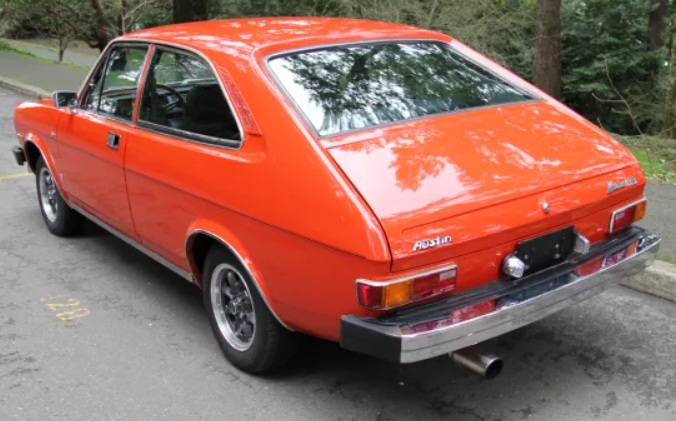
The Coupe (1972) In 1972, BMC introduced the Marina Coupe. Marketed as a sporty alternative, the Coupe featured a fastback roofline and a larger rear window. While aesthetically distinct from the saloon, the Coupe shared the same mechanical underpinnings. It was initially offered with the 1.3L A-series engine but later received the powerful 1.8L B-series engine.
Engine Evolution and the “TC” Models As the 1970s progressed, the Marina’s engine range expanded to meet the demand for performance.
- The 1.8L (B-Series): Introduced in 1972, this engine was borrowed from the MGB and the Austin 1800. It provided adequate performance but highlighted the chassis’ limitations.
- The Marina 1.8 TC (1973): This was the high-performance variant of the Coupe. The “TC” (Touring Coupe) featured twin SU carburetors, a vinyl roof, and sporty trim. It became a favorite of the British police and traffic wardens, who used its straight-line speed for pursuit duties.
- The “HL” and “Super” Trims: Throughout the mid-70s, trim levels were shuffled to align with market trends. The “HL” (High Line) offered vinyl upholstery and improved trim, while the “Super” added features like a heater and windscreen washers as standard.
The ADO28 Van and Pickup Utilizing the Marina’s mechanicals, BMC launched the Morris Marina Van and Pickup in 1972. These commercial vehicles were robust and utilitarian, lacking the rear windows of the saloon. They were sold primarily under the Morris badge and were popular with small businesses in the UK and export markets.
Facelifts and the End of Production By 1975, the Marina received a minor facelift (often referred to as the Marina II, though technically a continuous production run). This update included a new plastic grille, revised taillights, and an improved interior to combat rust issues. However, the fundamental design was aging. The Austin Allegro and Princess were taking precedence in BMC’s (now British Leyland’s) lineup.
Production of the Austin Marina in the UK ceased in 1980, with the final cars rolling off the line at Cowley. It was replaced by the Austin Maestro. By the time production ended, over 500,000 Marinas had been sold in the UK.
Part III: The New Zealand Story – The “Morris” Legend
While the Austin Marina in the UK is remembered as a competent but flawed family car, the story in New Zealand is radically different. Here, the car was assembled by Motor Holdings International (MHI) and sold almost exclusively as the Morris Marina.
The 1.8L TC and the Birth of a Rally Car In the mid-1970s, New Zealand’s rally scene was dominated by Ford Escorts. The local Morris assembly plant began producing the Morris Marina 1.8L TC. Unlike the UK version, which was often detuned to meet tax brackets, the New Zealand TCs were potent.
However, the real magic happened when privateers got hold of the chassis. The Marina’s rear-wheel-drive layout and simple construction made it an ideal candidate for modification. Drivers like Paul Adams and Mike Marshall stripped the interiors, reinforced the chassis, and installed roll cages.
The 1975 Southern Cross Rally The turning point for the Marina’s reputation came in 1975. The Southern Cross Rally was an endurance event spanning thousands of kilometers across Australia and New Zealand. A heavily modified Morris Marina, driven by Paul Adams, shocked the motorsport world by winning the event outright. This victory wasn’t just a fluke; it proved that the Marina’s chassis, when properly set up with rally suspension and wider tires, could outperform the stiffer, less forgiving Fords and Datsuns of the era.
The “Morris Marina 1.8L GL” and “Supa Sura” Throughout the late 1970s, the New Zealand market offered specific trim levels that were unique to the region:
- Morris Marina 1.8L GL: The luxury trim, featuring velour seats, a woodgrain dash, and often a 3-speed automatic transmission. This was the “Sunday drive” car for the middle class.
- The “Supa Sura” Phenomenon: While not an official factory trim, the term “Supa Sura” (Super Sure) became synonymous with the high-performance TC models in New Zealand. It represented the tuner culture that emerged around the 1.8L B-series engine. Local mechanics developed camshafts, extractors, and carburetor setups that made the Marina a formidable drag and circuit car.
The 1.3L and 1.6L Variants In New Zealand, due to tax laws based on engine capacity, smaller engines were also popular. The Morris Marina 1.3L was a common sight, offering economy over speed. Interestingly, some local racers even swapped the 1.3L block for the 1.6L (from the Cortina) to create “underdog” racers that could compete in lower capacity classes.
Part IV: Technical Specifications and Model Breakdown
To summarize the evolution, here is a breakdown of the primary models and trim levels offered throughout the Marina’s life (1971–1980):
1. The Saloon Range (UK & Export)
- Marina 1.0 (1971–1975): Base model. 998cc A-series engine. 44 bhp. 4-speed manual. Minimal trim (rubber mats, basic seats).
- Marina 1.3 (1971–1980): The volume seller. 1275cc A-series engine. 58 bhp. 4-speed manual (5-speed optional later). Trim levels included “City” (basic), “Super” (improved trim), and “HL” (vinyl roof, better upholstery).
- Marina 1.8 (1972–1980): 1798cc B-series engine. 84 bhp. 4-speed manual or 3-speed automatic. Trim levels: “HL,” “L,” and “Supreme” (top spec with wood dash, clock, and heated rear window).
2. The Coupe Range
- Marina 1.3 Coupe (1972–1980): Aesthetic upgrade over the saloon. Same mechanicals as the 1.3 saloon.
- Marina 1.8 Coupe (1972–1980): Fastback styling. 1.8L B-series engine.
- Marina 1.8 TC (1973–1980): The performance flagship. Twin carburetors, vinyl roof, sports seats, and full instrumentation. Often painted in “Harvest Gold” or “Pageant Blue.”
3. Commercial Variants
- Morris Marina Van/Pickup (1972–1980): Sold primarily in the UK and Commonwealth. Lacked rear seats and side windows. 1.3L or 1.8L engines. High-roof options available for the van.
4. New Zealand Specifics
- Morris Marina 1.8L GL: Luxury trim with automatic transmission options.
- Morris Marina 1.8L TC: The rally special. Manual only, high compression engine.
- Morris Marina 1.3L: Economy trim, often with vinyl bench seats.
Part V: Legacy and Future Outlook
The Rust Factor One cannot discuss the Marina’s evolution without addressing its Achilles’ heel: corrosion. Both the UK and New Zealand Marinas were notorious for rusting. The wheel arches, sills, and boot floors were particularly susceptible. Today, finding a pristine, unmodified Marina is incredibly difficult. Most surviving examples in the UK are restored classics, while in New Zealand, the majority of survivors have been modified for historic motorsport.
Cultural Impact The Austin Marina represents the twilight of the British “badge engineering” era. It was a car that prioritized cost-saving over innovation, resulting in a vehicle that was fundamentally outdated upon release. In the UK, it is remembered with a mix of nostalgia and derision—a symbol of the British Leyland labor disputes and quality control issues of the 1970s.
However, in New Zealand, the Marina is revered. It is a symbol of a golden age of local motorsport, where ingenuity and driver skill could turn a humble family car into a world-beater. The “Morris Marina” name carries a weight of respect in Kiwi motorsport circles that it never achieved in Britain.
Future Outlook As the classic car market matures, the Austin Marina is experiencing a quiet renaissance.
- In the UK: Prices for good TC Coupes are rising. They are seen as affordable classics compared to the Ford Capri or MGB. The “restomod” scene is also embracing the Marina, with owners swapping in modern Rover K-series engines and fitting custom suspension to fix the handling flaws of the original.
- In New Zealand: The motorsport legacy ensures that the Marina remains active. Historic rally events frequently feature modified Marinas. The demand for original TC parts is high, and restoration projects are becoming valuable.
Conclusion The Austin Marina was born of necessity and executed with frugality. It was a car that divided opinion: a sluggish family hack in Britain, and a giant-killing racer in New Zealand. Its evolution from the humble 1.0L saloon to the 1.8L TC Coupe tells the story of the automotive industry in the 1970s—a decade of transition, oil crises, and changing tastes.
While it may never achieve the iconic status of the Mini or the Mustang, the Marina holds a unique place in history. It is a testament to the versatility of the internal combustion engine and the passion of the drivers who refused to accept the car at face value. Whether viewed as a flawed relic or a motorsport hero, the Austin Marina remains an indelible part of the automotive tapestry.