Yenko (Chevrolet) Nova: The Rare Muscle Car That Defied Convention
The Yenko Nova is one of the most obscure, limited-production, and highly collectible muscle cars ever created — a compact Chevy Nova turned into a street-shredding performance machine by one of America’s most storied performance dealers, Don Yenko. Unlike mainstream production cars with formal model years, factory trims, and extensive documentation, the Yenko Nova exists more as a legend and a handful of verified examples than a traditional lineup. But its impact on muscle-car lore is unmistakable. This article dives into the history of the Yenko Nova, explains exactly what models were produced, and explores its legacy among collectors.
Origins — Who Was Yenko?
Don Yenko was not a manufacturer in the normal sense — he was a performance-oriented Chevrolet dealer in Canonsburg, Pennsylvania, who built high-performance variants of Chevrolets beginning in the 1960s. His first success was with Corvair-based race cars and then the famed Yenko Camaro, which saw Chevrolet actually install big-block engines via COPO (Central Office Production Order) to meet customer demand.
Yenko’s reputation as a local tuner turned muscle-car icon enabled him to bring outsized performance to a variety of Chevrolet platforms, setting the stage for his most compact muscle creation: the Yenko Nova.
The Chevrolet Nova — Brief Context
The Chevrolet Nova began life as the Chevy II compact in 1962, created to compete in smaller car segments. By the time of the third generation (1968–1974), the Chevy II was rebranded simply as the Nova and offered a range of engines and trim levels, including the performance-oriented Super Sport (SS) packages.
For most customers, Nova SS cars offered upgraded suspension, trim, and factory performance engines, such as the 350-ci small-block and the 396-ci big-block V8. But even SS cars were far more mainstream muscle than true competition machines.
.

.
Yenko’s Foray into Nova — 1969 Super Nova
The first Yenko-enhanced Nova project began in 1969, when Don Yenko saw potential in the Nova’s compact platform and the new Corvette/ Camaro 427 V8 (L72). Chevrolet did not allow the 427 to be factory-installed in the Nova via COPO, so Yenko devised his own approach by converting SS396 cars to accept the big block.
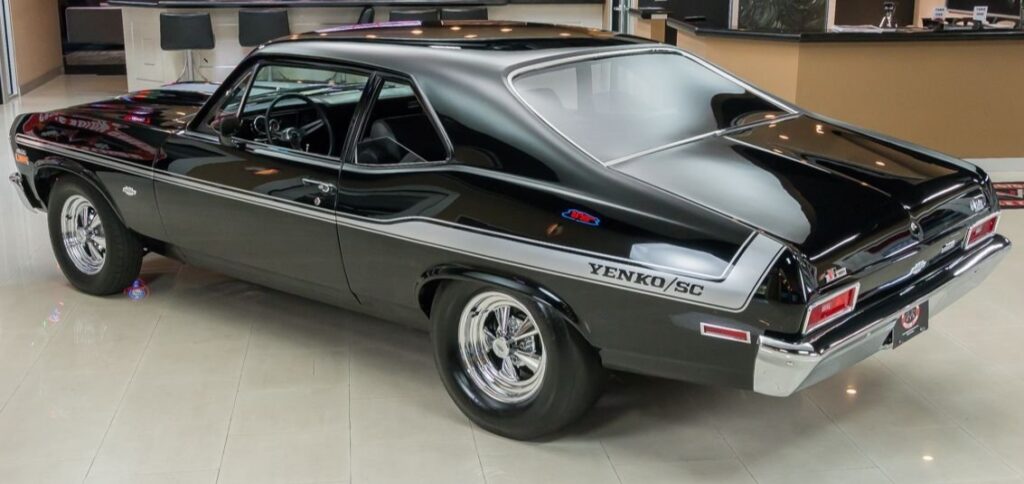
1969 Yenko Super Nova (S/C 427)
- Production: Extremely limited — approximately 37–38 cars total.
- Base Vehicle: 1969 Chevrolet Nova SS396 brought in from the factory.
- Engine: Yenko converted these cars to fit a 427-ci big-block V8 (L72 with heavy modification), unofficially rated near 450 hp.
- Transmission: 4-speed manual (M-21) or automatic depending on customer choice.
- Suspension & Drivetrain: Reinforced rear axles (12-bolt), heavy-duty suspension upgrades, Positraction differential.
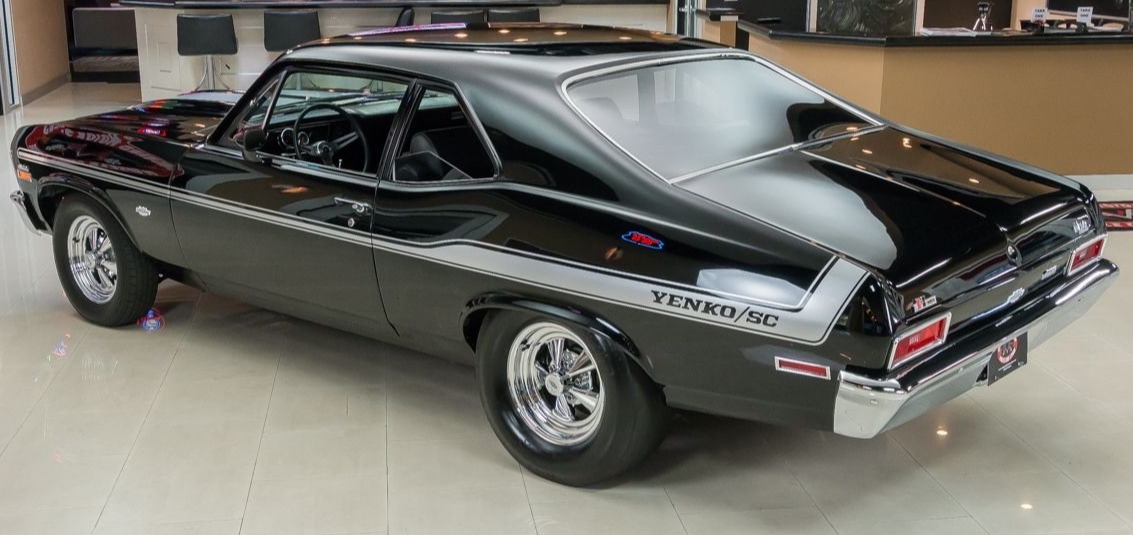
- Trim & Appearance: Yenko stripes, badges, and subtle performance cues distinguished them from standard SS cars.
This 1969 package is often called the Super Nova or Yenko/SC 427 — a true muscle-car conversion designed to compete with the era’s biggest threats in quarter-mile racing. Due to the extremely limited production and homologation rules, these cars were assembled one-by-one rather than mass-manufactured.
The 1969 Yenko Nova isn’t categorized in traditional trim levels; rather, it’s defined by its engine conversion and performance upgrades. Only a handful remain today — perhaps fewer than ten — making surviving examples some of the rarest muscle cars in existence.
1970 Yenko Nova — The “Deuce”
By 1970, changing emission regulations, rising insurance costs, and the waning muscle-car market made big blocks less sustainable for compact cars. Yenko’s solution for the Nova was to shift from the oversized 427 to a high-performance small-block that was more compliant with both factory rules and customers’ needs.
1970 Yenko “Deuce” Nova
Dubbed the Yenko Deuce, this version kept the Nova’s compact appeal but updated the performance recipe:
- Production: Approximately 175 cars built and converted by Yenko.
- Engine: LT1 350-ci small-block V8 producing around 360 hp, the same engine used in the Z/28 Camaro and Corvette.
- Transmission: Customer choice of Muncie M-21 4-speed manual or Turbo-Hydramatic 400 automatic.
- Drivetrain & Suspension: 12-bolt Positraction rear differential with 4.10:1 gears, upgraded heavy-duty suspension, dual exhausts, and enhanced cooling.
- Trim & Features: Bench seating, rubber mats, AM radio, and distinctive Yenko stripes and badging defined the Deuce visually.
The Deuce offered one of the most competitive compact muscle packages of 1970, combining a strong small-block, manual gearbox option, and performance-ready hardware. This made it far more common — though still rare in overall automotive terms — than its 1969 big-block sibling.
Models and Trim Levels — What Existed?
Strictly speaking, the Yenko Nova did not follow traditional factory models and trim levels like regular production cars. Instead, there are two primary distinct Yenko Nova variants, both defined by the engine and performance conversions performed by Yenko Chevrolet:
- 1969 Yenko Super Nova (S/C 427)
- Big-block 427 conversion on SS396 donor cars
- Extremely limited production (~37–38)
- High-horsepower performance machine
- 1970 Yenko Nova “Deuce”
- Small-block LT1 performance package
- Greater production (~175)
- Enhanced performance and sporty drivability with manual or automatic transmission options
Because Yenko’s conversions were done on existing Nova SS or COPO vehicles, these cars did not have factory-assigned trim levels in Chevrolet’s lineup beyond the SS designation on the donor car. The Yenko enhancements — engine swap, suspension upgrades, and Yenko badges/stripes — are the defining characteristics.
Production Numbers and Rarity
In total, only a few hundred Yenko Novas were ever created:
- 1969: ~37-38 Super Nova conversions.
- 1970: ~175 Yenko Deuce conversions.
This places total authentic Yenko Nova production at just over 200 cars, far less than many of the most iconic muscle cars from Detroit’s major factories. Existing examples are prized at auctions, often commanding six-figure prices due to rarity and performance pedigree.
Performance and Driving Experience
Both Yenko Nova variants were built for serious performance. The 1969 big-block model reportedly unleashed over 450 hp — an unheard-of figure for a compact car at the time — and could launch from 0-60 mph in roughly the low 5-seconds range and cover the quarter-mile in the low 11s with racing slicks.
The 1970 Deuce, with its LT1 engine, offered a more usable yet still formidable performance package, blending street-friendly driving with competitive acceleration and handling from its upgraded suspension and Positraction rear end.
Legacy and Future Outlook
The Yenko Nova never became a long-running model with multiple factory trims and annual revisions. Instead, it remains a collector’s artifact — a snapshot of the peak muscle-car era when manufacturers, dealers, and enthusiasts were pushing the boundaries of what production cars could do.
Today:
- Collector Value: Authentic Yenko Novas are rare and valuable, especially 1969 big-block cars with verified Yenko provenance.
- Muscle-Car History: Recognized among enthusiasts as one of the most extreme dealer-built muscle cars, the Yenko Nova occupies a unique niche alongside Yenko Camaros and other COPO specials.
- Future Revival? No modern Yenko designation exists from Chevrolet or Yenko Chevrolet today; any new “Yenko Nova” would likely be a tribute or restomod rather than an official factory model.
Conclusion
The Yenko Nova stands as a testimony to ingenuity in the golden age of muscle cars. With just two principal variants — the 1969 big-block Super Nova and the 1970 LT1-powered Deuce — this dealer-modified compact may lack the traditional model years and trims of mainstream cars, but it boasts a mystique and performance heritage few others can match.
The Yenko Nova’s rarity, performance, and place in automotive lore ensure it will continue to fascinate collectors and enthusiasts for generations.