Yenko (Chevrolet) Chevelle: The One-Year Muscle Legend and Its Enduring Legacy
In the pantheon of American muscle cars, few names carry as much mystique as Yenko Chevrolet — the Canonsburg, Pennsylvania dealership turned performance legend that transformed ordinary Chevrolet models into some of the most desirable and collectible cars ever built. Among those, the Yenko Chevelle stands out as one of the rarest and most significant, even though its official production lasted for just a single model year: 1969. Unlike a factory production car with model years and trim levels spanning decades, the Yenko Chevelle is best understood as a special-order, high-performance COPO Chevelle crafted under the auspices of famed dealer Don Yenko in 1969 — a unique moment in muscle-car history.
This article explores the origins, production, specifications, rarity, and legacy of the Yenko Chevelle, shedding light on what makes this one-year wonder one of the crown jewels of classic American performance automobiles.
The Man Behind the Super Car: Don Yenko
To appreciate the Yenko Chevelle, you have to understand Don Yenko — a Chevrolet dealer with a racer’s passion and a talent for tapping General Motors’ Central Office Production Order (COPO) system to create performance cars that blurred the lines between showroom and race track.
Yenko began his performance ventures in the early 1960s, transforming Chevrolet Corvairs into sporty hybrids and eventually gaining fame with the Yenko Camaro — COPO-ordered Camaros equipped with big-block engines long before Chevrolet officially offered them. By the late 1960s, Yenko’s reputation was such that savvy performance buyers sought out his dealership specifically for these tuned machines.
In 1969, emboldened by the success of his Camaro program, Yenko expanded his performance offerings to include other Chevrolet nameplates, including the compact Nova and the intermediate-sized Chevelle — creating cars that were rare then and almost mythical now.
Chevrolet Chevelle: A Brief Context
Before diving into the Yenko version, it helps to understand the broader Chevrolet Chevelle family. Introduced in 1964, the Chevelle was Chevrolet’s mid-size car — available in a variety of body styles (coupe, convertible, sedan, and wagon) and trim levels ranging from the base Chevelle 300 to the upscale Malibu. Performance-minded buyers could opt for the Super Sport (SS) package, which from 1966 onward promised higher-output engines and sport-oriented features.
By 1969, Chevrolet’s factory muscle strategy was well underway: the SS396 was the big performance draw for Chevelle buyers, but GM generally restricted big-block engines above 400 cubic inches in Chevelles. This created the perfect opening for performance-hungry buyers and creative dealers like Yenko to exploit the COPO system and get around corporate limits.
.

.
1969: The Only Official Year of the Yenko Chevelle
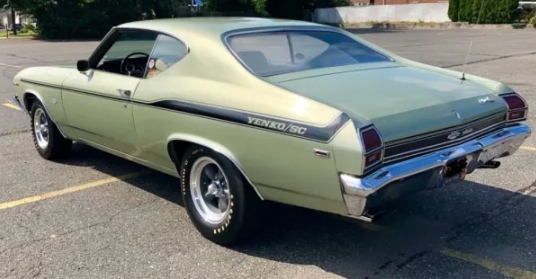
The 1969 Yenko Chevelle — sometimes referred to as the Yenko SC 427 Chevelle — is, by design, a one-year wonder. Yes, Chevrolet built Chevelles through the 1960s and into the 1970s, but the Yenko-branded COPO Chevelle existed only in 1969, making it one of the rarest muscle cars ever produced.
Why 1969 Only?
In 1969, Chevrolet offered the COPO 9562 package that married the big-block 427-cu-in L72 V8 to the Chevelle — an engine normally not available in the intermediate line due to GM’s internal restrictions on displacement. This was a loophole that serious performance buyers could exploit via the COPO system, but most dealers didn’t take full advantage of it. Don Yenko did — ordering and selling a specific subset of these COPO Chevelles through his high-performance dealership.
All other years of production for the Chevelle did not see a sanctioned COPO big-block Chevelle dealership-converted into a Yenko version. Thus, 1969 stands alone — making the Yenko Chevelle a singular phenomenon rather than a multi-year lineup.
Production Numbers and Rarity
Of the approximately 323 COPO 427 Chevelles built by Chevrolet in 1969, only 99 were ordered, modified, and sold through Yenko Chevrolet, complete with the distinctive sYc graphics and performance touches that defined Yenko Super Cars.
These 99 cars were not just regular Chevelles with stickers — they were ordered with factory performance underpinnings and enhanced with specific equipment packages that made them serious competitors on the street or strip. Among these 99, only a handful survive today, possibly fewer than 50 — making them extremely rare and highly valued by collectors.
What Was a Yenko Chevelle? — Specs and Features
Unlike regular factory trim levels with hierarchical designations like base, Malibu, SS, etc., the Yenko Chevelle was defined by a specific performance package rather than traditional trims. What made these cars special includes:
Engine and Powertrain
- 427 cubic-inch L72 V8 — rated at 425 horsepower at the factory, but with Yenko’s performance tuning and Super Tune, actual output is often cited as closer to 450 hp.
- Transmission Options — buyers could choose either a 4-speed Muncie manual (typically M21 close-ratio) or a Turbo-Hydramatic 400 3-speed automatic.
- Drivetrain Enhancements — all cars were equipped with a GM 12-bolt rear axle with Positraction and typically geared at 4.10:1 for strong acceleration.
Performance Hardware (COPO Packages)
The COPO system provided factory installation of several performance-oriented options:
- COPO 9562 — the factory designation that included the big-block L72.
- COPO 9737 — a “Sports Car Conversion” that included upgraded suspension components, larger sway bars, and 15×7 Rally wheels.
- Heavy-duty cooling — larger radiator and cooling system to support sustained high output.
Exterior and Interior Distinguishing Features
Yenko Chevelles are instantly recognizable to enthusiasts partly due to signature stripes and badging:
- Side and hood stripes — distinctive contrasting 3M vinyl graphics that set these apart visually.
- “sYc” logos — short for Yenko Super Car, featured on front seat headrests and exterior badges.
- Yenko/SC and 427 emblems — placed prominently on quarter panels and cowl.
- Stewart-Warner gauges — common feature in the interior for oil pressure, temperature, and high-rpm tachometer.
These visual cues — combined with the factory COPO performance hardware — made the Yenko Chevelle a unique blend of subtle styling and serious performance.
Trim Levels? Not Quite
In traditional automotive terms, trim levels might refer to a range of base, mid, and premium versions of a model year. The Yenko Chevelle, however, never had multiple trim levels in that sense. It was a single special edition of the 1969 Chevelle — defined by:
- Its COPO performance equipment
- The L72 big-block engine
- The Yenko Super Car branding and decals
There were no officially designated “base,” “Deluxe,” or “Limited” trims within the Yenko Chevelle itself — it was simply the 1969 Yenko Chevelle, always built to this high-performance specification and nothing else.
Performance and Driving Experience
For its day, the Yenko Chevelle was a serious muscle machine. Backed by the L72 big-block and heavy-duty drivetrain, these cars were capable performers:
- 0–60 mph figures were brisk for their era — generally in the mid-to-high 5-second range, depending on gearing and tire grip.
- Quarter-mile times varied around the low 13-second range with appropriate gearing.
- Top speed was limited primarily by gearing and aerodynamics, but capable of exceeding 130 mph with proper conditions.
With a beefed-up rear end, heavy-duty cooling, and performance upgrades, these cars were built for hard driving — whether on the street, strip, or backroads.
Collectors’ Market and Legacy
Fast forward to the modern day, and the Yenko Chevelle is not just rare — it’s legendary. Fewer than half of the original 99 cars are believed to still exist, and documented, original examples routinely fetch six-figure sums at auctions and private sales.
Collectors prize them for:
- Originality and provenance — COPO documentation, build sheets, and verified Yenko dealer invoices dramatically increase value.
- Performance pedigree — they represent one of the purest expressions of late-1960s muscle car performance in a mid-size package.
- Historical significance — the synergy between dealership performance programs and factory engineering in the muscle car era is embodied in the Yenko Chevelle story.
Many enthusiast communities, registries, and clubs exist specifically to celebrate and document authentic Yenko vehicles, including this rare Chevelle.
Future Outlook
Given that the Yenko Chevelle was produced only in 1969, there will be no future factory versions — the model has a well-defined endpoint. Its future lies in:
- Restoration and preservation by classic car enthusiasts
- Provenance research to distinguish originals from replicas
- Legacy recognition in automotive museums and collections
- Tribute and continuation builds by restomod specialists inspired by its performance ethos
As classic car values continue to grow, especially for rare muscle cars with documented history, the Yenko Chevelle’s significance and desirability are almost certain to remain strong.
Conclusion
The Yenko Chevelle occupies a unique place in automotive history: it is not a multi-year model line or a series of trim levels, but rather a singular 1969 high-performance super car born from the vision and initiative of Don Yenko. With only 99 built under the COPO system, equipped with the formidable 427-cu-in L72 V8, and branded with Yenko’s distinctive sYc style cues, it remains one of the rarest and most coveted muscle cars ever produced.
Its legacy echoes through the collector world and the broader story of the muscle car era — a testament to what one dealer could achieve by blending factory engineering, grassroots performance culture, and an unyielding passion for speed.