Yenko (Chevrolet) Camaro: The Evolution of an American Muscle Legend
Few names in automotive history evoke the raw spirit of late-1960s horsepower like the Yenko Camaro. Born from the vision of Don Yenko — a high-performance Chevrolet dealer in Canonsburg, Pennsylvania — the Yenko Camaro transformed Chevrolet’s pony car into some of the most potent, collectible street-and-strip muscle machines ever made. Its story spans from humble custom conversions in the 1960s to iconic factory-built performance cars, and even later rebirths in the 21st century. This article traces the evolution of the Yenko Camaro, detailing its years of production, key variants and “trim levels,” its historical context, and its enduring legacy in automotive culture.
The Roots: Who Was Don Yenko?
Don Yenko was more than a car dealer — he was a racer, tuner, and performance enthusiast whose name became synonymous with high-performance Chevrolet vehicles. In the early 1960s, Yenko began modifying Chevrolet models at his dealership to improve speed, handling, and overall performance, often blending racing tech with street usability. His reputation grew with cars like the Yenko Corvair Stinger and the famed Yenko Nova before he turned his attention to the most popular pony car of the era: the Chevrolet Camaro.
Camaro Emerges as a Performance Platform
Chevrolet introduced the Camaro in 1967 to compete with the Ford Mustang and other “pony cars.” While performance options were available — including the SS396 and Z/28 — a corporate edict limited the Camaro’s engine displacement to no more than 400 cubic inches (6.6 L), essentially protecting the Corvette’s higher-displacement engines from internal competition.
This restriction didn’t deter performance fans, and Don Yenko recognized an opportunity. If Chevrolet wouldn’t offer a big-block 427 ci engine in the Camaro, he would go around the rule and build his own. Thus began the Yenko Camaro legacy.
1967-1969: First Generation Yenko Camaros — Super Camaros and the SC
1967 Yenko Super Camaro
In 1967, Yenko created his first high-performance Camaro by selecting SS-spec Camaros — typically with the L78 396 ci V8 — and swapping in the potent L72 427 ci V8 from the Corvette. These cars produced approximately 450 hp and were equipped with performance-oriented components such as heavy-duty suspension and a 4.10:1 rear end.
Although not ordered via Chevrolet’s Central Office Production Order (COPO) system at this point, the result was a remarkable performance machine for the time. Around 54 of these first-generation Yenko Super Camaros were built, making them rare even among muscle cars.
1968 Yenko Super Camaro
Encouraged by the success of the 1967 cars, Yenko continued his Super Camaro initiative in 1968. Starting with SS396 Camaros, he again installed the Corvette-sourced L72 427 ci engine and added visual and performance upgrades such as a twin-snorkel fiberglass hood, special wheels, and distinctive Yenko badging.
Approximately 64 of these 1968 Super Camaros were built. Though still not COPO cars with a factory-installed 427, they carried many performance upgrades and Yenko’s signature presence.
1969 Yenko SC Camaro — Factory COPO Cars
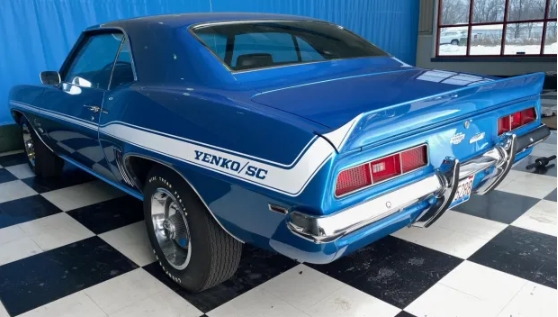
The most definitive and widely recognized Yenko Camaro came in 1969. Through the COPO system, which allowed dealers to request special performance equipment from Chevrolet’s factory, Yenko ordered Camaros with the L72 427 ci big-block V8 and a suite of performance enhancements already installed on the assembly line.
These included:
- COPO 9561: L72 427 ci engine (~425 hp).
- COPO 9737 “Sports Car Conversion” package: Additions such as power disc brakes, a larger stabilizer bar, upgraded suspension, and a 140 mph speedometer.
- Positraction 4.10 rear axle and heavy-duty cooling system.
Buyers could choose either a Muncie four-speed manual or a Turbo-Hydramatic 400 automatic transmission. Visual cues, including bold “Yenko 427” stripes and sYc (Yenko Super Car) headrest branding, completed the package.
In total, 201 Yenko SC Camaros were built in 1969, making them the most numerous of the first-generation Yenko Camaros. Approximately 171 were equipped with four-speed manuals and 30 with automatics.
.

.
Trim Levels & Variants: What Existed?
Unlike regular Chevrolet models — which might offer base, SS, Z/28, or other trims — the Yenko Camaro’s variants were defined primarily by performance specification rather than formal trim hierarchies. The key distinctions across the years include:
Yenko Super Camaro (1967)
- Based on SS models with dealer-installed L72 427 swaps.
- Performance enhancements: heavy-duty suspension, Positraction rear end, fiberglass hood.
- Rare and unofficial COPO arrangements.
Yenko Super Camaro (1968)
- Continued dealer conversions with L72 427 swaps.
- A few additional performance and aesthetic upgrades over ’67 models.
- Still primarily dealer-modified rather than factory COPO.
1969 Yenko SC (COPO) Camaro
- Factory-ordered 427 engines and performance gear via COPO.
- Two transmission options (manual or automatic).
- Upgraded brakes, suspension, cooling, and unique Yenko graphics.
There were no traditional “trim levels” like base or luxury versions — all Yenko Camaros were purpose-built for performance, with differences only in specific configurations or options such as transmission choice.
Later Yenko Camaros (Post-1969)
The original run of classic Yenko Camaros ended in 1969, but the story didn’t stop there:
1981 Yenko Turbo Z
While muscle cars had largely faded by the 1970s due to emissions and insurance pressures, Yenko returned in 1981 with the Turbo Z — a limited run of 19 performance-oriented Camaros based on the 1981 Z28 platform. These featured turbocharged engines and performance upgrades to combat the era’s more austere output levels.
2007 Continuation Series
In 2007, Classic Automotive Restoration Specialists in North Carolina restarted production of the 1969 Yenko Camaro, building licensed continuation models (starting with #202 and beyond). These cars matched the original specifications as closely as possible, using modern production methods and available components of the era.
2010 and Beyond
Yenko-branded Camaros made appearances at SEMA shows in 2009 and later, based on newer Camaro platforms. The 2010 Camaro received supercharged LS3 V8 power in the Phase I Yenko package, with later iterations (Phase II and Phase III) expected to include higher-output engines like the LS7 and LS9.
2016–2024 Specialty Vehicle Engineering Yenko/SC Camaros
From 2016 onward, Specialty Vehicle Engineering, Inc. (SVE) announced custom Yenko/SC Camaros based on modern Chevrolet platforms. These offered staged performance packages — including supercharged LT1 and LT4 engines with outputs ranging from roughly 750 hp to 1,500 hp in the highest Stage III builds by 2024.
These later Yenkos are not factory Chevrolet production cars, but they bear the Yenko/SC branding and carry forward the ethos of high-performance aftermarket Camaro enhancements.
Performance and Driving DNA
Across its iterations, the Yenko Camaro was built for sheer performance. The original big-block cars from the late 1960s, with their 427 ci engines, heavy-duty suspension, Positraction rear ends, and upgraded brakes were designed to be formidable on both road and strip.
Even the later Turbo Z and modern Yenko/SC Camaros reflect similar performance priorities, albeit through very different technological eras — turbocharging, advanced engine management, and forced induction combined with strengthened internals and cooling systems to achieve modern levels of performance.
Collector Value and Cultural Impact
Today, original Yenko Camaros — particularly the 1969 COPO SC models — are among the most prized American muscle cars. A prototype 1969 Yenko Camaro sold for a record $1.815 million at Mecum Auctions in January 2026, a testament to their rarity and desirability.
Collectors seek these cars not only for their performance but for their place in muscle car history: they represent a moment when dealer ingenuity and factory cooperation created a true street-legal supercar. Their value at auction and in private hands continues to ascend as surviving examples become ever more scarce.
Future Outlook
While original Yenko Camaro production dates back to a brief 1967–1969 span, the Yenko legacy continues in several forms:
- Continuation models keep the spirit of the 1969 shorts alive for enthusiasts who want the experience without the price tag of an original.
- Modern Yenko/SC performance packages on current Camaro platforms bring the name into the modern era with extraordinary power figures, including supercharged 1,500 hp variants.
- Collector interest and historical recognition ensure that the originals will remain treasured artifacts, studied and celebrated in automotive literature, museums, and shows.
Though Don Yenko’s original dealership closed decades ago, his influence permeates muscle car culture — the Yenko Camaro remains a benchmark of performance and a beloved symbol of an era when horsepower reigned supreme.
Conclusion
The Yenko Camaro is not just a car — it’s a legend. From its first dealer-built big-block conversions in 1967, through the classic COPO SC Camaros of 1969, and into later reinterpretations and homage builds, the Yenko name has been synonymous with ambitious performance and automotive passion. Though its original production life spanned only a few short years, its impact on muscle car history — and on the hearts of enthusiasts and collectors — is enduring and profound.