Callaway (Chevrolet) Camaro: The Evolution of an American Performance Icon
For more than three decades, Callaway Cars Inc. has carved out a unique place in the automotive world as one of the most respected independent performance engineering firms — best known for transforming Chevrolet vehicles into higher-performance machines with superb engineering, proprietary supercharger systems, and bespoke upgrades. While Callaway is perhaps most famous for its work on the Corvette, it has also applied its performance expertise to the Chevrolet Camaro on multiple occasions. This article traces the evolution of the Callaway Camaro, detailing its history, key models and packages, years offered, and its overall impact on the performance car landscape.
A Brief History of Callaway Cars
Callaway Cars Inc. was founded in 1977 by Reeves Callaway in Old Lyme, Connecticut, initially focusing on turbocharging European vehicles before expanding into American muscle cars and sports cars. Over time the company earned a reputation for high-quality performance upgrades, engineering rigor, and innovation — including becoming one of the few independent tuners whose modifications were factory-warranted and had official recognition from General Motors (GM) in certain cases. While Callaway’s Corvette programs are more widely documented and extensive, the Callaway Camaro represents an important chapter in the company’s broader performance legacy.
.

.
The First Generation: Callaway C8 SuperNatural Camaro (1994–1997)
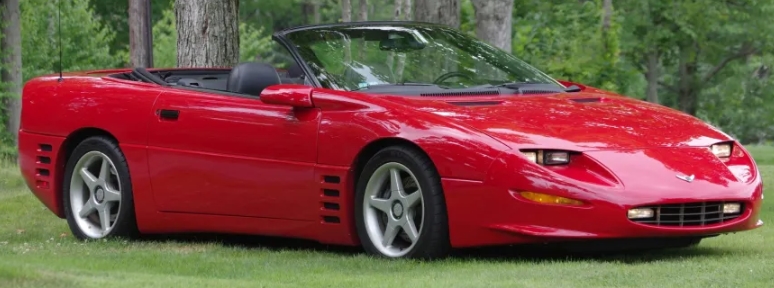
The earliest Callaway Camaro project — though technically predating the later “C18” designation that the company later used for its Camaro program — was the Callaway C8 SuperNatural variant of the fourth-generation Chevrolet Camaro (1993–2002).
Unlike later bolt-on supercharger packages, the C8 SuperNatural was a comprehensive modification that blended performance enhancements with significant bodywork and handling upgrades. Between 1994 and 1997, Callaway built approximately 18 examples of this rare custom model, each featuring:
- Enhanced LT1 V8 engine tuned to around 400 horsepower (with later upgrades to 425, 435, or 450 hp available)
- Suspension and brake upgrades for improved handling
- A distinctive CamAerobody aerodynamic body kit designed by Paul Deutschman, giving the car a more aggressive stance and improved high-speed stability
The SuperNatural Camaro was capable of roughly 170 mph, making it one of the fastest production-based Camaros of its era. These cars were largely bespoke, with few built and primarily offered to select customers wanting a truly unique performance machine.
Callaway Camaro C18 – The Modern Era (2009–Present)
As Chevrolet revived the Camaro nameplate in the mid-2000s with the fifth-generation Camaro (2010–2015), Callaway reintroduced its performance program for the Camaro — this time under the internal designation C18, referencing the Camaro project within the company’s broader lineup of engineered vehicles (with C17 representing Corvettes).
This modern Callaway Camaro program began in 2009 and continued into the present day, with a series of performance packages based on the modern F-body and later sixth-generation Camaro platforms.
Callaway SC572 and SC552 (Circa 2009–2011)
Callaway’s initial packages for the modern Camaro were designated by their approximate horsepower output:
- SC572 (manual) — a high-performance supercharged Camaro producing around 572 hp
- SC552 (automatic) — a similar package tuned for automatic transmissions at approximately 552 hp
These early offerings boosted power significantly over the factory Camaro SS’s output, enhancing acceleration and overall performance while incorporating Callaway’s signature air induction, supercharging systems, and engine calibration work.
Hendrick Motorsports 25th Anniversary Callaway Camaro (2010)
One notable special edition within the C18 era was the Callaway/Hendrick Motorsports 25th Anniversary Camaro SS, produced in 2010 to commemorate Hendrick Motorsports’ 25 years in NASCAR. Callaway was commissioned to build this limited edition — likely just 25 units — based on the Camaro SS with:
- Eaton TVS supercharger raising output to 582 hp
- Carbon fiber aerodynamic components, including front splitter, rear diffuser, and rocker panels
- Modified suspension with custom springs, shocks, and anti-roll bars
- Callaway badging and marketing graphics unique to the limited-run model
Performance figures included a reported 0-60 mph in 3.9 seconds and a quarter-mile elapsed time of 11.89 seconds at 120.1 mph — impressive figures at the time for a V8-powered muscle car.
SC582, SC562, and SC652 (2014–2015)
As the fifth-generation Camaro SS continued production through 2014 and 2015, Callaway refreshed its performance offerings:
- SC582 — a supercharged package for manual transmission Camaros with around 582 hp
- SC562 — a slightly detuned version for automatic transmission cars (~562 hp)
- SC652 — based on the Camaro Z/28, making the SC652 the most powerful Callaway Camaro to that point with approximately 652 hp
These packages maintained Callaway’s core philosophy: engineered supercharging with complementary hardware and tuning, all designed to improve performance while retaining drivability.
SC630 (2016)
With the advent of the sixth-generation Camaro (2016 onward), Callaway introduced the SC630 package — based on the standard Camaro SS with its naturally aspirated 6.2-liter V8 — boosting power to 630 horsepower while offering torque and performance levels competitive with the factory-built Camaro ZL1 from Chevrolet.
The SC630 package primarily used a proprietary supercharger and Callaway’s calibration expertise to drive power significantly higher than stock while maintaining factory-level drivability and reliability.
SC750 Camaro ZL1 (2017 – circa 2018)
One of the most potent Callaway Camaro builds of the modern era was the SC750, a package based on Chevrolet’s high-performance Camaro ZL1 platform. With this upgrade, Callaway engineers tuned the already supercharged LT4 V8 to around 750 horsepower and 739 lb-ft of torque, producing:
- 0-60 mph in about 3.2 seconds
- Quarter-mile times in the low 11-second range
The SC750 became, as of its introduction, the most powerful Callaway Camaro to date, showcasing the firm’s continued commitment to extracting high performance from Chevrolet’s muscle car platform.
Trim Levels and Package Details
Unlike Chevrolet’s factory trim hierarchy (such as Camaro LS, LT, SS, ZL1), the Callaway Camaro lineup is best understood as a series of performance packages or engineered variants rather than rigidly defined “trim levels.” Each package — identified by its approximate horsepower output — represents a combination of:
- Custom supercharging and induction systems, engineered and manufactured by Callaway
- Modified engine calibration and cooling systems
- Enhanced suspension components (often bespoke springs and shocks)
- Distinctive Callaway badging and branding
- Optional performance wheels and aesthetic upgrades
Some of the known packages and model designations over the years include:
- C8 SuperNatural (1994–1997) — bespoke fourth-generation Camaro upgrades (~400–450 hp)
- SC572 and SC552 (circa 2009–2011) — early modern era supercharged Camaros
- Hendrick Motorsports 25th Anniversary Edition (2010) — limited specialty model (~582 hp)
- SC582, SC562, SC652 (2014–2015) — refreshed fifth-generation performance packages
- SC630 (2016) — supercharged sixth-generation SS (~630 hp)
- SC750 (2017–approx. 2018) — high-power Camaro ZL1 upgrade (~750 hp)
These packages were typically available through select dealerships or directly through Callaway, often accompanied by authenticity documentation and a Callaway-specific build plate installed on the vehicle.
Significance and Enthusiast Appeal
The Callaway Camaro represents a unique performance cache among muscle car enthusiasts. Unlike many aftermarket tuners whose work remains purely bolt-on and unverified, Callaway’s engineering came with documentation, often dealer support, and a level of refinement that elevated these vehicles beyond simple “tuned Camaros.”
The rarity of early projects — such as the SuperNatural C8 variants or the limited Hendrick Motorsports 25th Anniversary editions — gives them collectible appeal. Later performance builds like the SC750 carry significance for pressing the limits of what a muscle car platform can achieve before venturing into territory typically reserved for exotic sports cars.
Future Outlook for the Callaway Camaro
The future of the Callaway Camaro program is intertwined with the evolution of the Camaro itself. With Chevrolet discontinuing the Camaro after the 2024 model year, traditional internal-combustion Camaros are reaching the end of their production run. This creates both challenges and opportunities for Callaway:
- Legacy and Collector Appeal: As production Camaros age and become more collectible, Callaway-enhanced models may appreciate in value due to rarity and performance heritage.
- Preservation and Restoration: Callaway could expand offerings in restoration, performance certification, and retrofitting for existing Camaro owners.
- Next-Gen Platforms: If Chevrolet — or another manufacturer — introduces new performance vehicles in the Camaro’s spirit, Callaway may adapt its engineering expertise to new platforms.
Overall, while the traditional Camaro is ending its production journey, the legacy of the Callaway Camaro — spanning rare early projects to high-power modern machines — remains an important chapter in American muscle car history.
Conclusion
From bespoke fourth-generation SuperNatural cars in the 1990s to limited anniversary editions and high-horsepower modern packages like the SC750, the Callaway Camaro embodies decades of performance engineering and innovation. Unlike factory trim levels, Callaway’s models are defined by their performance packages — each reflecting a unique moment in the evolution of the Camaro and the company’s approach to maximizing power and capability. As the Camaro era draws to a close, these meticulously engineered performance machines stand as a testament to Callaway’s commitment to high-performance excellence.