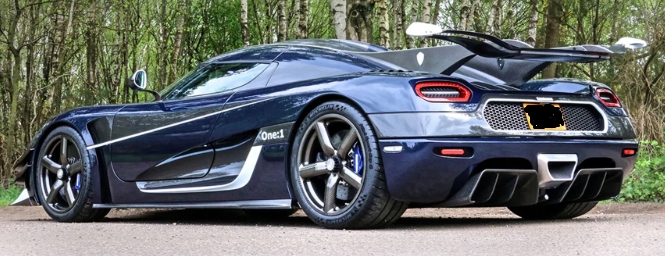
The Unicorn’s Horn: The Definitive History of the Koenigsegg One:1
In the pantheon of automotive history, few vehicles occupy a space as mythic as the Koenigsegg One:1. It was not merely a supercar; it was a physics experiment wrapped in carbon fiber, a machine that sought to shatter the very concept of performance limits. Produced for a fleeting moment between 2014 and 2015, the One:1 remains one of the most exclusive, powerful, and technologically significant vehicles ever created.
To understand the One:1, one must first understand the philosophy of its creator. Founded in 1994 by Christian von Koenigsegg, the Swedish boutique manufacturer operated on the mantra that “the impossible is just a word.” By the early 2010s, Koenigsegg had already established itself with the Agera, a hypercar capable of breaking speed records. However, the Agera R and S were still bound by the traditional metric of horsepower. The One:1 was designed to break that mold, introducing a new metric: the megacar.
The Concept: A Ratio of Perfection
Unveiled at the 2014 Geneva Motor Show, the One:1 derived its name from its revolutionary power-to-weight ratio. While most supercars of the era boasted power figures in the 500 to 700 horsepower range, the One:1 aimed for a 1:1 ratio of one megawatt of power to one metric tonne of weight.
The vehicle was built on the chassis of the Agera, but nearly every component was re-engineered. The result was a car producing 1,341 horsepower (1 megawatt) while weighing exactly 1,360 kilograms (dry). This ratio allowed the One:1 to theoretically accelerate from 0 to 400 km/h (249 mph) in roughly 20 seconds—a feat that took the legendary Bugatti Veyron nearly half a minute longer to achieve.
Production and Exclusivity
The production of the Koenigsegg One:1 began in 2014 and concluded in 2015. In a deliberate move to maintain exclusivity and bespoke craftsmanship, Koenigsegg produced only six examples. All six were sold before the car was publicly unveiled, a testament to the brand’s reputation and the allure of the megacar concept.
Because all six units were sold as “customer cars” (meaning they were commissioned by private owners rather than kept by the factory as prototypes), each vehicle is unique. While the mechanical specifications remain identical, the liveries, interior trims, and carbon fiber weaves vary significantly based on the owner’s preferences. This makes cataloging specific “trim levels” difficult, as Koenigsegg does not use traditional trim designations (like “Luxury” or “Sport”). Instead, the “trim” is defined by the bespoke commission of the chassis.
However, the six chassis numbers are distinct in the Koenigsegg registry:
- Chassis 7050: The original Geneva Motor Show car, finished in a striking blue and white carbon fiber.
- Chassis 7051: Often referred to as the “Grey” car, featuring exposed carbon fiber with silver accents.
- Chassis 7052: Finished in a unique matte black and silver configuration.
- Chassis 7053: Known for its vibrant orange and black carbon finish.
- Chassis 7054: A stunning example featuring a blue and black exposed carbon weave.
- Chassis 7055: The final production unit, often displayed at events, showcasing a sophisticated dark blue finish.
Engineering Marvels
The One:1 was not just about raw power; it was a showcase of Swedish engineering prowess. The heart of the beast was the 5.0-liter twin-turbocharged V8 engine. Unlike the Agera’s engine, the One:1’s powerplant utilized a unique carbon fiber air intake system and a 3D-printed titanium exhaust end can, which was lighter and stronger than traditional materials.
Aerodynamics played a crucial role. The One:1 featured active aerodynamics, including a top-mounted air scoop and a massive rear wing that adjusted automatically based on speed and driving mode. The car generated up to 600 kg of downforce at 160 km/h, effectively clamping the car to the road.
Furthermore, the One:1 was the first Koenigsegg to utilize 3D-printed components for structural parts, a technology that was in its infancy at the time but is now becoming standard in high-performance manufacturing.
.

.
The Track-Focused “XP” Prototypes
While the six production cars were road-legal, Koenigsegg developed several prototypes (designated as XP cars) to test the limits of the platform. The most famous of these is the One:1 XP (sometimes referred to as the “Blue Test Car”).
Although these prototypes were not sold to the public, they are integral to the One:1’s history. They were used to shatter records at various tracks, including the Nürburgring Nordschleife. In 2014, the One:1 XP became the first car to break the 7-minute barrier at the Ring with a verified time of 6:44, a record that stood until the arrival of the Lamborghini Aventador SVJ years later. These XP cars, finished in bright blue with yellow accents, represent the “unrestricted” version of the One:1, lacking the road-legal constraints of the customer cars.
Performance Legacy
The One:1’s performance figures remain staggering even by today’s standards. With a top speed exceeding 273 mph (440 km/h), it was the first homologated production car to achieve a megawatt of power. The acceleration is violent; the car can reach 0-100 km/h in 2.8 seconds, 0-200 km/h in 6.6 seconds, and 0-300 km/h in 11.9 seconds.
The braking performance was equally impressive, utilizing Koenigsegg’s Aircore carbon fiber wheels—hollow, lightweight rims that reduced unsprung mass and improved handling dynamics.
Current Status and Future Outlook
As of today, the Koenigsegg One:1 is a sold-out commodity. With only six units in existence, the vehicle has become a “unicorn”—a car that is virtually impossible to acquire. When one does occasionally surface at auction, it commands astronomical prices, often exceeding $5 to $6 million, far above its original production cost.
The future of the One:1 is one of preservation. Unlike the Agera RS, which saw a second production run and various evolution kits, the One:1 remains a static chapter in Koenigsegg’s history. It is unlikely that Koenigsegg will produce another “One:1” in the exact same form, as the industry is shifting toward hybridization and electrification rather than raw, internal combustion megapower.
However, the legacy of the One:1 lives on in the Jesko, Koenigsegg’s current flagship. The Jesko Absolut and Jesko Attack owe their aerodynamic philosophies and carbon fiber construction techniques to the groundwork laid by the One:1. The One:1 proved that a car could be both a track weapon and a record-breaking speed machine, a duality that defines the modern Koenigsegg brand.
Conclusion
The Koenigsegg One:1 is more than a car; it is a monument to the pinnacle of internal combustion engineering. Produced for only two years and limited to six units, it represents a brief, brilliant flash of automotive insanity. It bridged the gap between the Agera era and the hypercars of the future, proving that with enough determination, carbon fiber, and Swedish ingenuity, the 1:1 ratio was not just a dream, but a reality. For the lucky few who own one, and for the enthusiasts who gaze upon them in museums, the One:1 remains the ultimate expression of speed.