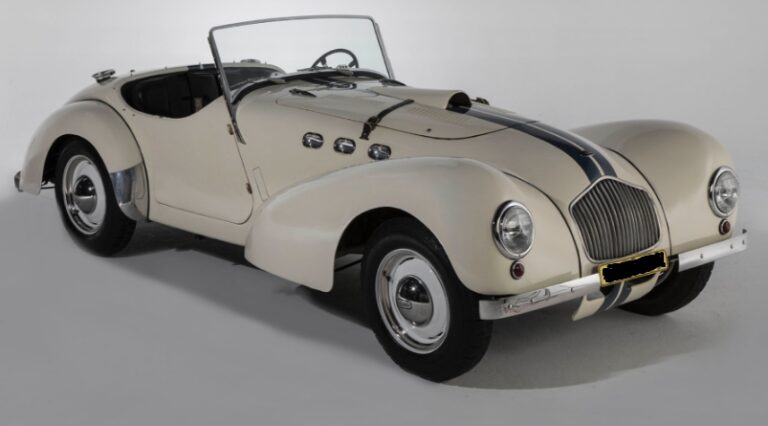
Allard P1: The Birth of a British Sporty Executive Saloon
The Allard P1 occupies a unique place in British automotive history as the first true saloon car produced by the Allard Motor Company, a marque better known for its rugged sports racers and distinctive mix of British engineering with American V-8 power. In production from the late 1940s into the early 1950s, the P1 blended performance, style, and practicality in a way that helped define post-war British automotive ingenuity. This article explores the evolution, variants, production details, history, and legacy of the Allard P1 — a car that, despite its limited production, made a lasting mark on the classic car world.
A Post-War Pioneer: Origins of the Allard P1
Founded by Sydney Herbert Allard in 1945, the Allard Motor Company was a small-volume British manufacturer that quickly gained a reputation for creative and spirited vehicles. Allard’s cars combined lightweight British chassis with robust and easy-to-service American V-8 engines — an approach that delivered strong performance with broad appeal, especially in export markets such as the United States.
Before the P1, Allard’s lineup was largely dominated by open-top sports cars and touring vehicles, including the popular M and L types. However, by the late 1940s the company saw an opportunity to build a sporty fixed-head saloon that could attract owners seeking a blend of performance, comfort, and everyday usability. The result was the Allard P1, often marketed simply as the Allard 3.6-litre Saloon — named for its standard engine displacement.
Production and Years of Manufacture (1949–1952)
The Allard P1 was produced from 1949 until 1952, with approximately 559 units built during that period. This relatively modest production makes the P1 a rare and highly collectible classic today. While some sources cite production extending into 1953, most authoritative records — including marque registries — confirm the core manufacturing years as 1949 to 1952.
The P1 was soon succeeded by its successor, the Allard P2, which carried forward the P1’s DNA while refining various design and mechanical elements.
.

.
Design, Engineering, and Specifications
Unlike many British saloons of its era, the Allard P1 was distinctive in both appearance and engineering. Built on a robust chassis with a 112-inch wheelbase, the P1 featured a two-door, five-seat body that combined elegant lines with a purposeful sporting stance.
Under the hood, the standard P1 was fitted with a 3.6-litre Ford side-valve V-8 engine — the Ford “Pilot” flathead — producing around 85 hp. This was paired with a three-speed manual transmission sourced from Ford, allowing for straightforward maintenance and compatibility with parts availability, particularly important for export markets like North America.
The P1 employed a divided front axle with coil springs and a live rear axle with a transverse leaf spring, an arrangement that balanced ride comfort with capable road manners for the time. Steering was handled via Marles gear, and braking was by drum on all four corners — typical of the period.
The body construction used a mix of materials, with lightweight aluminum panels over a sturdy frame, reflecting Allard’s dual focus on performance and durability.
Models and Trim Levels
Unlike modern cars, the Allard P1 did not have extensive trim levels in the way contemporary buyers would recognize — there were no distinct factory-defined “Deluxe,” “Sport,” or “Standard” trims with differing features. Instead, the P1’s variants were principally defined by different engine options and aftermarket enhancements that owners could commission.
1. Standard 3.6-Litre Ford V-8 Saloon
- Engine: 3.6 L Ford side-valve V-8
- Transmission: Three-speed manual
- Body Style: 2-door, 5-seat saloon
- Production: Majority of P1 units
The standard P1 provided a combination of accessible power and robust engineering. Its Ford V-8 ensured strong torque and reliability — key considerations for buyers and rally entrants alike.
2. Competition / Mercury V-8 Enhanced Versions
Some P1s were fitted with a larger 4.4-litre Mercury V-8, often referred to as a Competition Series engine, producing around 115 hp and providing markedly improved performance.
While these larger engines were less common than the Ford unit, they were popular with buyers who wanted stronger acceleration and higher top speeds, especially when planning to compete in events or rallies. Upgraded carburetors, aftermarket manifolds, and other performance parts — such as those from Edelbrock or Edmunds — were sometimes specified as further enhancements.
A Rally Triumph: Monte Carlo 1952
One of the P1’s most enduring claims to fame came in 1952, when Sydney Allard himself, alongside co-driver Guy Warburton and navigator Tom Lush, won the Monte Carlo Rally behind the wheel of a P1. This victory remains a unique achievement, as it marked the only time in the event’s history that a manufacturer’s founder drove his own car to overall victory.
The triumph showcased the P1’s durability, strong torque, and all-weather capability — qualities that helped dispel any notion that the car was merely a stylish saloon and underscored its genuine performance credentials.
Production Numbers and Survivors
Although exact production figures vary slightly between sources, most authoritative registries and historical accounts align around approximately 559 P1s built worldwide. Given that Allard production totals were finely recorded by enthusiasts and the company itself, this figure is generally accepted by classic car historians.
Today, an estimated fewer than 50 P1s survive, making them rare and valuable pieces for collectors. The scarcity of original examples adds to their desirability, particularly for cars with documented history and major events like the Monte Carlo victory attached to them.
Market Reception and Driving Experience
When new, the P1 was positioned as a distinctive alternative to more mainstream executive saloons of the late 1940s and early 1950s. It attracted buyers who appreciated spirited performance and the allure of American V-8 muscle within a refined British body.
Period road tests highlighted the P1’s respectable performance — with top speeds around 84–85 mph and 0-60 mph times in the low 20-second range — figures that were competitive with many contemporaries. While not a sports car in the purest sense, its blend of torque, handling, and everyday comfort made it an appealing choice for enthusiastic drivers looking for versatility.
Legacy and Collectibility
The Allard P1’s legacy rests on its unique place in automotive history as both a rally-winning machine and an early example of Anglo-American performance synergy. Its win at the 1952 Monte Carlo Rally and its distinctive engineering have ensured that it remains a highly regarded classic.
Collectors prize the P1 for its rarity, compelling history, and the authenticity of its design. Well-restored examples regularly surface at classic car auctions and prestigious concours events, where they draw interest for both their performance pedigree and charming period character.
Future Outlook
Looking forward, the Allard P1’s value and recognition within the classic car world are likely to continue growing. As interest in historically significant British cars increases, and as rally heritage becomes more appreciated by enthusiasts, models like the P1 — with documented victories and limited production — are especially well positioned to attract collectors.
Restoration and preservation efforts are central to keeping the P1’s legacy alive. With relatively simple mechanicals and strong enthusiast support, these cars are accessible to dedicated restorers and clubs. As more P1s are carefully restored and showcased, their profile in the classic car world will only rise further.
Conclusion
The Allard P1 stands as a fascinating chapter in post-war British automotive history. Produced from 1949 to 1952, the P1 combined American V-8 power with British craftsmanship in a two-door, five-seat saloon that was both capable and charismatic. With around 559 built and only a fraction surviving today, this model represents rarity, performance, and historic significance — epitomized by its 1952 Monte Carlo Rally victory under Sydney Allard’s command. As a collectible classic with a rich heritage, the Allard P1 remains a compelling symbol of the innovative spirit that defined its era.