Edsel Villager: The Rise, Life, and Legacy of a Classic American Station Wagon
The Edsel Villager stands as one of the most intriguing and enduring chapters in American automotive history. Produced for only three model years — 1958, 1959, and 1960 — the Villager was the sole station wagon model to survive the entire lifespan of the Edsel brand and represents a unique blend of mid-century design ambition, corporate strategic missteps, and automotive collectibility. This article explores the Villager’s evolution, its models and trim offerings, what made it distinctive, and how its name lived on after Edsel’s demise.
Origins: The Edsel Brand and the Need for a Wagon
Launched by Ford Motor Company as a separate division, Edsel was introduced with great fanfare in the 1958 model year. It was intended to fill a perceived gap between Ford’s mainstream offerings and Mercury’s more upscale products, combining unique styling with advanced features. However, the marque’s debut was poorly timed — coinciding with an economic downturn and a marketplace lukewarm to its controversial styling, particularly the vertical grille and unusual design cues.
From the outset, Edsel’s lineup included a range of sedans, hardtops, convertibles, and station wagons. Among these, the Edsel Villager was introduced as the mid-range four-door station wagon, positioned between the basic Edsel Roundup and the premium Edsel Bermuda in terms of trim and amenities.
.

.
1958: Villager Debuts — Features and Trim
For the 1958 model year, Edsel launched three distinct station wagons:
- Edsel Roundup – Base 2-door wagon
- Edsel Villager – Mid-range 4-door wagon
- Edsel Bermuda – Premium 4-door wagon
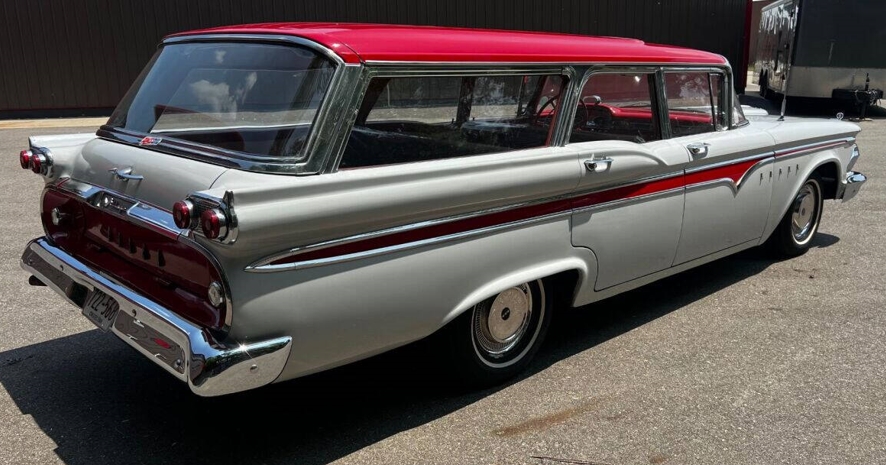
The Villager was the only one of the three to be offered in both six-passenger and nine-passenger configurations, providing flexibility for families and commercial buyers alike. All three shared the 116-inch wheelbase and much of their body stampings with Ford’s station wagons, specifically the Ford Country Sedan. However, to visually set Edsel wagons apart from their Ford counterparts, designers gave them unique front fascias and distinct taillight treatments.
Trim and Features (1958)
As a mid-trim offering, the 1958 Villager came equipped with a solid suite of standard features including:
- Rubber floor mats
- Armrests and ashtrays
- Chromed rear-view mirror
- Crank-operated rear windows
- Two-piece tailgate
- Optional seat belts
Under the hood, all Edsel wagons of 1958 were powered by a 361 cubic-inch V8 engine, producing robust performance for the era. Transmission choices included a three-speed manual, a three-speed automatic, and — for 1958 only — Edsel’s innovative but trouble-prone Teletouch automatic, which positioned drive-selection buttons in the center of the steering wheel.
While Roundup and Bermuda were aimed at the lower and higher ends of the sheet respectively, the Villager served as a practical and family-oriented choice — and in its first year, Villagers outsold the combined total of Roundup and Bermuda wagons, indicating reasonable market acceptance.
1959: Facelift and Station Wagon Consolidation
By 1959, Edsel’s woes had begun to mount. Sales of the marque overall slid, and the company made the strategic decision to discontinue both the Roundup and the Bermuda, leaving the Villager as the lone station wagon offering for the brand.
While the general wagon body remained similar to the previous year, several key design revisions were made:
- The “horsecollar” grille was toned down and better integrated into the front end
- The original boomerang-shaped taillights — which notoriously caused confusion when used as turn signals — were replaced with a set of four round taillamps and two reverse lamps
- Vestigial rear fins with a more subdued appearance
- The Teletouch system was dropped entirely, replaced by a conventional column-mounted automatic shifter
Mechanically, the Villager was largely carried over from the prior year, still offering a V8 engine and manual or automatic transmissions. In 1959 a total of 7,820 Villagers were built, with 5,687 six-passenger and 2,133 nine-passenger variants. Interestingly, this single model’s output exceeded the combined station wagon production of all three Edsel wagon lines from 1958, despite overall brand sales decline.
1960: Final Year and Near-End of an Era
By the time the 1960 model year arrived, Edsel was a leaner — and deeply troubled — marque. The brand was effectively cut back to just two offerings: Ranger passenger cars and the Villager station wagon.
For 1960, the Villager underwent more extensive changes than in 1959. These included:
- A shift to an “hourglass” grille, eliminating the legendary Edsel horsecollar entirely
- New four vertical oval taillights for both Ranger and Villager models
- A longer wheelbase — now at 120 inches, aligning with Edsel Ranger sedans rather than the Ford Country Sedan platform
Perhaps most importantly, the powertrain lineup was diversified:
- A 223 cubic-inch inline-6 engine was offered as the entry option
- A 292 cubic-inch V8 became the standard engine
- A 352 cubic-inch V8 was available as an optional upgrade
- Manual transmissions were paired with the inline-6 and 292 V8, while automatic options were offered with all three engine choices
Despite these updates, the 1960 model year was disastrous for Villager production. Due to Edsel’s abrupt discontinuation and final assembly shutdown in November 1959, only 275 Villagers were built for 1960 — 216 six-passenger and 59 nine-passenger units. The 59 nine-passenger models remain among the rarest of all Edsel station wagons ever produced.
Trim Levels and Configurations Summarized
Across its three-year lifespan, the Edsel Villager’s available configurations and trim offerings can be summarized as follows:
| Model Year | Body Style | Seating | Notable Features |
|---|---|---|---|
| 1958 | 4-door station wagon | 6 or 9 passengers | Mid-trim wagon; rubber mats, ashtrays, two-piece tailgate, optional seat belts; Teletouch available |
| 1959 | 4-door station wagon | 6 or 9 passengers | Only wagon in Edsel line; revised grille and taillights; conventional automatic |
| 1960 | 4-door station wagon | 6 or 9 passengers | Redesigned front end; additional engine options; longest wheelbase; extremely limited production |
Why the Villager Matters
Although Edsel is often remembered as a commercial failure, the Villager holds a unique place in automotive culture for several reasons:
- It was one of only two Edsel models (along with the Ranger) to be produced throughout the brand’s entire existence.
- Its availability in multiple passenger configurations made it versatile in an era when station wagons were growing in popularity as family vehicles.
- The model’s rarity, especially the 1960 Villager, makes it desirable among classic car collectors and enthusiasts.
Collectors often highlight the Villager’s distinctive styling and relative rarity. Cars offered at classic auctions can command notable prices, especially for well-preserved or restored examples with original drivetrain components.
After Edsel: The Villager Name Lives On
Although the Edsel brand was discontinued after the 1960 model year, the Villager name did not disappear. Within the Ford Motor Company, the nameplate was revived by Mercury in 1962 as part of the Mercury Comet Villager wood-trim station wagon. Over the next two decades, Mercury would apply the Villager name to a variety of wood-trim wagons, including versions of the Montego, Bobcat, Cougar, Zephyr, and Lynx.
In the early 1990s, the Villager name returned yet again — this time as a standalone model in collaboration with Nissan, producing a compact minivan counterpart to the Nissan Quest. While entirely unrelated to the original Edsel station wagon in design or purpose, this modern Villager carried forward the name into a new vehicle class.
Legacy and Future Outlook
Today, the Edsel Villager represents a fascinating footnote in automotive history — a model born from ambition, challenged by timing and market forces, yet ultimately enduring through its rarity and distinctive design. Classic car enthusiasts value the Villager not only as a collectible but as a reminder of a bold period in American automotive design.
While no new Edsel-branded vehicles are planned, the continued use of the Villager nameplate in various Ford and Mercury products reflects its enduring appeal. Older Villagers, especially low-production models like the 1960 nine-passenger wagons, are sought after at auctions and collector events. Their rarity, combined with nostalgia for 1950s and 1960s Americana, ensures that the Villager will continue to be remembered — not just as part of a failed brand, but as a distinctive piece of automotive history.
In the broader story of the American station wagon, the Edsel Villager remains a testament to postwar optimism and the challenges of automotive marketing. It stands today not just as a rare classic, but as a symbol of what could have been — a landmark in design that continues to captivate enthusiasts and historians alike.