Evolution of The TVR Tuscan
The TVR Tuscan is one of the most distinctive British sports cars of the late 20th and early 21st centuries — a raw, driver‑focused machine with striking design, a potent straight‑six engine, and a passionate following among enthusiasts. Produced primarily between 1999 and 2006, the Tuscan revived a historic TVR name while introducing modern engineering and performance attributes typical of the marque’s final era before its 2006 closure. This article traces the evolution of the TVR Tuscan, detailing its models, trim levels, production history, technical specifications, racing connections, and outlook.
A Brief History of the Tuscan Name
The Tuscan name is rooted in TVR’s early history. The original TVR Tuscan was built from 1967 to 1971, offered with either a Ford V8 or Essex V6 and produced in limited numbers. That car’s blend of performance and exclusivity laid the foundation for the use of the name again decades later.
In the late 1990s, TVR — under independent ownership and following models like the Griffith and Cerbera — looked to reinvigorate its lineup with a more contemporary sports car. Thus the TVR Tuscan Speed Six was introduced, directly leveraging the brand’s in‑house Speed Six engine and performance ethos.
Production and General Overview (1999–2006)
The modern TVR Tuscan was produced from 1999 until 2006, with approximately 1,677 units built during its production lifespan. Manufactured at TVR’s Blackpool, England factory, it was positioned as a pure driver’s car — powerful, lightweight, and intentionally devoid of electronic driving aids such as ABS or traction control, in keeping with TVR’s philosophy that such technologies detracted from the driving experience.
During its life, the Tuscan underwent minor design updates, powertrain refinements, and the introduction of convertibles and uprated variants, but never saw a complete generational reset. All models shared the same basic layout: front‑mid mounted engine, rear‑wheel drive, fiberglass bodywork over a tubular steel chassis, and a close‑ratio 5‑speed manual transmission.
.

.
Engine and Performance
What set the Tuscan apart from many competitors was its use of the TVR Speed Six engine — a 24‑valve, DOHC inline‑six designed and built by TVR — in various displacements and power outputs over the years.
Speed Six Engine Variants
Different versions of the Speed Six engine were used in the Tuscan, including:
- A 3.6‑litre version producing around 350–360 hp, sometimes used early in the model’s life.
- A range of 4.0‑litre versions with outputs generally from around 360 hp to 400 hp depending on tuning and year.
- A 4.2‑litre T440R variant appeared on limited or racing‑focused versions yielding even higher power.
These engines delivered performance figures that placed the Tuscan among serious sports cars of its era. For example, earlier Tuscans with the 4.0 L engine could sprint from 0‑60 mph in around 4 seconds, with top speeds well in excess of 180 mph — impressive for a naturally aspirated six‑cylinder sports car without driver aids.
Models and Trim Levels
Unlike typical “trim levels” in mass‑market cars, the TVR Tuscan’s variants were defined largely by engine tuning and specification packages. Over its life, several key versions were offered:
1. Tuscan (Base / Standard)
Produced from the model’s inception, the standard Tuscan was available as a coupe/targa‑top sports car with either the base 3.6 L or 4.0 L straight‑six engine. This model balanced raw performance with TVR’s traditional analog driving character, lacking modern electronic stability aids.
2. Tuscan Speed Six
The “Speed Six” designation was sometimes used interchangeably with the base Tuscan, denoting the use of the Speed Six engine. Early 3.6 L models typically produced power similar to the lower‑tuned 4.0 L variants, around 350–360 hp.
3. Tuscan Red Rose
An option or upgrade offered in some model years, the Red Rose pack boosted power and included performance‑oriented chassis upgrades and a better braking system. This package was particularly aimed at buyers looking for track‑ready capability.
4. Tuscan S
The Tuscan S was the higher‑performance and better‑equipped variant, typically featuring a more highly tuned 4.0 L engine producing around 390–400 hp, along with aerodynamic enhancements like a small rear spoiler and undertray to improve downforce. The S model was positioned toward enthusiasts seeking the most extreme performance from the Tuscan platform.
5. Mk II and Convertible (2005–2006)
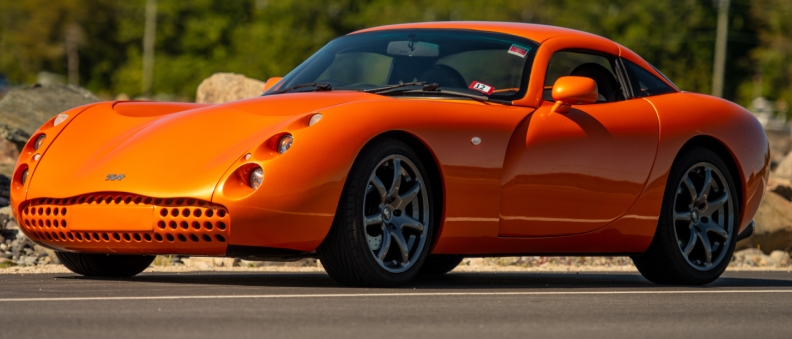
In 2005, TVR introduced a mild facelift — often referred to retrospectively as the Mk II — which included cosmetic updates such as redesigned headlights and taillights, a revised interior layout, and minor suspension tweaks aimed at improving handling and road manners. This update coincided with the introduction of a convertible variant, broadening the Tuscan’s appeal to open‑top driving enthusiasts. Both standard and S trim levels were offered in Mk II form, and some Mk II Tuscans included a mix of updated tuning and enhanced ergonomics.
6. T440R and Racing‑Derived Variants
TVR developed race‑oriented derivatives such as the T400R/TuscanR platform based heavily on the Tuscan’s chassis and engine architecture for competition use — including entries at events like the 24 Hours of Le Mans. While these were typically not sold as road cars under the Tuscan badge, they influenced performance perception and highlighted the platform’s versatility.
Design and Engineering
Visually, the Tuscan featured sharply sculpted front and rear fenders, an aggressive nose, and a low‑slung profile typical of TVR’s design language. The Mk II facelift refined some of these elements to improve aesthetics and usability.
Its mechanical architecture centered on a lightweight tubular steel chassis and fiberglass body panels, keeping weight generally around 1,100 kg (approx. 2,425 lbs) depending on specific variant and equipment. Suspension employed double wishbone setups front and rear, contributing to the agile, sometimes challenging handling that purists embraced.
Within the cabin, materials ranged from minimalist sports‑oriented trim to leather and polished metal surfaces, depending on customer specification — TVR typically allowed buyers to tailor interiors during ordering. Like other TVRs, the Tuscan lacked many modern driver aids, reinforcing its analog, engaging driving experience.
Performance and Driving Experience
The Tuscan’s performance was defined by its high‑revving naturally aspirated engine, rear‑wheel drive layout, and low weight. Even base models with around 350 hp could reach 0‑60 mph in approximately 4.2 seconds and top speeds around 180 mph, while S variants edged closer to 190 mph. The absence of electronic aids meant that mastering launch control, throttle modulation, and chassis control was firmly the driver’s responsibility — a trait that endeared the Tuscan to enthusiasts while intimidating less experienced drivers.
Motorsport and Special Versions
Although the Tuscan was primarily a road car, TVR also developed race‑ready derivatives. The T400R, sometimes linked to the Tuscan lineage, campaigned at endurance events including the 24 Hours of Le Mans in the early 2000s (e.g., 2003 and 2004), showcasing the Speed Six engine’s durability and TVR’s engineering prowess.
Production Timeline and Context
While TVR officially lists manufacturing from 1999 to 2006, many early Tuscans were not delivered until around 2000 as production ramped up following their debut at the 1998 Motor Show and extensive development.
Throughout its production life, the Tuscan remained a niche product: low volume, hand‑built, and specialized. Its production continued until TVR’s factory closure in 2006 under the ownership of Nikolai Smolenski, who reportedly oversaw some of the best‑built examples prior to closure.
Overall production figures for the Tuscan cluster around 1,677 units, a modest number that contributes to its collectibility today.
Cultural Impact and Enthusiast Appeal
The TVR Tuscan has secured a cult classic status among sports car aficionados. Its combination of bold styling, high‑revving straight‑six performance, and lack of electronic driver aids make it a pure driver’s car — akin to the Dodge Viper in ethos for many enthusiasts, albeit with a distinctly British character.
The Tuscan also gained visibility in popular culture, including an appearance in the film “Swordfish” (though this is more anecdotal from enthusiast sources), helping cement its image among U.S. audiences even where official imports were rare due to regulatory and homologation challenges.
Future Outlook and Legacy
Since TVR’s closure in 2006, the Tuscan — like other TVR models of that era — has garnered increasing collector interest. Well‑preserved examples, particularly rarer S and Mk II variants, command appreciation among enthusiasts who value analog performance and classic British sports car character.
There have also been occasional discussions in enthusiast communities and collector circles about what a modern TVR Tuscan revival might look like, especially as TVR itself has been resurrected under new ownership with contemporary models such as the Griffith revival project. However, as with many niche classics, any formal resurrection of the Tuscan name would likely depend on market demand, regulatory realities, and TVR’s strategic direction.
The TVR Tuscan stands as a testament to a distinct chapter in British automotive history — a period when TVR offered raw, unfiltered performance with a focus on driver engagement rather than electronic safety nets or mainstream refinement. Produced from 1999 to 2006 with multiple variants including standard, Red Rose, S, and Mk II models, the Tuscan showcased the capabilities of the Speed Six engine and TVR’s engineering philosophy. Though low‑volume and specialist by nature, its bold styling, strong performance, and analog purity have ensured that the Tuscan remains an enduring icon among sports car enthusiasts worldwide.