Examining The History of The Daihatsu Tanto
Of the myriad automotive classifications that exist globally, few are as specific, as regulated, and as ingeniously designed as Japan’s kei jidōsha, or “light automobile.” Born from post-war necessity, the kei car category is a masterclass in spatial efficiency, a rolling testament to the philosophy of doing more with less. Within this highly competitive segment, one name stands as a giant of ingenuity and practicality: the Daihatsu Tanto. More than just a car, the Tanto is a solution—a thoughtfully engineered response to the challenges of urban life, family needs, and an aging population. This is its story.
A Brief History: The Birth of a “Super Height Wagon”
Before the Tanto arrived in 2003, the kei car landscape was already dominated by “tall wagon” models like the Suzuki Wagon R, which revolutionized the class by prioritizing vertical space. Daihatsu, a long-established specialist in small vehicles and a subsidiary of Toyota, saw an opportunity not just to compete, but to redefine the segment. Their concept was simple yet ambitious: to create a vehicle with the absolute maximum interior volume possible within the strict kei car dimensional limits (3.4m length, 1.48m width, 2.0m height) and a 660cc engine displacement cap.
The name “Tanto” was chosen from the Italian word for “a lot” or “much,” a fitting descriptor for the cavernous interior they aimed to create. The result was a vehicle that looked like a cube on wheels, but whose unassuming exterior hid a world of practicality that would make it one of Japan’s best-selling vehicles for two decades.
First Generation (L350S/L360S): 2003 – 2007
Launched in November 2003, the first-generation Tanto immediately established its core identity. Its design was friendly and approachable, with a short nose and an incredibly tall, upright cabin. The focus was on a low, flat floor and a high roofline, creating a “living room on wheels” feel. The rear seats could slide, recline, and fold flat, offering a level of versatility previously unseen in such a small package. While it lacked the revolutionary feature of its successor, its sheer practicality won it a loyal following.
Key Models and Trim Levels:
- The model codes L350S denoted the front-wheel-drive (FF) versions, while L360S designated the four-wheel-drive (4WD) models, a common offering in Japan for snowy regions.
- L: The base model, offering the essentials. It typically came with steel wheels and basic interior amenities.
- X: A step-up, adding features like full wheel covers, power windows, and upgraded upholstery.
- X Limited: A popular mid-range trim that bundled desirable features like air conditioning, keyless entry, and better interior trim.
- R: This trim level introduced the 660cc 3-cylinder turbocharged engine, providing a much-needed boost in performance for highway driving and hilly terrain.
- RS: The sportiest model, combining the turbocharged engine with cosmetic enhancements like alloy wheels, a small roof spoiler, and a more aggressive front bumper design.
Second Generation (L375S/L385S): 2007 – 2013
If the first generation established the Tanto, the second, launched in December 2007, cemented its legendary status. This was the generation that introduced the Tanto’s single most iconic feature: the Miracle Open Door.
Daihatsu’s engineers achieved a remarkable feat by removing the B-pillar on the passenger (left) side of the vehicle. The front passenger door opened conventionally, while the rear passenger door was a power slider. When both were open, they revealed a massive, 1,480mm wide, unobstructed aperture. This innovation transformed the vehicle’s utility. Parents could easily install child seats or help toddlers climb in without contorting themselves. It provided effortless access for elderly passengers or those with mobility challenges. The B-pillar’s structural rigidity was ingeniously integrated into the front and sliding doors themselves, ensuring the vehicle met stringent safety standards.
.
NO MORE dead batteries with this:

.
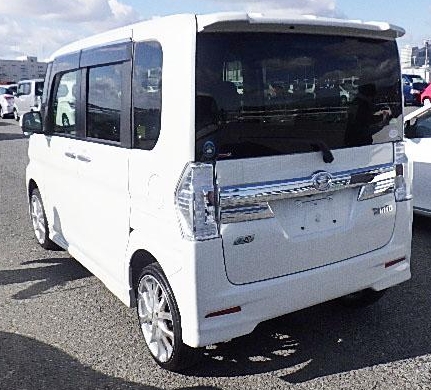
This generation also saw the introduction of a distinct sub-model: the Tanto Custom. While the standard Tanto retained its friendly, approachable look, the Custom was designed for a younger, more style-conscious buyer. It featured a large, chrome-heavy grille, sharp, angular headlights, clear “Euro” style taillights, and a more aggressive body kit.
Key Models and Trim Levels:
- Tanto (Standard):
- L: Base model.
- X: The volume seller, with more comfort features.
- X Limited: Added features like the left-side power sliding door.
- G / G Special: The top-tier non-turbo model, often including both power sliding doors and automatic air conditioning.
- Tanto Custom:
- Custom L: The entry point to the more stylish Custom line.
- Custom X: A well-equipped model with many standard features.
- Custom RS: The flagship, combining the turbocharged engine with all the top-line cosmetic and convenience features, including 15-inch alloy wheels.
A spin-off model, the Tanto Exe (2009-2014), was also introduced. It used the Tanto platform but featured conventional, pillar-equipped doors and a slightly lower roofline, targeting customers who wanted the Tanto’s efficiency but preferred a more traditional car design.
Third Generation (LA600S/LA610S): 2013 – 2019
The third generation, released in October 2013, was an exercise in refinement. The Miracle Open Door was a proven success, so Daihatsu focused on improving fuel economy, safety, and convenience. The most significant advancement was the integration of “Smart Assist” (SA), Daihatsu’s suite of active safety technologies. Early versions included low-speed collision mitigation braking and forward-start prevention, with later updates (SA II and SA III) adding features like lane departure warning and pedestrian detection.
Convenience was enhanced by making the passenger-side power sliding door standard on most trims and offering a driver’s side power slider as an option. The powertrain was refined for better fuel efficiency, aided by Daihatsu’s “eco-IDLE” auto stop-start system. The exterior design was an evolution of the previous generation, with both the standard and Custom models receiving sharper lines and more modern detailing.
Key Models and Trim Levels:
- Trims largely followed the previous generation’s structure, but with the “SA” designation becoming a key differentiator. A model might be an “X,” but the “X ‘SA'” or “X ‘SA II'” would be the more desirable version with the safety package.
- Tanto (Standard): L, X, G (and their “SA” variants).
- Tanto Custom: X, RS (and their “SA” variants). The RS “Top Edition SA” became the ultimate expression of the Tanto, loaded with every available feature.
Fourth Generation (LA650S/LA660S): 2019 – Present
The current generation of the Tanto, launched in July 2019, represents the most significant platform change in the model’s history. It is built on the Daihatsu New Global Architecture (DNGA), a modular platform (akin to Toyota’s TNGA) that provides a stiffer, lighter chassis. This results in a discernibly improved ride, handling, and crash safety performance.
The headline innovation for this generation is the “Miracle Walk-Through Package.” This includes the world’s first driver’s seat with up to 540mm of forward-backward sliding range. A driver can park, engage the parking brake, and then slide their seat all the way back, allowing them to easily move into the rear of the cabin to attend to a child without ever leaving the vehicle—a game-changer for parents.
Technology took another leap forward with the “Next Generation Smart Assist,” which includes features like Adaptive Cruise Control with full stop-and-go functionality, Lane Keep Assist, and an advanced automatic parking system (“Smart Panorama Parking Assist”).
Key Models and Trim Levels:
- Tanto (Standard):
- L: Base model, often with Smart Assist as an option.
- X: The mainstream model, including the Miracle Open Door and other comforts.
- X Turbo: A new trim offering the turbocharged engine in the standard, less aggressive body style.
- Tanto Custom:
- Custom X: Feature-rich version with the distinctive Custom styling.
- Custom RS: The top-of-the-line model with the turbo engine, premium interior appointments, and the full suite of technology and styling upgrades.
An additional variant, the Tanto FunCross, was added in 2022. This model capitalizes on the popular “crossover” trend, featuring rugged styling cues like a unique grille, black plastic cladding on the bumpers and wheel arches, and roof rails, appealing to those with an active, outdoor lifestyle.
OEM Supply and The Future Outlook
Reflecting a common practice in the Japanese domestic market, the Daihatsu Tanto has been supplied as an OEM (Original Equipment Manufacturer) vehicle to Subaru since 2016, where it is sold as the Subaru Chiffon. The Chiffon is virtually identical to the Tanto, sharing the same body, engines, and features, including the Miracle Open Door.
The future for the Tanto looks both promising and challenging. It remains a titan of the kei car market, consistently battling the Honda N-Box and Suzuki Spacia for the top sales spot. The core principles of maximum space and ultimate accessibility will continue to resonate with its target demographic in Japan. The next logical step is electrification. A Tanto Hybrid or full EV seems inevitable, as the quiet, instant torque of an electric motor is perfectly suited for the urban environments where the Tanto thrives.
However, Daihatsu faces headwinds. In late 2023, the company was embroiled in a significant safety testing scandal, which led to a temporary halt in production and shipments of all its vehicles, including the Tanto. While production has resumed, rebuilding public trust is a critical challenge. The company’s future success will depend on its ability to demonstrate unwavering commitment to safety and quality, all while continuing the legacy of innovation that made the Daihatsu Tanto a household name and a true marvel of automotive design.