From Quirky Cube to Family Hauler: The Evolution of the Honda Mobilio
In the vast pantheon of Honda’s automotive achievements, names like Civic, Accord, and CR-V resonate globally as pillars of reliability, innovation, and engineering excellence. Yet, nestled within its history is a more regionally-focused but equally significant nameplate: the Mobilio. More than just a single vehicle, the Mobilio represents two distinct eras of Honda’s design philosophy, each tailored perfectly to the needs of its time and target market. Its story is one of transformation, from a quirky, Japan-centric utility vehicle to a mainstream family workhorse for the burgeoning markets of Southeast Asia. This is the comprehensive evolution of the Honda Mobilio.
The First Generation (GB1/GB2): A Quirky Cube of Japanese Ingenuity (2001-2008)
The dawn of the 21st century saw Honda riding a wave of innovation, particularly in compact vehicle design. Building on the revolutionary success of the Honda Fit/Jazz and its “Man Maximum, Machine Minimum” philosophy, Honda launched the “Small Max” series, a trio of vehicles sharing the same Global Small Car platform. The first of these was the Mobilio, which made its debut in Japan on December 21, 2001.
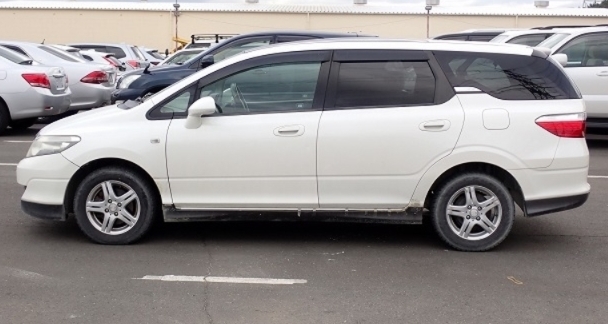
Concept and Design: The first-generation Mobilio was a vehicle born from the unique demands of the Japanese domestic market (JDM), where space efficiency, practicality, and compact dimensions are paramount. It was a tall, unapologetically boxy multi-purpose vehicle (MPV) that prioritized interior volume above all else. Its design was utilitarian, featuring a low, flat floor, vast windows for excellent visibility, and a surprisingly compact footprint.
This remarkable interior space was made possible by Honda’s ingenious center-tank layout, which placed the fuel tank beneath the front seats, liberating floor space in the rear. This allowed the Mobilio to accommodate three rows of seating for seven passengers within a body just over four meters long. The rear doors were conventional hinged units, but their large size provided easy access to the versatile cabin.
Powertrain and Models: The Mobilio was powered by a 1.5-litre L15A i-DSI (intelligent Dual & Sequential Ignition) engine, producing a modest but adequate 90 horsepower. This engine was paired exclusively with a Continuously Variable Transmission (CVT), emphasizing smooth acceleration and fuel economy. Honda offered both a front-wheel-drive (model code GB1) and an optional real-time all-wheel-drive (model code GB2) version.
Trim Levels (Japan): The trims were straightforward, catering to different budgets and needs:
- Y: The most basic entry-level model.
- A: A mid-range trim that added more comfort and convenience features.
- W: The top-tier trim, which included features like alloy wheels, more premium interior finishes, and additional power amenities.
A minor facelift in 2004 saw the introduction of a more powerful 1.5L VTEC version of the engine, boosting output to 110 horsepower for better performance, especially under load.
The Mobilio Spike (GK1/GK2) (2002-2008): Recognizing a different kind of user, Honda introduced the Mobilio Spike on September 19, 2002. While sharing its platform and core mechanics with the standard Mobilio, the Spike was a radical reinterpretation aimed at a younger, more active demographic. Marketed as a “compact multi-wagon,” it was a five-seater designed for utility and lifestyle pursuits.
- Design: The Spike’s styling was more aggressive and rugged. It featured a completely different front fascia with bold, square headlights, a tougher-looking grille, and unique bumpers. Crucially, it featured dual sliding rear doors (power-operated on higher trims), making it exceptionally practical for loading gear or passengers in tight spaces.
- Interior: The rear seats could be folded completely flat, creating a cavernous, 1.86-meter-long cargo bay. Honda marketed this space for everything from hauling camping equipment and bicycles to creating an impromptu sleeping area.
- Trim Levels (Japan): Like the standard Mobilio, the Spike came in various trims, often distinguished by letters and special editions:
- A/AU: Standard trims with a focus on value.
- W: Higher-spec trims with features like power sliding doors, automatic air conditioning, and premium audio systems.
- Special editions often featured unique interior fabrics and exterior colors.
The entire first-generation Mobilio line was discontinued in mid-2008, making way for its spiritual successor in the Japanese market, the more refined and conventionally styled Honda Freed, which continued the legacy of the compact three-row MPV.
.

.
The Second Generation (DD4): Reimagined for the Modern Family (2014-2023)
After a six-year hiatus, the Mobilio name was resurrected, but with a completely new mission. The second generation was not designed for Japan, but was instead developed by Honda R&D Asia Pacific specifically for emerging markets like Indonesia, India, Thailand, and South Africa. It made its world premiere at the Indonesia International Motor Show in September 2013, with sales commencing in early 2014.
Concept and Platform: This new Mobilio was a product of strategic platform sharing. It was based on the extended platform of the Honda Brio, a successful city car in the region. This cost-effective approach allowed Honda to create a spacious, affordable, and fuel-efficient seven-seater MPV that hit a sweet spot for growing families in these markets.
Design and Powertrain: Gone was the quirky boxiness of its predecessor. The second-generation Mobilio adopted a much more conventional and aerodynamic MPV design. It was longer, wider, and had a more dynamic silhouette, famously characterized by the “lightning bolt” kink in the rear window line, a design element shared with the Brio and Amaze.
Under the hood was Honda’s reliable 1.5-litre L15Z1 i-VTEC engine, producing a healthy 118-120 horsepower, making it one of the most powerful engines in its class at the time. This was a significant selling point against competitors. Transmission choices were a 5-speed manual or a modern, efficient Earth Dreams Technology CVT.
Market-Specific Models and Trim Levels: The trim strategy for the second-generation Mobilio was tailored to each country.
Indonesia (Primary Market): Indonesia was the Mobilio’s launchpad and strongest market. The initial lineup was:
- S: The base model, available only with a manual transmission. It featured steel wheels, a single-DIN audio system, and basic amenities.
- E: The volume-seller, available in both manual and CVT. It added alloy wheels, a double-blower air conditioner to cool the rear passengers (a crucial feature in the tropical climate), a 2-DIN audio system, and power windows.
- E Prestige: A more luxurious CVT-only variant that added chrome garnishes, a touchscreen infotainment system with a reversing camera, and fog lights.
In June 2014, Honda Indonesia introduced the Mobilio RS, a sporty flagship model. The RS featured a full body kit (front and rear bumpers, side skirts, spoiler), projector headlights with LED daytime running lights, unique alloy wheels, and a black-themed interior with a more advanced touchscreen audio system. It was available in both manual and CVT.
The Indonesian Mobilio received two significant facelifts. The first, in 2017, brought a completely redesigned front end with new headlamps and grille, resembling the contemporary Honda CR-V, along with a new dashboard design. The second, more minor facelift in 2019, added projector headlights and DRLs to more trims.
India: The Mobilio was launched in India in mid-2014 to compete with the Maruti Suzuki Ertiga and Toyota Innova. A key differentiator for the Indian market was the availability of a diesel engine.
- Engines: 1.5L i-VTEC petrol (119 hp) and the highly efficient 1.5L i-DTEC “Earth Dreams” diesel (100 hp).
- Trim Levels:
- E: The base trim for both petrol and diesel.
- S: The mid-level trim.
- V: The top-spec trim, featuring alloy wheels, rear defogger, and a 2-DIN audio system.
- RS: Offered exclusively with the diesel engine, the RS trim in India included the sporty body kit, projector headlamps, and more premium interior touches.
Despite a promising start, the Mobilio struggled in India against entrenched competition and the market’s rapid shift towards SUVs. It was discontinued in 2017.
South Africa: Launched in 2015, the South African Mobilio was offered with the 1.5L petrol engine.
- Trim Levels:
- Trend: The entry-level model.
- Comfort: The higher-spec model which added features like a rear window wiper, color-coded mirrors and door handles, and a more comprehensive audio system. It was available in both manual and CVT.
End of the Road: Legacy and Market Shifts
The second-generation Mobilio was, for a time, a phenomenal success, particularly in Indonesia where it frequently ranked among the country’s best-selling cars. However, the automotive landscape was shifting dramatically. The rise of the compact SUV and “Crossover MPV” began to erode the Mobilio’s market share.
Ironically, its biggest internal competitor became the Honda BR-V. Based on the same extended Brio platform, the BR-V offered similar seven-seat practicality but packaged it with SUV-like styling, higher ground clearance, and roof rails, which proved irresistible to consumers. Externally, new-generation rivals like the Mitsubishi Xpander and Suzuki Ertiga offered fresher designs and more modern features.
Production and sales gradually wound down in most markets. By 2023, Honda Indonesia officially ceased production of the passenger version of the Mobilio, marking the end of its nine-year run as a family favorite.
Conclusion: A Tale of Two Vehicles
The Honda Mobilio’s evolution is a fascinating case study in automotive adaptation. The first generation was a clever, JDM-focused exercise in maximizing space within strict constraints, resulting in a quirky but brilliant utility box. The second generation was a pragmatic and strategic pivot, leveraging a cost-effective platform to deliver exactly what the families of Southeast Asia needed: an affordable, reliable, powerful, and spacious seven-seater.
While it may not have achieved the global icon status of a Civic, the Mobilio perfectly encapsulates Honda’s engineering spirit—its ability to understand a market, identify a need, and create a purpose-built solution. From the streets of Tokyo to the bustling highways of Jakarta, the Honda Mobilio served two very different generations of drivers, leaving a legacy as an unsung, yet deeply practical, workhorse.