From Spacio to Sunset: The Complete History of the Toyota Verso
In the landscape of modern family transport, the SUV has become the undisputed king. Yet, for a significant period, the crown belonged to a more modest, yet infinitely more practical, vehicle: the Multi-Purpose Vehicle (MPV). Within this highly competitive segment, Toyota carved out a formidable reputation for reliability and intelligent design. The standard-bearer for this effort in Europe was the Toyota Verso, a nameplate that became synonymous with no-nonsense family motoring. Its story is not one of flashy performance or revolutionary styling, but of gradual, thoughtful evolution, perfectly mirroring the changing needs of the families it was built to serve.
The Verso’s lineage, however, did not begin with a standalone model. It grew from the roots of one of Toyota’s most globally successful cars, the Corolla.
The Predecessor: The Corolla Verso (2001-2009)
Before the Verso stood on its own, it was an extension of the Corolla family, leveraging the hatchback’s bulletproof reputation to win over cautious family buyers. This era is defined by two distinct generations.
First Generation Corolla Verso (E120; 2001-2004)
Launched in 2001, the first model to bear the “Corolla Verso” name in Europe was based on the ninth-generation Corolla (E120). It was a direct response to the burgeoning compact MPV market, pioneered by vehicles like the Renault Scénic. Its design was conservative and function-driven—a tall, five-door hatchback with an elevated roofline.
Its key selling point was its interior flexibility. While strictly a five-seater, the three individual rear seats could be folded, tumbled, or removed entirely, allowing for a van-like loading bay. This modularity was a revelation for families needing to transport anything from sports equipment to flat-pack furniture.
Engines and Trim Levels (2001-2004):
The engine lineup was simple, reliable, and mirrored that of the standard Corolla, focusing on economy over outright power.
Petrol: 1.6-litre VVT-i (109 bhp) and a 1.8-litre VVT-i (133 bhp), the latter available with an optional automatic gearbox.
Diesel: The workhorse 2.0-litre D-4D (89 bhp), prized for its robust nature and strong fuel economy.
Trim levels in the UK market followed a familiar Toyota hierarchy:
T2: The entry-level model, it was fairly basic, equipped with steel wheels, a CD player, and central locking. Air conditioning was often an optional extra.
T3: The mid-range and volume seller. This added crucial comforts like air conditioning, alloy wheels, front fog lights, and roof rails, making it a much more complete family package.
T Spirit: The top-of-the-range model, featuring additions like an automatic climate control system, a sunroof, and enhanced interior trim details.
.

.
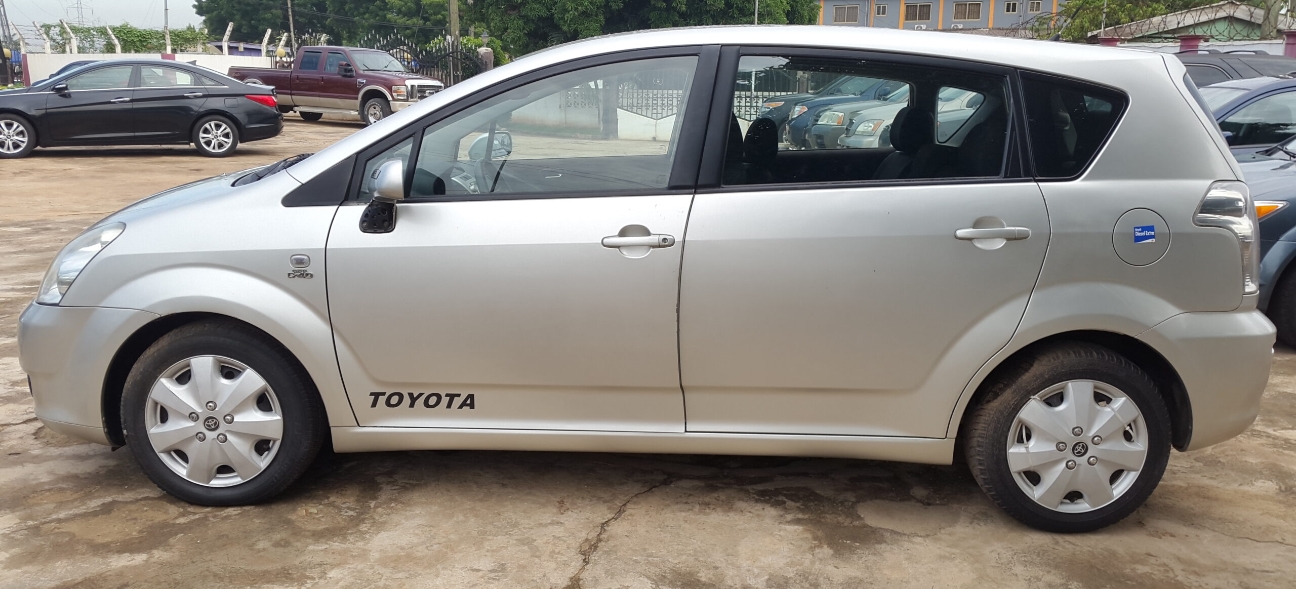
Second Generation Corolla Verso (AR10; 2004-2009)
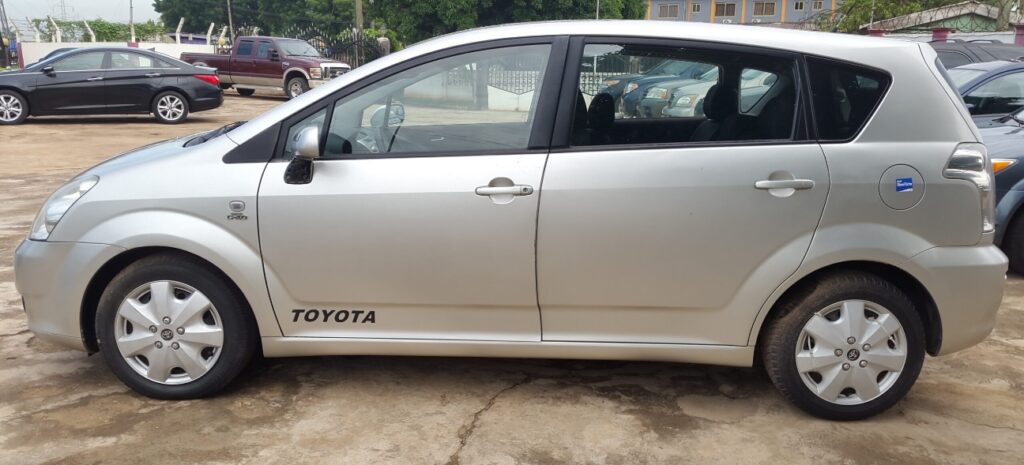
In 2004, Toyota launched a completely new Corolla Verso that marked a pivotal moment for the nameplate. Designed at Toyota’s ED² design studio in the South of France, this model was engineered specifically for the European market. It was a significant leap forward in design, safety, and practicality.
The exterior styling was more dynamic and less utilitarian. But the real revolution was inside. Toyota introduced its groundbreaking “Easy Flat-7” seating system. This ingenious design allowed all five rear seats to fold completely flat into the floor with the simple pull of a lever. There was no need to physically remove heavy seats, a common complaint with rivals. This system set a new benchmark for convenience in the class and became the Verso’s defining feature.
Furthermore, safety was a paramount concern. The second-generation Corolla Verso was the first vehicle in the compact MPV segment to achieve a maximum five-star rating in the stringent Euro NCAP crash tests, a huge selling point for its target audience.
Engines and Trim Levels (2004-2009):
The engine range was expanded and refined to offer more power and better emissions.
Petrol: The 1.6-litre and 1.8-litre VVT-i engines were carried over but refined for efficiency.
Diesel: The diesel offering became much more sophisticated. The old 2.0-litre unit was replaced by a new generation of 2.2-litre D-4D engines, available in two states of tune: a standard 134 bhp version and a powerful 175 bhp “D-CAT” (Diesel Clean Advanced Technology) variant, which featured advanced emissions-reducing technology.
The trim structure was also updated:
T2: Remained the entry point, now with seven seats as standard, air conditioning, and a CD player.
T3: Added 16-inch alloy wheels, dual-zone climate control, and cruise control.
T Spirit: Included features like automatic headlights and wipers, rear parking sensors, and tinted rear windows.
T180: Introduced as the flagship model, this trim was exclusively paired with the 175 bhp D-CAT engine. It was distinguished by 17-inch alloy wheels, unique interior trim, and served as a sporty, high-performance option in the range.
The Standalone Model: The Toyota Verso (R20; 2009-2018)
By 2009, the Verso had established its own identity, and Toyota decided it was time for the model to stand on its own. The “Corolla” prefix was dropped, and the new model was launched simply as the “Toyota Verso.” While it was an evolutionary design, it was built on a new platform and refined every aspect of its predecessor.
The design philosophy was dubbed the “Dynamic Lounge,” aiming to combine a sleek, aerodynamic exterior with a spacious, comfortable, and highly flexible interior. The Easy Flat-7 system was improved, offering more space and greater ease of use.
Significant attention was paid to reducing Noise, Vibration, and Harshness (NVH), making the cabin a quieter and more refined place for long journeys. Toyota also introduced its “Optimal Drive” technologies across the engine range, a suite of enhancements designed to maximise fuel economy and minimise CO2 emissions.
Engines and Trim Levels (Pre-Facelift, 2009-2013):
Petrol: New Valvematic petrol engines were introduced: a 1.6-litre (130 bhp) and a 1.8-litre (145 bhp). The 1.8L was available with a new “Multidrive S” CVT automatic transmission.
Diesel: The 2.0-litre D-4D (124 bhp) and the 2.2-litre D-4D (148 bhp) were the primary diesel offerings, with the powerful D-CAT variant also available.
Trim levels were renamed for the new model:
T2: The base model, equipped with air conditioning, seven seats, and vehicle stability control (VSC).
TR: The likely best-seller, adding 16-inch alloy wheels, Bluetooth connectivity, dual-zone climate control, and cruise control.
T Spirit: The premium trim, featuring 17-inch alloy wheels, keyless entry and start, automatic headlights and wipers, and an upgraded sound system.
The Mid-Life Facelift (2013-2018)
In 2013, the Verso received a comprehensive facelift, with over 470 parts changed. The most noticeable update was to the front end, which adopted Toyota’s sharper “Keen Look” design language, bringing it in line with models like the Auris and Yaris. The new grille and headlight design gave the Verso a more aggressive and contemporary appearance.
The interior was also upgraded with higher-quality soft-touch materials, improved switchgear, and the introduction of Toyota’s “Touch” and later “Touch 2” touchscreen infotainment systems on higher-grade models. The chassis and suspension were retuned to provide a more engaging driving experience without sacrificing comfort.
A significant change occurred under the bonnet. In a landmark deal with the BMW Group, Toyota sourced a new diesel engine.
Engines and Trim Levels (Post-Facelift, 2013-2018):
Petrol: The 1.6-litre and 1.8-litre Valvematic engines remained.
Diesel: The Toyota 2.0-litre D-4D was replaced in 2014 by a BMW-sourced 1.6-litre D-4D engine (110 bhp). This unit was lighter, more efficient, and offered lower CO2 emissions, making it more attractive for company car drivers and tax-conscious buyers. The 2.2L diesel was eventually phased out.
The trim level names were revised again to align with Toyota’s new global strategy:
Active: The entry point, featuring essentials like air conditioning and front electric windows.
Icon: The heart of the range. This popular trim added 16-inch alloy wheels, the Toyota Touch 2 infotainment system with a reversing camera, cruise control, Bluetooth, and dual-zone climate control.
Trend: A sportier-themed trim that built on the Icon grade, adding 17-inch alloy wheels, front parking sensors, and integrated satellite navigation (Touch 2 with Go).
Excel: The luxury-focused flagship. This included leather upholstery, keyless entry, heated front seats, and a panoramic sunroof, creating a premium family vehicle.
The End of an Era: Discontinuation in 2018
Despite the 2013 facelift keeping it competitive, the Verso was fighting against a seismic shift in the automotive market. The rise of the crossover and SUV was relentless. Families were increasingly drawn to the high driving position, rugged styling, and perceived safety of vehicles like the Nissan Qashqai and Toyota’s own RAV4.
Sales of traditional MPVs across Europe began to dwindle. The Verso, a master of practicality, simply couldn’t compete with the fashion-led appeal of the SUV. In late 2018, with sales declining, Toyota quietly ceased production of the Verso. There was no direct replacement. Instead, Toyota directed customers with a need for seven seats towards the Prius+ hybrid MPV, the commercial-van-based Proace Verso, and larger SUVs like the Highlander.
Legacy of the Unsung Hero
The Toyota Verso was never a car to set the pulse racing. It was never the most stylish or the most exciting to drive. But for the thousands of families who owned one, it was something far more important: a trustworthy, endlessly versatile, and utterly dependable partner. Its legacy is found in its intelligent design, particularly the Easy Flat-7 seating system that defined a generation of MPVs. It represented an era of automotive design where function triumphed over form, where the ultimate goal was to make family life just a little bit easier. The Verso was the unsung hero of the school run, the family holiday, and the weekend trip to the DIY store—a mission it fulfilled with quiet, unassuming excellence.