History of The Kaiser Darrin: America’s First Fiberglass Sports Car
The Kaiser Darrin is one of the most distinctive and short-lived automobiles in American automotive history. Produced for only a single model year in 1954, this stylish two-seat roadster stood out for its advanced use of fiberglass, unique sliding doors, and striking design penned by Howard “Dutch” Darrin. While its production run was brief, and sales numbers were modest, the Kaiser Darrin remains a highly collectible and historically significant car today.
In this article, we’ll take an in-depth look at the Kaiser Darrin’s history, specifications, design elements, production details, models and trim levels, and its place in the collector car market.
Origins and Historical Context
To understand the Kaiser Darrin, it’s important to place it within the postwar American automobile industry. Kaiser-Frazer, the company behind the car, was founded in 1945 as a partnership between industrialist Henry J. Kaiser and automotive executive Joseph W. Frazer. Kaiser-Frazer began producing cars in 1946 and initially enjoyed moderate success. However, by the early 1950s, the Big Three (General Motors, Ford, and Chrysler) dominated the American market, and independent automakers like Kaiser-Frazer faced increasing competition.
Howard “Dutch” Darrin was a respected automotive designer with a long career, known for his work with Packard and for creating custom-bodied luxury cars. By the early 1950s, he was working as a consultant for Kaiser-Frazer. Darrin envisioned a stylish, sporty two-seater that could compete with European imports and new domestic entries like the Chevrolet Corvette, which debuted in 1953.
.
NO MORE dead batteries with this:

.
Conception and Design Innovation
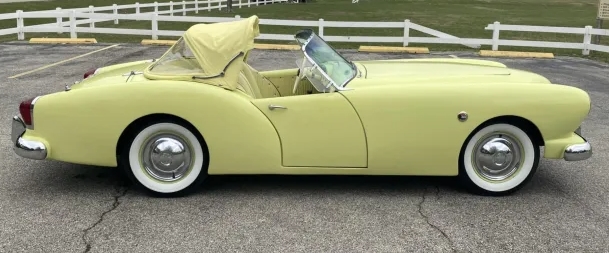
Darrin’s concept stood out immediately for its innovative features. Most notably, the Kaiser Darrin featured sliding doors that retracted into the front fenders rather than swinging outward. This gave the car a sleek profile and made it practical in tight spaces, though the idea was more about style than function. The doors were a signature element and remain one of the most recognizable aspects of the car.
The body was constructed from fiberglass, making it one of the first American production cars to use the material. While the 1953 Corvette is often credited as the first production fiberglass-bodied American car, the Darrin was in development around the same time and debuted in prototype form in 1952—before the Corvette reached customers.
The prototype was shown at various auto shows in 1952 and 1953, generating buzz. However, Kaiser management was initially hesitant to approve production. Henry J. Kaiser was not convinced there was a viable market for such a niche vehicle. Darrin persisted, even building the prototype largely on his own initiative, until Kaiser finally agreed to greenlight production.
Production Years and Numbers
The Kaiser Darrin was produced only in 1954, making it a one-model-year car. Production took place in Jackson, Michigan. A total of 435 cars were built, which included the prototypes and pre-production units.
This low production figure was due to several factors: limited demand, high production costs, and Kaiser’s decision to exit the U.S. passenger car market after 1955 to focus on Jeep production through its acquisition of Willys-Overland.
Models and Trim Levels
Unlike many cars that offer multiple trim levels, the Kaiser Darrin was offered in a single configuration:
- Model: 161 Roadster (officially designated the Kaiser Darrin Model 161)
- Body Style: Two-door convertible roadster
- Trim: One standard trim level, with minor options available
The “161” designation referred to the 161-cubic-inch displacement of the engine.
Standard equipment included the unique sliding doors, convertible top with a three-position feature (fully closed, partially open as a “landau” style, or fully retracted), wire wheel covers, and leather-trimmed bucket seats. Optional equipment was minimal, mainly limited to radio, heater, and some dealer-installed accessories.
Mechanical Specifications
The Kaiser Darrin used mechanical components from Kaiser’s existing lineup to keep costs manageable:
- Engine: Willys F-head Hurricane inline-six, 161 cubic inches (2.6 liters) displacement
- Horsepower: 90 hp at 4,200 rpm
- Torque: Approximately 130 lb-ft
- Transmission: 3-speed manual with overdrive optional
- Drive Layout: Front-engine, rear-wheel drive
- Suspension: Independent front suspension with coil springs, live rear axle with leaf springs
- Brakes: Drum brakes all around
While the Darrin’s styling was advanced, its engine performance was modest compared to sports cars of the era. The 90-horsepower inline-six limited acceleration, with 0–60 mph times in the 15–16 second range. Some owners later swapped in V8 engines for improved performance.
Styling and Design Details
The Kaiser Darrin’s styling was one of its strongest selling points. The front end featured a distinctive “pursed lips” grille opening, which earned it nicknames such as the “lipstick car.” The long hood, short rear deck, and pronounced front fenders gave it classic sports car proportions.
The three-position folding top was another unique feature. In addition to being fully raised or lowered, it could be set halfway, creating a semi-enclosed cabin similar to a landaulet. This was intended to provide shade while keeping the cabin airy.
The dashboard was fairly simple, with a central speedometer and auxiliary gauges. The interior was trimmed in leather, reflecting the car’s premium positioning.
Market Reception and Challenges
The Kaiser Darrin entered the market at a time when the American sports car segment was still in its infancy. The Chevrolet Corvette had debuted the year before, and imported British sports cars like the MG TD and Jaguar XK120 were gaining popularity among enthusiasts.
However, the Darrin faced several challenges:
- Price: At around $3,668, the Darrin was more expensive than a Corvette and considerably more than many imported sports cars.
- Performance: The modest inline-six engine could not match the performance of rivals, especially as the Corvette was soon offered with a V8.
- Timing: By the time the Darrin reached production in early 1954, Kaiser’s passenger car sales were in steep decline, and the company’s future in the U.S. market was uncertain.
- Niche Market: Sports cars were still a small segment of the American market, and the Darrin’s unusual styling and sliding doors may have been too unconventional for many buyers.
As a result, sales were slow. Many cars remained unsold at dealerships well into 1955, and some were eventually sold at deep discounts.
End of Production and Legacy
By the end of 1954, Kaiser had decided to cease production of passenger cars in the United States, focusing instead on Willys Jeep products. Production of the Darrin ended after just 435 units were built. Dutch Darrin personally purchased around 50 unsold cars and fitted some with Cadillac V8 engines to improve performance before selling them through his own shop in California.
Despite its short life, the Kaiser Darrin left a lasting impression. Its design has been celebrated in museums, car shows, and automotive history books. The sliding doors, while never widely adopted, remain a standout feature that makes the Darrin instantly recognizable.
Collectibility and Current Market
Today, the Kaiser Darrin is considered highly collectible due to its rarity, historical significance, and unique design. Collectors value originality and condition, with fully restored examples commanding six-figure prices at auctions.
The limited production run means that finding one for sale is relatively rare. Enthusiast groups and clubs help owners source parts and share restoration knowledge. The fiberglass body means rust is not a major issue, but mechanical components and trim pieces can be difficult to find.
Future Outlook
The future outlook for the Kaiser Darrin in the collector market remains strong. As one of the few truly unique American cars of the 1950s, and as the first U.S. production car with a fiberglass body and sliding doors, it appeals to collectors who value innovation and rarity.
In the coming years, as classic car collecting continues to evolve, the Darrin will likely remain a “blue chip” collectible within the niche of 1950s American sports cars. However, because it is lesser-known outside enthusiast circles, there is still potential for its value to grow as more people learn about its story.
Technical Specifications Summary
| Specification | Detail |
|---|---|
| Model Year | 1954 only |
| Total Production | 435 units |
| Body Style | 2-door convertible roadster |
| Engine | Willys F-head Hurricane I6 |
| Displacement | 161 cu in (2.6 L) |
| Horsepower | 90 hp |
| Transmission | 3-speed manual (overdrive optional) |
| Drive Layout | FR (front-engine, rear-wheel drive) |
| Notable Features | Fiberglass body, sliding doors into front fenders, 3-position convertible top |
The Kaiser Darrin occupies a special place in American automotive history. It was bold, innovative, and stylish, yet ultimately a commercial failure due to timing, performance limitations, and market conditions. Produced for just one year, it serves as a rare reminder of an era when independent automakers could take big risks in design and engineering.
Howard Darrin’s vision for a uniquely American sports car may not have achieved mass-market success, but it has endured in the hearts of enthusiasts and collectors. Today, the Kaiser Darrin is celebrated not only for its rarity but also for its role in pushing the boundaries of automotive design in the early 1950s.
While its sliding doors never became mainstream, and its fiberglass body was soon overshadowed by more powerful competitors, the Darrin remains a testament to the creativity and ambition of a small automaker willing to try something different. Its story is one of vision, persistence, and the challenges of competing in a rapidly changing industry.
In the pantheon of classic American cars, the Kaiser Darrin’s legacy is secure: a brief but brilliant flash of innovation that still turns heads nearly seventy years later.