Kenworth Trucks: A Century of Innovation and Road‑Ready Evolution
For more than 100 years, Kenworth Trucks has been a cornerstone of the North American trucking industry, developing vehicles that range from rugged vocational workhorses to sleek, aerodynamic highway tractors. Known for durability, customization, and engineering innovation, Kenworth has built a lineage of models that reflect both the technological demands and cultural shifts in commercial transportation. This article details the evolution of Kenworth trucks, including key models and variants produced over time, major technical advancements, cultural impact, and a look ahead at the future of the brand.
Origins and Early Years (1920s–1940s)
Kenworth traces its roots back to 1923 in Seattle, Washington, when founders Harry Kent and Edgar Worthington established a truck company focused on building custom vehicles tailored for logging and commercial hauling. The name itself—Ken from Kent and Worth from Worthington—symbolized a partnership that would design machines capable of handling rugged terrain and heavy loads.
Early Innovations
- 1923–1930s: The earliest Kenworth trucks were specialized logging and heavy‑haul models designed for the Pacific Northwest.
- 1933: Kenworth became one of the first U.S. truck makers to install a diesel engine as standard equipment, a major innovation that boosted long‑haul efficiency.
- 1933: An integrated sleeper cab was introduced, allowing drivers to rest inside their trucks on long routes—an early step toward the modern highway tractor concept.
- 1936: The company built its first cab‑over‑engine (COE) truck, intended to maximize cargo length under restrictive overall length laws.
These innovations helped cement Kenworth’s reputation for engineering excellence and practical problem‑solving.
Postwar Expansion (1950s–1960s)
In the mid‑20th century, Kenworth expanded its model lineup and refined both conventional and cab‑over designs:
Notable Model Introductions
- 500 Series (pre‑1956): Often referred to as the “Needle Nose,” this series served as Kenworth’s backbone in the 1940s and early 1950s.
- 900 Series (1956): Replaced the 500 Series with a conventional‑cab truck featuring a dropped front frame for larger radiators and more powerful engines.
- W900 (1961): A landmark model with a long hood and durable construction that would become one of Kenworth’s most iconic products.
- K100 (1961): A cab‑over‑engine truck that became the company’s main COE offering for decades, especially valuable where length regulations limited overall tractor‑trailer length.
During these decades, Kenworth also broadened its export markets and production facilities, reaching customers beyond the United States.
The Aerodynamic Revolution and Model Diversification (1970s–1990s)
Classic Innovation: Aerodynamics and Driver Comfort
The 1970s saw Kenworth tackle increasing fuel costs and demand for driver comfort:
- Aerodyne Sleeper (mid‑1970s): Raised‑roof sleeper that allowed drivers to stand inside the cab, setting a new standard for comfort.
- Across the 1970s and 1980s, Kenworth continued refining both conventional and COE platforms.
Aerodynamic Breakthrough: Kenworth T600 (1985)
A pivotal moment for Kenworth arrived with the T600, introduced in 1985. This model featured a sloped hood and set‑back front axle designed from the ground up for aerodynamics, rather than being an adaptation of a conventional design. Its form significantly reduced drag and fuel consumption, reshaping expectations for highway tractors.
The T600 quickly became a best‑seller, at one stage making up a large portion of Kenworth’s Class 8 sales, and earned industry recognition for its innovative approach to efficiency.
.

.
Model Line Era: Expanding the Kenworth Family
Heavy‑Duty Conventional Models
W900 Series (1961–Present):
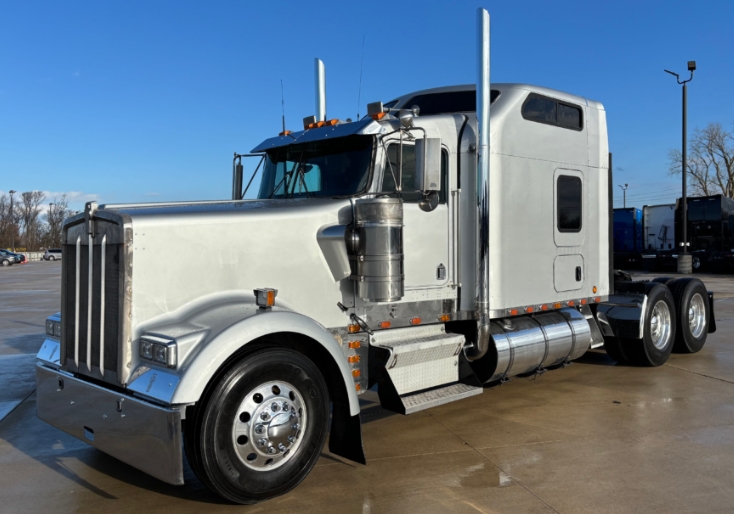
One of the longest‑running truck lines in North America, the W900 has been produced continuously since 1961. It evolved through sub‑variants such as W900A, W900B, and W900L (long‑hood) to suit varying preferences for performance and styling. In 2018, the W990 emerged as a modern flagship conventional sharing the 2.1‑meter wide cab from newer aerodynamic designs.
Note: Kenworth announced that production of the long‑running W900, along with selected other legacy models, is planned to end in 2026 as emissions regulations and component constraints shape future development.
Variants and Trim Levels:
Within the W900 line, owners could often choose from multiple hood lengths, bumper‑to‑back‑of‑cab (BBC) configurations, sleeper options (from day cabs to extended studio sleepers), and special editions like the 100th Anniversary Limited Edition with unique interior trim and badges.
Aerodynamic Highway Tractors
- T600 (1985–2007): Pioneered aerodynamics in heavy trucking.
- T660 (2008–2017): Evolved the T600 with updated aerodynamics and PACCAR powertrains.
- T700 (2011–2014): A transitional aerodynamic model with larger grille and design tweaks.
- T680 (2013–Present): Kenworth’s primary aerodynamic flagship, serving as a replacement for both the T660 and T700. A second‑generation T680 Next Gen introduced modern digital and aerodynamic enhancements.
Trim and Options:
Across these models, fleets could select cab sizes, roof heights, sleeper configurations, engine and transmission pairings, advanced driver‑comfort packages, and aerodynamic enhancements — creating near‑infinite customization tailored to specific hauling missions.
Vocational and Severe‑Service Trucks
Kenworth diversified into vocational and heavy work markets with models that shared cab platforms with highway trucks but were tailored for tough conditions:
- T800 (1987–Present): A stalwart vocational truck with set‑back or set‑forward axles suited for construction, logging, and other challenging applications.
- T880 (2013–Present): A modernized successor to the T800 with the 2.1‑meter cab, optimized for vocational use including concrete mixers, dump trucks, and heavy‑haul configurations.
These lines offer multiple configurations based on axle spacing, frame strength, and duty cycle — from rigid vocational configurations to semi‑tractor setups.
Medium‑Duty and Cab‑Over Models
Kenworth also built a broad range of medium‑duty products:
- T300/T400/T450 (1990s–2000s): Early medium and light vocational models based on Class 7 and 8 platforms.
- T170/T270/T370/T380/T480 (2008–Present): Modern medium‑duty conventionals covering Classes 5–8 for regional haul, urban delivery, and vocational operations.
- K100 Series (1963–2002): A classic cab‑over model that dominated COE sales for decades until declining demand led to its phase‑out in North America.
- K260/K360 and K270/K370 (2008–Present): Smaller cab‑overs based on DAF LF technology for medium‑duty markets.
Off‑Highway Specialists
Kenworth also produces specialized off‑highway models like the C500 and 963 series designed for oilfield, mining, and other heavy‑haul environments, often in rigid, multi‑axle configurations with high horsepower and torque ratings.
Technological Evolution and Driver Focus
As decades passed, Kenworth embraced technologies to meet modern demands:
- Aerodynamics and Fuel Efficiency: Advances from T600 to T680 delivered significant improvements in fuel economy and emissions compliance.
- Engine and Drivetrain: Partnerships with PACCAR, Cummins, and other engine builders have enabled a wide range of horsepower and torque options to match hauling requirements.
- Driver Comfort and Technology: Cabs have evolved with integrated digital instrument panels, climate control, ergonomic seating, and safety systems designed to reduce driver fatigue on long routes. Newer models also incorporate digital mirrors and advanced dashboard displays.
Cultural Impact
Kenworth trucks have transcended their commercial role to become icons of highway culture. The W900 in particular has been celebrated in media and trucking folklore, appearing in films and truck shows and often customized by owner‑operators for both performance and aesthetic appeal.
Future Outlook: Emissions, Electrification, and Beyond
Kenworth continues to adapt to evolving regulations and customer needs. Recent developments include:
- Electric Trucks (EVs): Models like the T680E (battery‑electric) reflect Kenworth’s entry into zero‑emissions vehicles for regional freight markets.
- Hydrogen Fuel Cell Exploration: Efforts to develop alternative fuel systems further signal the company’s commitment to innovation.
- Phasing Out Legacy Models: With production of iconic models like the W900 planned to end in 2026, Kenworth is focusing on more efficient, modern trucks that blend heritage with technology.
Kenworth’s enduring philosophy of building “the right truck for the job” continues to guide product development for fleets and independent operators alike.
The evolution of Kenworth trucks mirrors the broader changes in the trucking industry — from early custom‑built logging rigs to aerodynamic long‑haul tractors and cutting‑edge electric vehicles. Over a century, Kenworth has expanded its model lineup to serve Classes 5 through 8, vocational and severe‑service markets, medium‑duty commercial needs, and specialized off‑road applications. With iconic models like the W900, influential aerodynamic designs such as the T600 and T680, and an ongoing commitment to innovation and driver experience, Kenworth stands as a testament to both tradition and forward‑looking engineering in commercial trucking.