Peterbilt Trucks: The Evolution of an American Heavy‑Duty Icon
From humble beginnings in 1939 to its status today as one of the most respected and recognized names in commercial trucking, Peterbilt Motors Company has built a legacy of rugged trucks serving industries across North America and beyond. Known for their distinctive design, durability, and versatility, Peterbilt vehicles have evolved through decades of innovation — spanning early cab‑over and conventional tractors, iconic long‑nose highway trucks, medium‑duty workhorses, and the modern aerodynamically optimized models that meet today’s regulatory and environmental demands. This article explores the evolution of Peterbilt trucks, including their history, notable models and trim variants over the years, technological advancements, future outlook — and what makes the brand enduring in a competitive industry.
A Brief History: From 1939 to Mid‑Century
Peterbilt was founded in 1939 by T.A. Peterman, a former logging‑industry entrepreneur who purchased the distressed Fageol Motor Company to build heavy trucks better suited for rugged work and hauling. That first year saw just 14 trucks produced, but it marked the beginning of a lineage that would grow tremendously over the following decades.
Early Models and Identity Formation (1939–1950s)
Early Peterbilt models included prototypes and the first heavy tractors that helped establish the company’s reputation for toughness. By 1954, the Peterbilt 281/351 — known for its narrow “Needlenose” hood and butterfly design — had debuted and would remain in production for over two decades.
During this era, Peterbilt also introduced cab‑over‑engine (COE) designs such as the 282/352, offering improved visibility and maneuverability for certain applications.
The Rise of Classic Conventionals (1960s–1980s)
Through the 1960s and 1970s, Peterbilt expanded its lineup with models like the 352 (featuring an aluminum cab and tilt UniLite design) and heavy‑haul workhorses such as the 358. In 1967, the Peterbilt 359 was introduced — a long‑nose highway tractor that would influence Peterbilt’s conventional‑cab styling for decades.
By the late 1970s, Peterbilt began simplifying model designations but remained committed to the conventional (long‑hood) truck style that became its hallmark. In 1980, the Denton, Texas, manufacturing facility opened and would soon become Peterbilt’s primary production hub.
.

.
Classic Era Highway Trucks (1980s–2000s)
Peterbilt 379 (1987–2007)
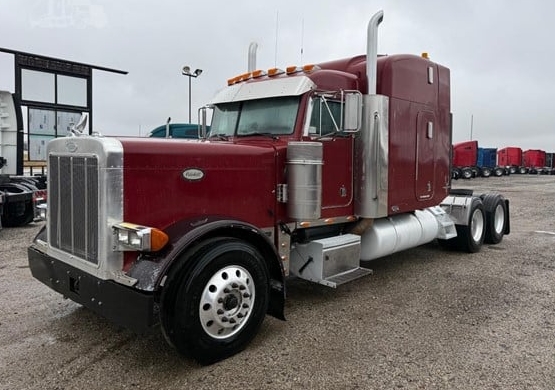
Perhaps the most iconic Peterbilt truck ever produced, the Model 379 served as the brand’s flagship Class 8 highway tractor from 1987 to 2007. Built with a conventional cab and classic long hood, the 379 quickly became popular with owner‑operators and was frequently customized for style and performance.
The 379 offered different configurations including varying bumper‑to‑back‑of‑cab (BBC) lengths (such as 119″ and 127″) and optional sleepers for long‑haul comfort. Engines ranged from Caterpillar and Cummins diesels to Detroit Diesel options — all aimed at balancing power with reliability.
In its final production year, Peterbilt offered a special Legacy Class edition for the last 1,000 units, honoring the model’s impact on trucking culture.
Peterbilt 389 (2007–2023)
In 2006, Peterbilt introduced the Model 389 to replace the 379. While maintaining the classic long‑hood aesthetic that drivers loved, the 389 incorporated updated styling such as redesigned headlamps, trim, and aerodynamic enhancements to improve fuel efficiency without compromising on the traditional look and feel.
Production of the 389 continued into the 2020s and became a favorite for owner‑operators and fleets seeking classic styling with modern capability.
Aerodynamic and Fuel‑Efficient Models
As fuel economy and emissions standards tightened, Peterbilt expanded its lineup with models optimized for efficiency and long‑haul performance:
Peterbilt 387 (2000–2017)
Introduced around 2000, the 387 featured improved aerodynamics and comfort. It was designed to offer long‑haul drivers both performance and reduced fuel consumption, leveraging a new cab design.
Peterbilt 386 (2006–2016)
Released in 2006, the 386 combined a setback steer axle with a shorter, more aerodynamic hood than the classic 379/389 series. It provided a balance of maneuverability and fuel efficiency for dedicated and regional haul operations.
Peterbilt 587 (2010–2018)
In 2010, Peterbilt launched the Model 587, a wide‑cab aerodynamic tractor that replaced the 387. It brought improved forward visibility, lighting, and aerodynamics, along with advanced engine options from Cummins and PACCAR, further boosting fuel efficiency.
Peterbilt 579 (2012–Present)
The Model 579 debuted in 2012 and became Peterbilt’s flagship aerodynamic on‑highway tractor. With an all‑new cab, enhanced ergonomics, and a focus on fuel economy and driver comfort — including options such as UltraLoft sleepers — the 579 exemplified Peterbilt’s modern approach to heavy‑duty trucking.
The 579 remains in production today, helping fleets meet stringent efficiency and emissions requirements while providing a comfortable environment for long‑haul drivers.
Medium‑Duty and Vocational Trucks
While Peterbilt is best known for Class 8 heavy tractors, it also developed a broad array of medium‑duty and vocational trucks over the years:
Early Medium Duty Entries
- Model 330 (1995–2022) – One of Peterbilt’s first medium‑duty conventional trucks, offering Class 6–8 capabilities with a variety of engine options.
- Model 335 (2005–2010) & Model 337 (2010–2022) – Continued evolution of the medium‑duty lineup, designed for delivery, beverage, utility, and other applications.
- Model 340 & 348 – Vocational variants introduced to serve construction and heavy‑haul applications, later replaced or updated in subsequent years.
Modern Medium Duty (2021–Present)
In 2021, Peterbilt overhauled its medium‑duty offerings with new Models 535, 536, 537, and 548, featuring modern cabs, PACCAR engines, and updated systems to serve Classes 5 through 8.
These models reflected Peterbilt’s responsiveness to market demands for versatility, maneuverability, and compliance with modern emissions standards.
Cab‑Over and Specialty Medium Trucks
Peterbilt also produced cab‑over engine (COE) models like the 210 and 220, especially for urban delivery and refuse operations. These returned in updated form in the 2010s, sharing components with medium‑duty chassis for efficiency and serviceability.
Vocational and Severe‑Service Trucks
Peterbilt’s vocational lineup — trucks designed for specific work tasks such as concrete mixing, construction, and other heavy‑duty tasks — includes:
- Model 365 & 367 (2007–Present) – Class 8 severe‑service and vocational trucks suitable for concrete, dump, and boom applications.
- Model 567 (2014–Present) – A heavy‑duty vocational truck incorporating modern cab design and robust chassis for demanding tasks.
These trucks often come in set‑back or set‑forward front axle configurations and accommodate various powertrain and body options to fit specific vocational needs.
Technical Innovations and Options
Peterbilt trucks are highly configurable, with numerous engine, cab, sleeper, and drivetrain options depending on the model and application. Engines include offerings from Cummins, Caterpillar, Detroit Diesel, and PACCAR’s own MX series — providing customers options to tailor performance and efficiency to their operations.
Interior trim and comfort levels have also evolved, with premium options such as American Class, Platinum, and UltraLoft interior packages focused on driver comfort for long‑haul service.
Future Outlook: Electrification and Efficiency
In recent years, Peterbilt has embraced emerging technologies and sustainability. In 2021, the company began production of all‑electric trucks, including:
- Model 579EV (Class 8) for regional haul applications.
- Model 520EV and Model 220EV (cab‑over city trucks) aimed at urban delivery and refuse collection.
These electric variants demonstrate Peterbilt’s commitment to reducing emissions and supporting fleets in transitioning to cleaner technologies.
The Model 589, introduced in 2023 as the successor to the 389, continues Peterbilt’s tradition of blending classic styling with modern performance, featuring improved aerodynamics, cab comfort, and regulatory compliance — a bridge between heritage and future trucking needs.
Cultural Impact and Legacy
Peterbilt’s contributions to trucking culture are profound. Iconic models like the 379 are celebrated among owner‑operators, often customized in show rigs and collector vehicles. The company’s long‑running Denton, Texas assembly plant has produced hundreds of thousands of trucks since 1980, becoming a pilgrimage site for enthusiasts and customers alike.
Through nearly a century of innovation, Peterbilt has grown from building logging‑industry tractors to producing a full lineup of heavy, medium, and vocational trucks — each tailored to the demands of North American transportation, construction, and logistics industries.
The evolution of Peterbilt trucks mirrors the growth of the modern trucking industry itself — from simple rugged tractors to highly configurable, fuel‑efficient machines that meet diverse commercial needs. From early pillars like the 281/351 and 359, through the iconic 379, aerodynamic pioneers like the 387 and 386, and into the era of modern flagship models such as the 579, 567, and new‑generation 589, Peterbilt has continually adapted and innovated. Supported by a strong dealer network and a tradition of quality craftsmanship, Peterbilt remains a symbol of American heavy‑duty trucking excellence with an eye toward a future that includes sustainability and technological advancement.