Sharpening the Blade: The Honda e:NP2 and the Fight for China’s EV Market
In the hyper-competitive, fast-evolving landscape of the global electric vehicle market, nowhere is the battle more intense than in China. It is a crucible where legacy automakers are forced to reinvent themselves or risk obsolescence against a tidal wave of dynamic domestic startups. For Honda, a company whose name is synonymous with engineering excellence and peerless internal combustion engines, this transition presents a monumental challenge. The Honda e:NP2 is not merely another electric car; it is a meticulously crafted statement of intent, a second-generation effort designed to prove that the Japanese giant can not only survive but thrive in this new electric era.
Launched in April 2024, the e:NP2 represents a significant step forward from its predecessors, embodying a sharper design, more integrated technology, and a clearer understanding of what the modern Chinese consumer demands. It is a vehicle born from a unique corporate structure and aimed squarely at the heart of the world’s largest automotive market.
A Brief History: The “e:N” Genesis and a Tale of Two Hondas
To understand the e:NP2, one must first understand Honda’s unique operational strategy in China. For decades, foreign automakers have been required to form joint ventures with local companies. Honda operates through two primary partnerships: GAC Honda (with Guangzhou Automobile Group) and Dongfeng Honda (with Dongfeng Motor Group). This dual-venture approach means that for many key models, Honda develops a single platform and then releases two cosmetically distinct but mechanically identical versions—one for each joint venture.
This strategy carried over into its electric ambitions. In 2021, Honda announced its “e:N Series” of electric vehicles specifically for the Chinese market. The “e” stands for electric and energy, while the “N” represents “New” and “Next.” The first fruits of this labor were the e:NS1 (from Dongfeng Honda) and the e:NP1 (from GAC Honda), which debuted in 2022. These were subcompact electric crossovers based heavily on the globally popular HR-V/Vezel platform. While they were competent first efforts, they were criticized for feeling like EV conversions of an existing gasoline car rather than ground-up EVs, and they struggled to make a significant impact against a flood of more advanced and aggressively priced local competitors.
Learning from this experience, Honda developed its second wave. The e:NP2, produced by GAC Honda, and its twin, the e:NS2 from Dongfeng Honda, are the direct result of this learning curve. They are built on Honda’s dedicated EV platform, the “e:N Architecture F,” and showcase a far more bespoke and forward-thinking design and technology package.
.
THIS is GOOD stuff if your car is in need:

.
Design Philosophy: The Prime Fastback
The e:NP2’s design is a radical departure from the somewhat conventional look of the e:NP1. Honda describes the design concept for the GAC version as “e:N Design – P,” with the “P” standing for “Prime.” This philosophy aims to create a vehicle that feels sharp, sophisticated, and intelligent.
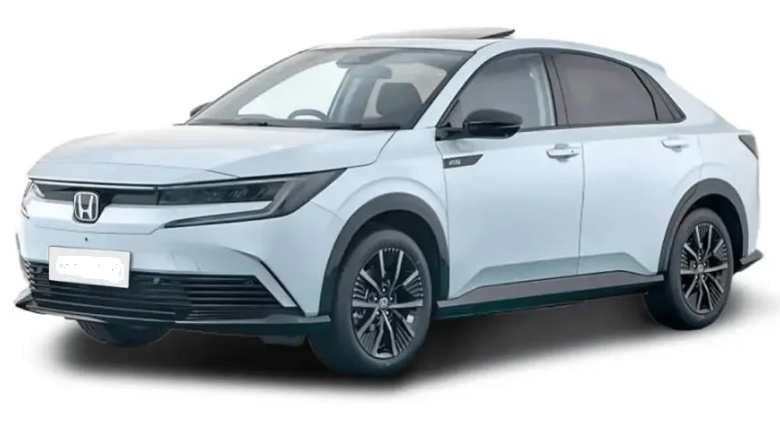
Visually, the e:NP2 takes the form of a sleek fastback or liftback sedan, blending the practicality of a hatchback with the profile of a coupe. The bodywork is defined by sharp, intersecting character lines and clean, uncluttered surfaces. The front fascia is dominated by a slender, piercing headlight signature connected by a light bar, which surrounds an illuminated “H” logo—a new hallmark for Honda’s EVs. The traditional grille is replaced by a smooth, body-colored panel, emphasizing its electric nature.
The side profile is arguably its most dramatic angle. A low, sweeping roofline terminates in a short, integrated ducktail spoiler. The rear door handles are cleverly hidden in the C-pillar, a classic Honda design cue that enhances the coupe-like illusion. The rear echoes the front’s design language, with a full-width taillight assembly that features intricate C-shaped light signatures at either end. The overall impression is one of aerodynamic efficiency and modern dynamism, positioning it far more effectively against rivals from Tesla, BYD, and XPeng.
Inside, the e:NP2 continues the “Prime” philosophy with a minimalist, tech-forward cabin. The dashboard is a clean, horizontal affair, dominated by a large, vertically-oriented 12.8-inch central infotainment screen and a slim, digital instrument cluster for the driver. Physical buttons are kept to a minimum, with most climate, media, and vehicle controls integrated into the central display. This system runs on Honda CONNECT 4.0, a significant software upgrade featuring AI-powered voice assistance, over-the-air (OTA) updates, and expansive smartphone integration.
Honda has also focused on creating a more immersive cabin experience. The e:NP2 features a sophisticated interior lighting system, a large panoramic glass roof (on the top trim), and an intelligent heating system that uses a radiant panel near the driver’s legs to warm them directly, reducing the overall energy load on the main climate control. A unique feature is the Honda “Aroma System,” which allows the driver to select and diffuse different fragrances throughout the cabin via the infotainment screen.
Powertrain, Platform, and Performance
The Honda e:NP2 is underpinned by the e:N Architecture F. The “F” in the name denotes a front-motor, front-wheel-drive configuration. This platform was engineered to maximize interior space while providing a low center of gravity for improved handling.
- Battery: The vehicle is equipped with a 68.8 kWh ternary lithium-ion battery pack sourced from CATL, a leading global battery manufacturer.
- Motor and Power: A single electric motor drives the front wheels, producing a healthy 150 kW (204 horsepower) and 310 Nm (229 lb-ft) of torque.
- Range and Charging: According to China’s CLTC (China Light-Duty Vehicle Test Cycle) standard, the e:NP2 is rated for a driving range of 545 kilometers (approximately 339 miles) on a single charge. While the CLTC cycle is known to be more optimistic than the EPA or WLTP standards, this figure places it competitively within its segment in China. The vehicle supports DC fast charging, though specific peak charging rates are designed to align with China’s prevalent charging infrastructure.
Honda has placed a strong emphasis on maintaining its famed “joy of driving” ethos. Engineers have meticulously tuned the chassis, suspension, and throttle response to deliver a driving experience that is smooth and linear yet engaging and direct. The goal was to eliminate the disconnected feeling some EVs can have, providing a sense of unity between the driver, the car, and the road.
Production Timeline, Models, and Trim Levels
Production Years: 2024 – Present
The Honda e:NP2 officially went on sale in China on April 25, 2024, following its debut at the Beijing Auto Show. Production is handled at GAC Honda’s dedicated EV production facilities.
At its launch, the GAC Honda e:NP2 was offered in two distinct trim levels:
- Base Trim (进阶版 – Jìnjiē Bǎn): This can be translated as the “Advanced Edition.”
- Price: Starting at ¥159,800 (approximately $22,000 USD at the time of launch).
- Key Features: This model includes the full standard powertrain (150 kW motor, 68.8 kWh battery), the 12.8-inch central display with Honda CONNECT 4.0, the digital instrument cluster, LED lighting, automatic climate control, and a comprehensive suite of passive safety features. It typically rides on smaller, more efficiency-focused alloy wheels.
- Top Trim (极锐版 – Jí Ruì Bǎn): This translates to the “Extreme Sharp Edition,” emphasizing its premium positioning.
- Price: Starting at ¥189,800 (approximately $26,200 USD at the time of launch).
- Key Features: Building upon the base trim, the top-tier model adds a host of luxury and technology features. These include:
- A large, non-opening panoramic glass roof.
- A premium Bose sound system.
- The Honda Aroma System.
- A power-operated tailgate.
- An advanced suite of driver-assistance systems, Honda SENSING 360, which includes features like adaptive cruise control, lane-keeping assist, collision mitigation braking, and additional sensors for more comprehensive environmental awareness.
- Larger, more stylish alloy wheels, often with a two-tone finish.
It is important to note that the Dongfeng Honda e:NS2 offers a nearly identical trim structure and pricing, with the primary differentiators being subtle design tweaks to the front and rear bumpers and lighting signatures to distinguish it for its respective sales network.
Market Position and Future Outlook
The Honda e:NP2 enters an incredibly crowded segment. Its primary competitors are not just global players like the Tesla Model 3 and Volkswagen ID.7, but a formidable array of domestic rivals such as the BYD Seal, XPeng P5 and P7, and the Deepal SL03. These local brands often compete fiercely on price while offering cutting-edge battery technology and in-car software.
Honda’s strategy with the e:NP2 is to leverage its brand reputation for quality, reliability, and excellent driving dynamics. While it may not win on raw specs or the lowest price point, Honda is betting that a significant portion of the market still values a polished, well-engineered product from an established brand. The sleek design and user-friendly, albeit minimalist, interior are aimed at attracting younger, tech-savvy buyers who may have grown up in Honda-owning households.
Currently, the e:NP2 and its e:NS2 twin are exclusively for the Chinese market. Honda has not announced any plans to export these models to Europe, North America, or other regions. This is a strategic decision, as Honda is pursuing a different EV path in other markets, exemplified by the GM-coproduced Honda Prologue SUV in North America and its own upcoming “0 Series” of global EVs.
The e:NP2 is best viewed as a crucial stepping stone. It is a product that demonstrates Honda is listening, learning, and rapidly adapting to the demands of the EV era. Its success will be a key indicator of whether Honda’s brand equity can translate effectively from the age of VTEC engines to the era of lithium-ion batteries. The launch of the even newer “Ye” series of EVs in China, also in 2024, shows that the e:NP2 is part of a relentless, multi-pronged offensive. It is a sharp, well-aimed blade in a fight that is only just beginning.