The Aluminum Interceptor: The Evolution of the Panoz AIV Roadster
In the pantheon of automotive history, certain cars are remembered for their speed, others for their luxury, and a select few for their sheer audacity. The Panoz AIV Roadster belongs firmly in the latter category. Born from the brain of a visionary racing enthusiast, this vehicle was a defiant roar in the face of automotive conformity. It was a paradox: a car that looked like a vintage British roadster but packed the heart of a Le Mans-winning GT car. Its story is one of passion, innovation, and the relentless pursuit of a unique driving experience.
The Genesis: From Racing Pedigree to a Street-Legal Dream (1995-1996)
The Panoz story begins not on a road, but on a race track. Don Panoz, a successful pharmaceutical magnate and avid racing enthusiast, founded the Panoz Motor Company in 1989. His initial goal was to produce a limited-edition sports car, the Panoz Esperante GTR-1, a homologation special for a proposed GT1 racing program. The car was a stunning, long-nosed, front-engined coupe that defied the mid-engine convention of its competitors.
While the GTR-1 had a short and relatively unsuccessful racing career, it established Panoz as a legitimate builder of high-performance, bespoke automobiles. The experience gained in designing and building the GTR-1, particularly its advanced chassis technology, laid the groundwork for what would come next.
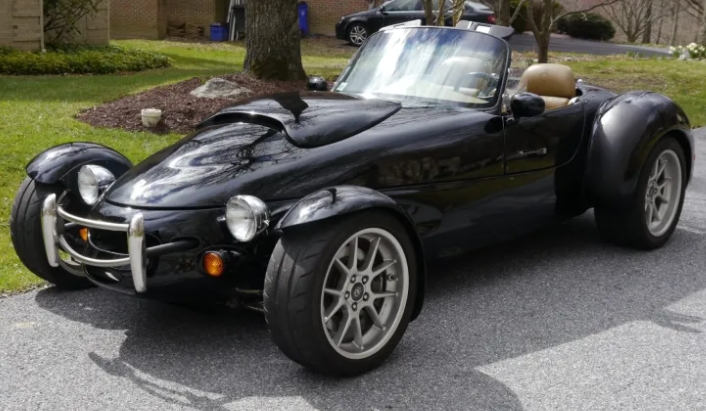
Don Panoz envisioned a “best of both worlds” car for the road. He wanted a vehicle that combined the open-air thrill and classic aesthetics of a traditional roadster with the world-class performance and engineering of a modern supercar. This vision materialized in 1996 with the debut of the Panoz AIV Roadster.
The “AIV” in its name stood for Aluminum Intensive Vehicle, which was the car’s single most important and innovative feature. While many cars used aluminum, Panoz took it a step further by employing a revolutionary bonding and riveting technique, adapted directly from aerospace and racing technology. The car’s chassis was constructed from 6061-T6 aluminum extrusions and sheet panels, bonded with high-strength epoxy and secured with 3,800 aircraft-grade rivets. This process created an incredibly rigid, lightweight, and strong structure—a “stressed member” of the chassis that formed the foundation for the car’s exceptional handling.
The body, designed with a classic roadster silhouette featuring a long hood and a short rear deck, was a masterful blend of old and new. It was made entirely of aluminum panels, further reducing weight. The result was a car with a curb weight of just 2,550 lbs (1,157 kg), significantly lighter than its V8-powered contemporaries like the Chevrolet Corvette.
Powering the first AIV Roadsters was a 4.6-liter Ford “Modular” V8 engine. While the engine itself was a relatively common pushrod design from Ford’s Mustang Cobra, Panoz significantly reworked it. They installed a new cast-aluminum cylinder block, four-valve cylinder heads inspired by the Mustang Cobra R, and a high-lift camshaft. This transformed the humble Ford V8 into a 320 horsepower beast, all the more potent in the lightweight AIV chassis.
.

.
Models and Trim Levels (1996-1999):
During this initial phase, the Panoz AIV Roadster was a relatively straightforward proposition. There were no complex trim levels, as each car was built to order.
- Panoz AIV Roadster: The base and only model. It was offered as a soft-top convertible, with a removable hardtop available as an option. Standard features included a six-speed manual transmission from the Chevrolet Corvette ZF, four-wheel independent suspension with double wishbones at all four corners, and high-performance Brembo brakes. The interior was a spartan yet functional affair, focused on the driver with aluminum accents and supportive leather seats.
The AIV Roadster was not a mass-produced car. Production was minuscule, with only about 50 units built between its introduction and 1999. This exclusivity, combined with its unique construction and performance, made it an instant collector’s item.
Refinement and Racing Homologation: The Roadster S (1999-2001)
By the late 1990s, Panoz was deeply involved in motorsports. The company had entered the American Le Mans Series (ALMS) with the Esperante GTR-1 and later with a purpose-built prototype, the Panoz LMP-1 Roadster-S. This racing program directly influenced the evolution of the street-legal AIV Roadster.
In 1999, Panoz unveiled the Panoz AIV Roadster S. The “S” signified significant upgrades in both performance and refinement. This model was, in essence, a homologation special designed to bridge the gap between the street car and the LMP-1 race car.
The most significant change was under the hood. The Ford V8 was replaced with a more powerful 4.6-liter dual-overhead-cam (DOHC) V8. This engine was a derivative of the legendary “Terminator” engine that would soon power the SVT Mustang Cobra, though Panoz developed its own unique iteration. In the AIV Roadster S, it produced a thrilling 390 horsepower and 390 lb-ft of torque. Paired with the lightweight chassis, this new power plant slashed the 0-60 mph time to a blistering 4.2 seconds.
Visually, the Roadster S was distinguished by a new, more aggressive front fascia with larger air intakes to feed the larger engine and cooling systems. It also featured polished side exhaust pipes, a signature styling cue that announced its performance intentions with every throttle blip.
Inside, the Roadster S offered a more polished experience. The dashboard and door panels were redesigned, and higher-quality leather was used. While still driver-focused, the interior felt less like a kit car and more like a refined, hand-built sports car.
Another key model introduced during this era, though often confused with the Roadster S, was the Panoz Roadster S-AIV. This was a distinct vehicle developed to homologate the AIV Roadster for the Grand-Am Koni Challenge series. It was essentially a race car with license plates, featuring a heavily modified version of the Ford V8, a sequential racing gearbox, and extensive aerodynamic additions, including a large rear wing and canards. Only two were ever built, making it one of the rarest Panoz models in existence.
The Apex of the Breed: The AIV Roadster S2 (2001-2003)
As the AIV Roadster approached the end of its life cycle, Panoz decided to give it one final, definitive version. Introduced in 2001, the Panoz AIV Roadster S2 (for “Super 2”) was the ultimate expression of the AIV concept.
The S2 represented the culmination of everything Panoz had learned from its racing programs. The core of the car remained the same: the bonded-and-riveted aluminum chassis and the DOHC 4.6-liter V8. However, nearly every component was re-evaluated and upgraded.
The engine in the S2 was tuned to produce an even more potent 420 horsepower. This was achieved through a more aggressive camshaft, a high-flow intake system, and an optimized engine control unit.
The most striking change was cosmetic. The S2 received a radical new body kit designed for improved aerodynamics and a more aggressive stance. This included:
- Flared wheel arches to accommodate wider tires.
- A prominent front splitter.
- A new, vented hood.
- Larger side scoops.
- A more pronounced rear spoiler.
The S2’s appearance was unmistakable and unapologetically purposeful. It looked every bit the Le Mans car it was inspired by.
The interior was also updated with a new three-spoke steering wheel, redesigned instrument gauges, and more bolstered racing-style seats. The S2 was the fastest, best-handling, and most visually arresting AIV Roadster ever built. By 2003, however, with the company’s focus shifting to the new, more practical Esperante GT and the development of the Alto, production of the AIV Roadster ceased. In total, Panoz produced approximately 100 AIV Roadsters in all its variants.
Legacy and Future Outlook
The Panoz AIV Roadster was never a sales juggernaut, nor did it aim to be. It was an automotive statement piece, a rolling testament to the idea that a small, passionate company could challenge the establishment. Its legacy is built on several key pillars:
- Innovative Construction: The aluminum bonded-and-riveted chassis was its defining feature and remains a marvel of automotive engineering.
- Unique Character: It offered a driving experience like no other—the raw, visceral feedback of a classic car combined with the blistering performance of a modern supercar.
- Racing Pedigree: Its direct link to Panoz’s ALMS and Grand-Am programs gave it an authenticity that few other boutique cars could match.
Today, the Panoz AIV Roadster is a highly sought-after collector’s car. Values have remained strong, and they are celebrated at concours events and track days alike.
As for the future, a direct successor to the AIV Roadster is unlikely. The Panoz Motor Company itself is now part of the larger Elan Motorsport Technologies group, which focuses on producing race cars, including the Elan DP02 and the chassis for the Mazda MX-5 Cup. While Don Panoz’s passion for automotive innovation continues through his other ventures, the era of the small-batch, road-going open-top Panoz is, for now, a closed chapter.
However, the spirit of the AIV Roadster—the spirit of innovation, risk-taking, and the pursuit of pure driving pleasure—remains a powerful inspiration. It stands as a bright, brief, and brilliant flame in automotive history, remembered as the Aluminum Interceptor that dared to be different.