The Arrow: The Definitive History and Legacy of the Porsche 550 Spyder
In the pantheon of automotive greats, few cars command the same level of reverence and mythical status as the Porsche 550 Spyder. It is a machine of pure, unadulterated purpose—a tiny, lightweight missile that became a giant-killer on the racetrack and forever cemented Porsche’s reputation for engineering brilliance. Its association with Hollywood legend James Dean has only amplified its legend, transforming it from a mere competition car into an enduring cultural icon. To understand the 550 Spyder is to understand the very soul of Porsche: a relentless pursuit of performance through clever engineering, weight reduction, and a deep-seated racing pedigree.
The Genesis of a Giant-Killer
The story of the 550 Spyder begins in the early 1950s. In the wake of the successes of the Porsche 356, the small, determined team in Stuttgart-Zuffenhausen had ambitions that stretched far beyond production car victories. They wanted to dominate the burgeoning world of motorsport, specifically in the highly competitive 1500cc sportscar class (Category S). The existing 356 was a formidable machine, but it was fundamentally a production-based car. For serious competition, Porsche needed a purpose-built weapon.
The project, internally designated “Type 540,” was born from this need. The name “Spyder” was a clear nod to the lightweight, open-cockpit racing specials that were dominating tracks at the time. The brief from Ferry Porsche was simple yet demanding: create a car that was “just right” for its class—agile, reliable, and powerful within the 1.5-liter regulations that were prevalent in European racing.
Engineering Philosophy: Lightness and the V-Engine
The design of the 550 Spyder was a masterclass in minimalist engineering. Unlike the rear-engine, air-cooled 356, the Spyder adopted a more conventional, for racing, mid-rear engine layout. This placement, just ahead of the rear axle, provided near-perfect weight distribution and handling balance, making the car incredibly stable and responsive on winding circuits.
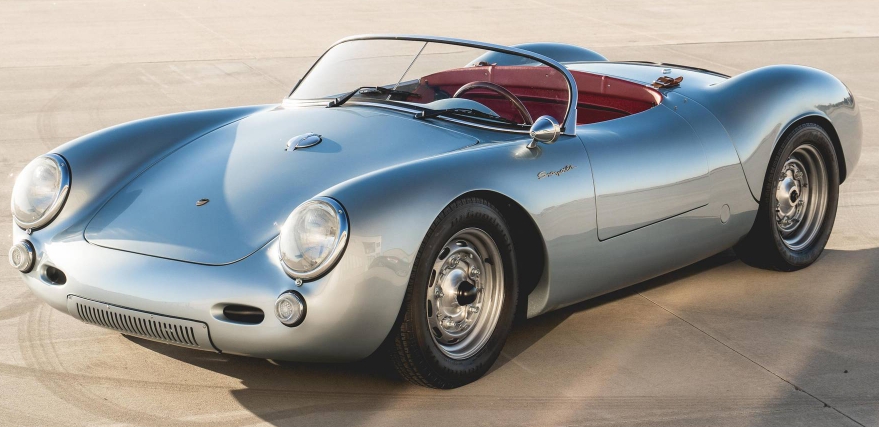
The chassis was a super-light, oval-tube spaceframe, a piece of intricate craftsmanship that formed the foundation of the car’s success. The body, penned by the legendary Tuscan artist and engineer Erwin Komenda, was a masterpiece of form following function. Made from thin-gauge aluminum, the bodywork was simple, low-slung, and exquisitely aerodynamic for its day. With no doors, the driver and passenger simply stepped over the side to enter, further saving precious pounds. The single, large windscreen could be folded flat for racing, and the tiny, removable canvas top was for use only in an emergency. The Spyder was also the first Porsche to feature pontoon fenders (or “flares”), which accommodated a wider track and larger wheels for better stability.
The heart of the 550, however, was its engine. This was perhaps its most revolutionary and controversial feature. In a bold departure from the 356’s four-cylinder, Porsche developed an all-new 1.5-liter, four-camshaft, V-8 engine. The choice of a V-8 was purely for racing regulations; it allowed Porsche to run in the up to 1.5-liter class, but with a smaller, more powerful engine than a straight-four of the same displacement would have allowed. This DOHC (double overhead camshaft) engine, with its two valves per cylinder, was a technological marvel. It was, in essence, half of the magnificent 540K engine that had powered the Cisitalia Grand Prix car, a project Porsche had been involved with.
The engine was designed by Ernst Fuhrmann, and it became known as the “Fuhrmann engine.” It was incredibly compact and lightweight, producing around 110 horsepower in its initial tune—enormous output for such a small displacement in the early 1950s. The engine was a masterpiece of precision, with four camshafts driven by a complex system of intermediate gears, a feature that would become a Porsche hallmark for decades. The sound of this high-revving, unmuffled V-8 was an exhilarating shriek that became the signature of the Spyder.
The Models and Trims: A Racing Evolution
Unlike modern Porsche models with extensive trim levels, the 550 Spyder was a competition-focused machine with a very focused production run. Its evolution was driven by racing needs and regulatory changes, resulting in a few distinct series.
- The Original 550 Spyder (1953-1954): The first examples, known as “Leichtbau” (lightweight construction), were the purest form of the concept. These cars weighed in at a mere 550 kg (about 1,212 lbs), a name that inspired the car’s final designation, the 550. Only a handful of these initial cars were built, and they were immediately successful. The most famous of these early cars was the 550-001, the prototype, which Stirling Moss drove to a stunning overall victory in the 1954 Mille Miglia in the 1.5-liter class.
- The 550A (1954-1956): The next evolution was the 550A. The “A” designation was not for a body style, but a reference to the slightly enlarged 1587cc engine, which complied with new regulations. This new engine produced 135-140 horsepower in race tune. The most significant upgrade, however, was the introduction of the highly successful “RS” (Rennsport) variant. The 550A RS was the ultimate evolution of the Spyder. It featured a heavily revised engine with larger carburetors, a higher compression ratio, and other performance enhancements, pushing power to around 150 horsepower. The chassis was also further lightened. The 550A RS, often called the “Mille Miglia” model, was a dominant force, winning its class at Le Mans in 1954 and 1955 and securing the 1956 Targa Florio overall victory for Huschke von Hanstein. The 550A is widely considered the pinnacle of the Spyder’s development and is the most sought-after and valuable version.
- The 550 Spyder “Carrera” (One-Off): It’s worth noting a very special, one-off variant. A single 550 chassis was fitted with the experimental four-cam 1.5-liter “Carrera” engine (the 547/1). This car, known as the “America” or “Carrera” Spyder, was built for the 1954 Carrera Panamericana. It demonstrated the future potential of the Carrera engine, which would go on to power Porsche’s future racing and production cars for decades. This car is a crucial bridge in Porsche’s engine development history.
The Racing Pedigree: A History of Dominance
The 550 Spyder’s reputation was forged in the crucible of motorsport. It was, from its inception, a winner. Its list of victories is a testament to its design and reliability. It conquered grueling endurance events like the Mille Miglia and the Targa Florio, and was a terror in its class at Le Mans and the Nürburgring.
The car’s nimble handling and blistering straight-line speed allowed it to outrun more powerful machinery, earning it the nickname “Der Rennspider” (The Racer). The drivers who campaigned the Spyder, from legendary figures like Stirling Moss and Herbert Linge to talented privateers, all praised its communicative chassis and fearless performance. The Spyder didn’t just win races; it defined Porsche as a brand that could punch well above its weight, using intelligence and engineering to overcome brute force.
The James Dean Connection: Myth and Tragedy
No discussion of the 550 Spyder is complete without mentioning James Dean. The Hollywood icon, a racing enthusiast himself, purchased a 550A Spyder in September 1955. His car, chassis number 550-0054, was finished in the now-famous “Silver” bare aluminum (though often called “Sliver” by Dean). He immediately began racing it, achieving a second-place finish at a Palm Springs event.
The legend was sealed on September 30, 1955. While driving to a race at Salinas, California, Dean’s Spyder was involved in a collision with another car at an intersection. Dean was killed instantly. The car, dubbed the “Little Bastard” by Dean himself, was shattered. Its bizarre and tragic post-crash history—a series of fires, crashes, and injuries involving the car’s salvaged parts—has become a piece of automotive folklore, forever entwining the Spyder with tragedy and mystique. While the story is often sensationalized, there is no denying that the car’s association with one of Hollywood’s brightest stars cemented its place in popular culture, elevating it from a mere race car to a legend.
The End of an Era and Future Outlook
Production of the 550 Spyder was short and sweet. In total, only 90 units were built between 1953 and 1956 (including the prototype and the Carrera one-off). The car was replaced by the more powerful and larger 718 RSK, which was the next logical step in Porsche’s racing evolution.
Today, the 550 Spyder is one of the most coveted and valuable collector cars in the world. Its value is astronomical, with pristine examples fetching millions at auction. Its rarity, beauty, racing history, and the James Dean connection all contribute to its phenomenal status.
The future outlook for the 550 Spyder is one of unshakeable iconography. It will never be more than a museum piece or the crown jewel of a private collection, but its influence is permanent. It represents the genesis of Porsche’s racing DNA. The spirit of the 550—the lightweight, agile, driver-focused philosophy—can be seen in every modern Porsche sports car, from the Cayman to the 911 GT3 RS.
For those who cannot afford a multi-million-dollar original, the spirit of the 550 lives on through high-quality continuations and recreations, such as those built by shops like The 550 Spyder. These cars allow enthusiasts to experience the pure, visceral thrill of driving the original without fear of destroying a priceless piece of history.
In conclusion, the Porsche 550 Spyder is far more than the sum of its parts. It was a car born of pure purpose, a brilliant example of engineering that achieved greatness through intelligence and finesse. It conquered the racetrack, captured the imagination of a Hollywood star, and became the blueprint for Porsche’s enduring success. It is a tiny car that cast a very long shadow, and more than 70 years after it first appeared, its arrow-shaped form remains a potent symbol of automotive perfection.