The Black Cab Chronicles: The Enduring Legacy of the Austin FX4
In the sprawling narrative of automotive history, few vehicles can claim to be as deeply woven into the cultural fabric of a city as the Austin FX4 is to London. For over half a century, its boxy silhouette, panoramic windows, and distinct mechanical clatter defined the rhythm of the British capital. More than just a taxi, the FX4 was a robust piece of engineering, a mobile living room, and a symbol of urban resilience. This article explores the comprehensive evolution of the Austin FX4, from its post-war inception to its final rolling days on the streets of London, detailing every model, trim, and the engineering ingenuity that kept it on the road for decades.
The Genesis: Post-War Necessity (1948–1958)
Following the Second World War, London’s taxi fleet was aging rapidly. The dominant vehicle was the Austin 16/18hp, a vehicle that, while reliable, was becoming antiquated. The Ministry of Transport, which held strict regulations over taxi specifications (known as the “Conditions of Fitness”), demanded a modern successor.
Austin initiated the project in 1947, designating it “FX” (F for the pre-1948 standard and X for experimental). The resulting vehicle, launched in 1948, was the Austin FX3. While not yet the FX4, the FX3 set the stage. Powered by a 2.2-liter six-cylinder engine and featuring a body built by The Metcalfe Motor Body Company, it was sturdy but lacked the agility required for tight city streets.
By the early 1950s, Austin sought to replace the FX3 with a vehicle that offered better maneuverability, lower running costs, and improved passenger comfort. The design was entrusted to Sir Alec Issigonis, the legendary engineer who would later create the Mini. The result was the Austin FX4, launched in 1958.
The Arrival of the Icon: The Classic FX4 (1958–1997)
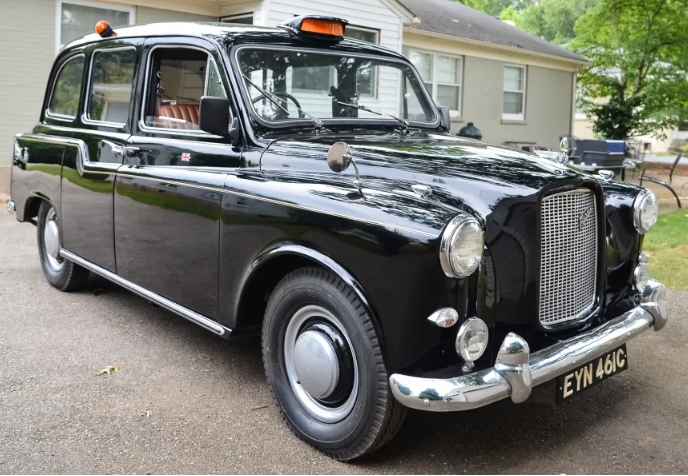
The Austin FX4 was an immediate visual departure from its predecessors. It featured a split-level design with a large panoramic rear window and a separate engine compartment, which reduced noise and heat intrusion into the cabin. The chassis was a robust box-section ladder frame, and the body was constructed from steel panels bolted to a hardwood frame—a design choice that facilitated easy repairs in an era when crash testing was in its infancy.
Engine and Drivetrain The FX4 was powered by the Austin “B” series engine. Initially, this was a 2.2-liter petrol engine (the same unit used in the Austin A90 Atlantic), producing approximately 66 horsepower. However, petrol taxis were becoming expensive to run. In 1960, Austin introduced the Austin FX4D, the diesel variant. This model utilized a 2.199-liter BMC B-series diesel engine, which offered significantly better fuel economy and torque, making it the preferred choice for high-mileage cabbies. The diesel engine would eventually become the standard for the FX4’s long life.
Transmission and Handling The FX4 employed a four-speed manual gearbox with a column change (a “H-pattern” shifter mounted on the steering column). It featured a front-engine, rear-wheel-drive layout. A defining characteristic of the FX4 was its highly sensitive turning circle, mandated by London regulations to allow taxis to navigate the city’s narrowest alleys. The rear wheels were mounted on a unique “floating” bogie suspension system with a single transverse leaf spring, allowing the vehicle to lean into corners—a feature that gave the FX4 a distinctive “wallowing” ride quality.
The Leyland Era and Refinements (1970s) In 1968, the British Motor Corporation (BMC) merged with Leyland Motors to form British Leyland (BL). This corporate shuffle affected the FX4, although the vehicle remained largely unchanged mechanically. However, the 1970s brought subtle visual and mechanical updates:
- The 1973 Update: In 1973, the FX4 received a significant facelift. The most noticeable change was the replacement of the sliding Perspex hopper windows (a frequent source of mechanical failure) with winding glass windows. The headlamps were also repositioned from within the grille to a lower position on the bumper, and the front indicators were enlarged. The interior received a revised dashboard with a more modern instrument cluster.
- The 1976 Diesel: The older 2.2-liter diesel was replaced by the larger, more powerful 2.5-liter diesel engine (still the B-series), offering improved performance for heavily loaded vehicles.
The Black Cab Boom Throughout the 1960s and 70s, the FX4 became ubiquitous in London. It was rugged, simple to repair, and instantly recognizable. During this period, a popular “limousine” variant was offered, which stretched the wheelbase to provide extra rear legroom, though this was less common than the standard version.
The Black Maria A notable, non-civilian variant was the police “Black Maria.” Based on the FX4 chassis, these prisoner transport vehicles featured a windowless steel cell in the rear and a distinct two-tone blue or white livery. They shared the same mechanical underpinnings but were fitted with heavy-duty suspension to cope with the weight of the cell and occupants.
.
THIS might be a great place to get your new car from!
Or for those who are into the “car flipping” business, here’s an excellent resource for you!

.
The Y-Type: A Radical Rear-End (1982–1985)
By the early 1980s, the FX4’s basic shape had been in service for over two decades. While the mechanicals were sound, the rear bodywork was deemed inefficient for production. In 1982, British Leyland (by then a state-owned entity) introduced the FX4Y.
The “Y” designation referred to the new rear section, which was manufactured using a polyester resin (plastic) instead of steel. This change was made to keep the old tooling in use while meeting modern crash safety standards, which required more rear-end deformation space. The Y-Type retained the classic front end but featured a redesigned, slightly longer, and more rounded rear body. However, the plastic rear was prone to cracking in cold weather and offered poor sound insulation. The Y-Type was short-lived, produced for only three years before production reverted to the classic steel design.
The Subtle Evolution: FX4S and Reliant (1985–1997)
In 1984, the taxi manufacturing rights were sold to Reliant, a company better known for the three-wheeled Scimitar and the Robin. Reliant began producing the FX4 under license, designating it the FX4S (or FX4D for diesel).
The FX4S (1985–1997) The Reliant-built FX4S looked virtually identical to the pre-Y steel models, but it incorporated several modernizations:
- Electrical System: Upgraded from 12-volt to 24-volt.
- Brakes: Front disc brakes were introduced to replace the older drum system (drums remained on the rear).
- Engine: The engine was updated to the 2.5-liter Leyland “H” series diesel (later the “O” series), which was more refined and met tightening emission standards.
- Interior: The dashboard was updated with a modern fascia, and the steering wheel was changed from a large Bakelite wheel to a smaller plastic one.
During this period, Reliant also offered a “blackout” version for police and private hire, which lacked the taxi meter fittings.
The End of the Line (1997–1998)
By the mid-1990s, the FX4 was a dinosaur. While beloved by cabbies for its handling and durability, it lacked modern safety features like airbags, ABS, and crumple zones. Furthermore, the interior space was compromised by the massive transmission tunnel, making it difficult to accommodate a fourth passenger.
The original production license between Reliant and Austin expired in 1997. Reliant continued building the vehicle for a short period as the FX4S Plus (featuring air conditioning and slightly updated trim), but sales dwindled. In 1998, the final Austin FX4 rolled off the production line, ending a 40-year production run—the longest of any British taxi.
The “Black Cab” Succeeded: The TX1 and Beyond
The gap left by the FX4 was immediately filled. A new consortium, the London Taxi Company (LTC), formed to design a modern successor. In 1997, the TX1 was launched. While it retained the FX4’s distinctive styling cues (the split-level windows, the rectangular shape), it was a completely new vehicle with modern engines, improved safety, and a flat floor.
The lineage continued with the TXII (2002) and the TX4 (2007). Today, the brand is owned by the Chinese company Geely, and the current model is the LEVC TX (2017), an electric hybrid vehicle. While the TX series carries the “taxi” torch, it lacks the raw, mechanical character of the FX4.
Trim Levels and Variations
Because the FX4 was a commercial vehicle, “trim levels” in the consumer sense (like LX, EX, etc.) didn’t exist. However, there were distinct configurations and body styles:
- Standard FX4 (FX4D): The most common configuration. Seating for five (three in the rear, one in the front passenger seat, plus the driver).
- FX4 Limousine: A stretched version with increased luggage space and rear legroom. Less common due to higher fuel consumption.
- Reliant FX4S: The licensed production model (1985-1997) featuring disc brakes and updated electrics.
- FX4Y: The short-lived plastic-rear variant.
- Police/Possible/Van Variants:
- Black Maria: Prisoner transport with a steel cell.
- “Possible” (Ambulance): A panel van version used by the AA/RAC and as small ambulances, lacking rear windows and seats.
- FX4 Hearse: A modified version used for funeral services.
The FX4 Driving Experience
To drive an FX4 was to experience a bygone era of motoring. The steering was heavy (unassisted) but precise. The column change required a specific rhythm to avoid grinding gears. The suspension was soft, designed to soak up London’s cobblestones rather than handle corners at speed.
The cabin was spacious but utilitarian. The rear seats were durable leatherette, designed for thousands of passengers. The dashboard was a flat plane of metal and plastic, housing a speedometer, fuel gauge, and warning lights for oil pressure and generator output. There was no tachometer. The engine noise was a constant, low thrum—a sound that many Londoners found comforting.
Legacy and Future Outlook
The Austin FX4 is more than a vehicle; it is a museum piece on wheels. It represents the pinnacle of British industrial pragmatism—over-engineered, durable, and perfectly suited to its specific environment.
Today, the FX4 is a sought-after classic. Prices for well-restored examples have risen significantly. Many have been converted for private use, and a vibrant enthusiast community keeps the surviving vehicles in pristine condition. Several companies in Eastern Europe and Asia still maintain fleets of FX4s, a testament to the vehicle’s longevity.
However, the future of the FX4 in its original role is nonexistent. London’s Ultra Low Emission Zone (ULEZ) has effectively banned the pre-2015 diesel engines found in the FX4. The vehicle that survived the Blitz and the oil crises could not survive the push for electrification.
Conclusion
The Austin FX4 ceased production over two decades ago, yet it remains the quintessential London taxi in the public imagination. Its evolution—from the 1958 launch with a petrol engine to the final Reliant-built FX4S—tells the story of British manufacturing in the 20th century. It survived corporate mergers, strikes, and shifting regulations, all while remaining fundamentally the same vehicle.
While the electric LEVC TX now prowls the streets of London, quiet and efficient, it is the clatter of the FX4’s diesel engine and the slam of its latching doors that echoes in the history of the city. The FX4 proved that a vehicle could be iconic not because it was fast or luxurious, but because it was honest, reliable, and utterly irreplaceable.