The Callaway AeroWagen: Evolution of a Chevrolet Corvette Shooting Brake Legend
The Callaway AeroWagen is one of the most unconventional and fascinating creations in the world of performance automobiles — a shooting brake (two-door “wagon”) conversion of the Chevrolet Corvette that blends American muscle with unique practicality and bespoke engineering. Unlike traditional production vehicles, the AeroWagen isn’t built on a factory assembly line; it’s a coach-built conversion package developed by Callaway Cars, Inc., a renowned American performance specialist with roots reaching back to the 1970s.
Over the years, the AeroWagen has gained attention from enthusiasts and collectors alike for its rare combination of Corvette performance, distinctive design, and significant innovation in custom automotive engineering. This article explores the evolution of the Callaway AeroWagen, its history, available variants, technical details, cultural significance, and future outlook.
Origins: Callaway Cars and the Corvette Legacy
To understand the AeroWagen, it helps to first understand the company that created it. Callaway Cars, Inc. — founded in 1977 by Reeves Callaway — earned worldwide acclaim for high-performance modifications of Chevrolet Corvettes and other vehicles. Early in its history, Callaway developed twin-turbo packages, supercharger systems, and aerodynamic enhancements that often transformed standard GM vehicles into exceptionally fast and highly collectible machines. The company’s legacy includes notable creations such as the Callaway Sledgehammer Corvette and bespoke Corvette models through multiple generations.
In the 2010s, Callaway began exploring unique body concepts to expand Corvette functionality and appeal. One such idea was the AeroWagen — a Corvette shooting brake designed to add practicality without compromising performance. Early renderings of the concept date back to at least 2013.
.
THIS could come in handy for your auto garage (and everywhere else!):

.
Birth of the AeroWagen (2016–2017)
The AeroWagen concept slowly gained traction over several years before evolving into a production-ready conversion package. By 2016–2017, Callaway began offering the AeroWagen conversion for real customers, built on the seventh-generation (C7) Chevrolet Corvette platform.
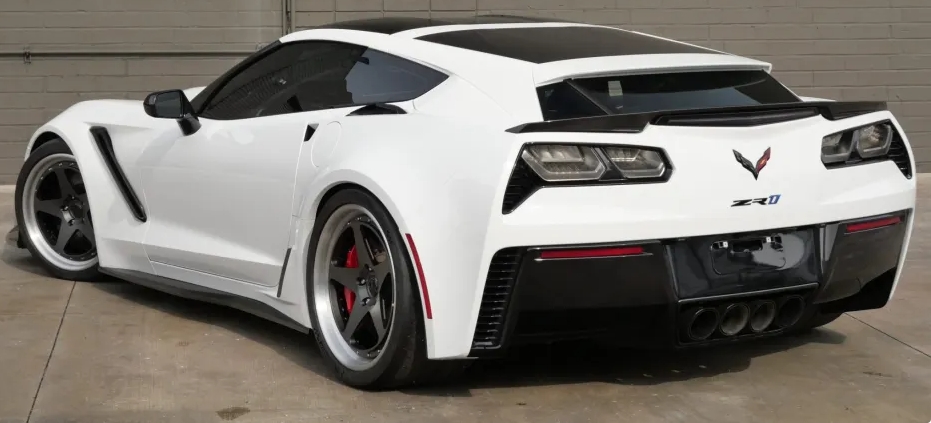
This package was not a separate model built from the ground up, nor was it an official GM vehicle — instead, Callaway developed a body conversion kit that replaced the standard Corvette rear hatch with an extended, carbon-fiber hatch and roofline, giving the car a shooting brake silhouette and increased cargo space while retaining the car’s original body structure and hardware.
Design Characteristics
- Shooting Brake Roofline: An elongated roof and rear hatch built from carbon fiber gives the Corvette an estate-like profile, contrasting sharply with the Corvette’s traditional coupe roof.
- Part-for-Part Replacement: The AeroWagen hatch assembly is a direct replacement for the factory hatch, using original Corvette hardware and operating identically, including latching and defroster functionality.
- Carbon-Fiber Construction: The package uses lightweight carbon-fiber components for the extended roof, rear structure, and related elements, helping maintain performance while altering the vehicle’s appearance.
- Badging and Styling: AeroWagen-specific badging, a halo bar, and a low-drag rear spoiler were often included to visually distinguish the conversion from a standard Corvette.
The conversion was installed at Callaway facilities in California and Connecticut or by authorized Callaway and Chevrolet dealers, and typically cost around $14,990 for the basic kit (before painting and additional options). Paint matching and an optional AeroSpoiler were extra.
Platform and Compatibility
The AeroWagen wasn’t limited to a single Corvette trim — the conversion kit was designed to fit all C7 Corvette coupes, including:
- Standard Chevrolet Corvette Stingray models
- Corvette Grand Sport
- Corvette Z06
- Callaway-enhanced variants such as SC627 (supercharged Stingray) and SC757 (supercharged Z06).
Because the AeroWagen was essentially a custom body conversion, its flexibility gained praise among enthusiasts: owners could theoretically have their factory Corvette modified into an AeroWagen or revert back to the original coupe configuration by reinstalling the OEM hatch.
Performance and Powertrain Integration
The AeroWagen didn’t introduce a new drivetrain but combined Corvette’s established performance with Callaway’s engineering. Many AeroWagen conversions were paired with high-performance Corvette powertrains, including Callaway’s own supercharged upgrades like:
- SC627 — Callaway’s GenThree supercharger package for Stingray and Grand Sport Corvettes, producing approximately 627 hp, with enhanced cooling and intake systems.
- SC757 — Callaway’s high-output supercharged Z06 upgrade, generating approximately 757 hp and 777 lb-ft torque. This package featured a much larger supercharger and enhanced intercooler, often featured on AeroWagen conversions showcased by media outlets.
Performance figures for these Callaway-enhanced models included very quick acceleration numbers (e.g., 0–60 mph in the low-3-second range for SC627 variants and sub-3-second times for SC757 Z06 based cars), making AeroWagen examples not just unique in appearance but genuinely quick on the road.
Model Years and Production Run
Because the AeroWagen was a conversion package rather than a factory-produced vehicle, it didn’t have discrete model years in the conventional sense. Instead, sales of the AeroWagen package took place primarily between 2017 and the end of the C7 Corvette’s production cycle (2019), though conversions could continue into subsequent years if owners requested retrofits.
The broad “model range” in which AeroWagen conversions were possible includes:
- 2014–2019 Chevrolet Corvette bases eligible for AeroWagen conversion.
- Multiple performance variants: Stock C7, Callaway SC627, SC757, and variants with additional Callaway accessories and options.
In essence, the AeroWagen spanned the lifetime of the C7 Corvette platform, but its production numbers are inherently limited by its bespoke nature and the fact that it was an ordered conversion rather than a mass-manufactured “model.” Detailed registration or production counts are not widely available in public sources, but it remains a rare sight due to its individualized build process and niche appeal.
Why Did Callaway Build the AeroWagen?
The AeroWagen serves several purposes in automotive culture:
- Functionality: By extending the roof and adding a hatch, the AeroWagen increased cargo capacity over the standard Corvette coupe, appealing to enthusiasts who wanted utility without losing performance.
- Style: It brought a distinct aesthetic, influenced by classic British shooting brake designs (a style historically associated with grand touring cars with extended cargo space). The term “shooting brake” itself refers to a two-door with wagon-like qualities, traditionally used to carry hunting gear — a theme subtly embraced by the AeroWagen transformation.
- Innovation: It demonstrated Callaway’s ability to blend bodywork innovation with performance engineering — not just tuning engines but creating new configurations altogether.
- Collector Appeal: Its rarity and uniqueness have made AeroWagen conversions sought after by collectors and Corvette enthusiasts who value individuality.
Cultural Reception and Notable Appearances
The AeroWagen quickly attracted media attention upon its release. For example:
- Jay Leno’s Garage featured the AeroWagen, where host Jay Leno drove and discussed its unique design and performance, spotlighting its supercharged capabilities and distinctive shape.
- Automotive publications like MotorTrend and Carscoops covered its launch, emphasizing its conversion process, compatibility with performance Corvettes, and its shooting brake styling.
The visibility in enthusiast media helped cement the AeroWagen’s reputation as a bold and imaginative reinterpretation of Corvette design.
Future Outlook and Legacy
Today, the AeroWagen remains tied to the Corvette C7 generation. As Chevrolet transitioned to the C8 Corvette platform in 2020 and beyond, there has been no official announcement from Callaway regarding a continuation of the AeroWagen concept on newer Corvettes. However, given Callaway’s history of innovation and bespoke projects — including retrofits and one-off commissions — it’s conceivable that future bespoke coach-built variations could emerge.
Callaway’s focus continues to evolve with performance upgrades, electrification research, and collaborations with other automotive technologies. While road conversions like the AeroWagen are unlikely to become mainstream, the concept remains a beloved example of automotive creativity that pushed the boundaries of what a sports car could be.
The Callaway AeroWagen stands as a singular achievement in the world of custom performance automobiles — a unique shooting brake transformation built on the beloved C7 Corvette platform. Over its production life from roughly 2017 to 2019, it offered Corvette enthusiasts the rare chance to combine high performance with increased practicality and one-off style.
While it didn’t follow the traditional model lineup structure of factory vehicles, the AeroWagen’s evolution — from concept design to real execution — reflects Callaway Cars’ broader legacy of performance innovation and bespoke engineering. Its rarity, distinctive design, and engineering sophistication ensure it will remain a notable chapter in Corvette and custom automotive history.