The Chevrolet Prizm – The Sleeper Hit: How a Rebadged Toyota Saved Chevrolet’s Compact Car Reputation
In the automotive world, the term “badge engineering” is often used with a sneer. It implies a lack of innovation, a simple changing of logos on a single platform to fill a showroom slot. However, history is littered with exceptions where this practice resulted in a vehicle that was not only reliable but arguably superior to its parent brand’s offerings. The Chevrolet Prizm is the ultimate example of this phenomenon.
For nearly a decade, the Chevrolet Prizm was not really a Chevrolet at all. It was a Toyota Corolla in disguise—built in a joint-venture plant, featuring Japanese engineering, and offering the kind of bulletproof reliability that American automakers were desperately trying to emulate in the 1990s.
Here is the evolution of the Chevrolet Prizm, a compact car that quietly became one of the most dependable vehicles to ever wear a bowtie badge.
Origins: The NUMMI Connection
To understand the Prizm, one must understand the New United Motor Manufacturing, Inc. (NUMMI). Established in 1984 in Fremont, California, NUMMI was a joint venture between General Motors and Toyota. It was GM’s attempt to learn the secrets of lean manufacturing and quality control from the Japanese, while Toyota gained a foothold in the U.S. market without establishing a standalone factory.
While the first product of this venture was the Chevrolet Nova (a rebadged Corolla), the Prizm nameplate officially debuted in 1990, replacing the Geo Spectrum. It became the flagship model of GM’s new “Geo” division, which was created to market small, fuel-efficient import fighters.
.
THIS might be a great place to get your new car from!
Or for those who are into the “car flipping” business, here’s an excellent resource for you!

.
First Generation (1990–1992): The Geo Prizm
When the Prizm launched in 1990, it was sold as a Geo, though the Chevrolet bowtie appeared on the grille. This generation was essentially the Toyota Corolla (E80 series) platform.
Models and Trim Levels: The first-generation Prizm was simple, focusing on value and efficiency.
- Base Model: The entry-level trim featured a 1.6-liter DOHC 4-cylinder engine (Toyota’s 4A-GE) producing 115 horsepower. It came standard with a 5-speed manual transmission, though a 4-speed automatic was optional. Interior features were sparse but functional, including cloth seats and a basic AM/FM radio.
- LS Model: The LS added a degree of comfort with standard air conditioning, power steering, and upgraded trim pieces. It often featured aluminum alloy wheels rather than steel hubcaps.
- Twin Cam Model: In 1991 and 1992, a specific “Twin Cam” trim was available, highlighting the performance-oriented engine. This was the enthusiast’s choice, offering better acceleration than most competitors in the subcompact class.
The 1990–1992 Prizms are now rare finds, known for their lightweight chassis and rev-happy engines, which made them popular in the emerging grassroots autocross scene.
Second Generation (1993–1997): The Corolla Platform Switch
In 1993, the automotive industry saw a major shift. The Geo brand was consolidated, and the Prizm was redesigned on the Toyota E90 Corolla platform. While the Geo badge remained on the trunk, the Chevrolet name became more prominent on the grille. This generation is widely regarded as the “golden era” for the Prizm.
Models and Trim Levels: The second generation offered distinct trims that catered to different budgets.
- Base: The standard model came with the 1.6-liter 4-cylinder engine (now rated at 105-115 hp depending on the year and emissions calibrations). It featured a manual transmission standard and a robust HVAC system.
- LS: The LS was the volume seller. It added power windows, power door locks, and a tachometer to the dashboard. The LS also featured a more sophisticated suspension setup, making it a comfortable highway cruiser.
- S: The “S” trim (introduced around 1994) was the sportiest iteration of the Prizm. It included a body kit, sport seats, a rear spoiler, and distinctive alloy wheels. Mechanically, it utilized the same 1.6-liter engine but tuned for slightly sharper throttle response.
A notable feature of this generation was the optional “4-Wheel Disc Brakes” on the LS and S trims—a rarity in the economy car segment of the mid-90s, where rear drums were the standard.
Third Generation (1998–2002): The Final Act
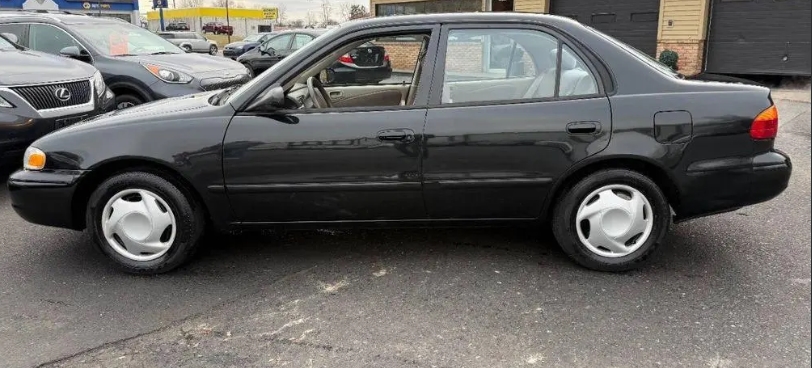
By 1998, the Geo brand was officially dissolved, and the car became the Chevrolet Prizm exclusively. This generation moved to the Toyota E100 Corolla platform. It was a more angular, modern design, but under the skin, it remained purely Toyota.
Models and Trim Levels: The third generation offered two distinct trims, defined by the engine options available.
- Base Model: This trim utilized the 1.6-liter 1ZZ-FE engine, producing 120 horsepower. It was paired with either a 5-speed manual or a 4-speed automatic. The Base model was de-contented compared to previous generations; it featured steel wheels with plastic covers and a simplified interior audio system. However, it maintained the Prizm’s reputation for high crash test scores.
- LS Model: The LS was the premium offering. It added the now-standard power package (windows, locks, and mirrors), keyless entry, and a digital climate control system (a feature Toyota reserved for its higher trims). The LS also featured aluminum alloy wheels and a rear spoiler as standard.
- LSi (2002 Only): For the final year of production in 2002, Chevrolet introduced the LSi trim. This was a value-packaged version of the LS, which included an upgraded stereo with a CD player, floor mats, and anti-lock brakes (ABS) as standard equipment.
The Engine Controversy: It is important to note a quirk of the 1998–2002 Prizm. The “Base” model used the same engine as a 1998 Toyota Corolla CE. However, the “LS” model actually used a slightly older, more durable engine block (the 1.6L 4A-FE) from the previous generation Corolla, while the Base model used the newer 1ZZ-FE engine. Enthusiasts often preferred the LS for this reason, as the 4A-FE was considered more robust and easier to maintain than the newer plastic-heavy engine in the Base model.
Why the Prizm Mattered
The Chevrolet Prizm was not a sales smash hit; it was a niche product. In 1990, the Toyota Corolla sold nearly 250,000 units in the U.S., while the Geo/Chevrolet Prizm struggled to break 60,000 units in its best years.
However, the Prizm’s significance lies in what it taught General Motors. The NUMMI plant, which built the Prizm, consistently scored higher in J.D. Power Initial Quality Studies than GM’s domestic plants. The Prizm proved that American workers, when given Japanese process engineering, could build a car that rivaled the best from Tokyo.
For the consumer, the Prizm was a “sleeper” purchase. It offered Toyota reliability and resale value at a slightly lower price point than the Corolla, often with better factory warranties (GM’s 3-year/36,000-mile bumper-to-bumper warranty was often more competitive than Toyota’s in the early 90s).
The End of the Line and Future Outlook
The Chevrolet Prizm production ended after the 2002 model year. GM and Toyota ended their NUMMI partnership (though it continued until 2009), and GM shifted its focus to its own global platforms.
The successor to the Prizm in Chevrolet’s lineup was the Chevrolet Cobalt (launched in 2005). While the Cobalt was a competent car, it lacked the “Toyota DNA” of the Prizm. Later, Chevrolet adopted the “Delta” platform (shared with the Cruze) for its compact offerings, which eventually evolved into the current Chevrolet Trax and Trailblazer.
Future Outlook: There is no future for the Chevrolet Prizm nameplate. It remains a relic of a unique era of automotive cooperation. Today, the used car market is where the Prizm lives on. High-mileage examples (200,000+ miles) are common, often serving as first cars for teenagers or dependable commuters for budget-conscious buyers.
Parts availability remains high due to the shared Toyota mechanicals. A mechanic can rebuild a Prizm’s engine using genuine Toyota parts, a testament to the vehicle’s enduring engineering.
Conclusion
The Chevrolet Prizm was a product of necessity. In the 1990s, American automakers needed a small car they could not build alone. By “borrowing” Toyota’s Corolla, Chevrolet created a vehicle that defied the typical stereotypes of American compacts.
While it never achieved the fame of the Corvette or the sales volume of the Silverado, the Prizm played a crucial role in Chevrolet’s history. It bridged the gap between the era of the American subcompact failure and the modern era of global platforms. For those who owned one, the Prizm wasn’t just a rebadged Toyota; it was the most reliable car they would ever own.