The Comeback Kid: The Evolution and Legacy of the AMC Jeepster Commando
In the pantheon of American automotive history, few stories are as poignant or fascinating as that of the American Motors Corporation (AMC). Often the scrappy underdog fighting against the “Big Three,” AMC was responsible for some of the industry’s most innovative and enduring designs, from the compact Rambler to the muscular Javelin and AMX. But perhaps one of its most ambitious, and ultimately short-lived, projects was the vehicle meant to bridge the gap between rugged utility and comfortable open-air motoring: the AMC Jeepster Commando.
This is the story of a vehicle that was decades ahead of its time, a retro concept before the term was coined, and a commercial failure that somehow managed to become a beloved cult classic. It is the evolution of the Jeepster Commando, a vehicle born from a legacy of war, reborn in the boardrooms of AMC, and destined to be reimagined for a new century.
A Tale of Two Jeeps: The Ghost of the Original
To understand the 1966 Jeepster, one must first look back to 1948. The post-war world was eager for recreation, and Willys-Overland, the company that had made the “Jeep” a household name during World War II, responded with the Willys Jeepster. It was a charmingly simple vehicle: a convertible with a fold-down windshield, side-curtains, and the same reliable “Go-Devil” engine that powered the military GP. It was marketed not as a farm or military tool, but as a leisure vehicle for the burgeoning post-war suburbs. However, with a base price of $1,125, it was expensive for what it was, and its lack of a 4WD option limited its true off-road appeal. Production ceased in 1950 after only 12,000 units, leaving behind a quirky, beloved footnote in Jeep history.
When American Motors Corporation purchased the “Jeep” brand from Willys-Overland in 1970 (a full two decades later), they inherited this legacy. While the initial 1966 model was a product of Kaiser Jeep, it was AMC’s deep pockets and marketing savvy that would push the Jeepster concept into the 1970s. The name itself was a powerful nostalgic hook, a nod to a simpler, more optimistic time in American history.
.
THIS might be a great place to get your new car from!
Or for those who are into the “car flipping” business, here’s an excellent resource for you!

.
The 1966-1971 Jeepster Commando: A Unique Proposition
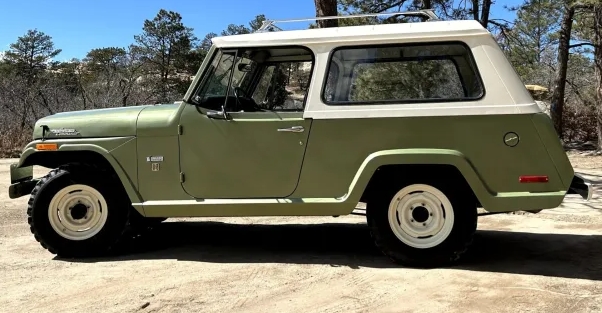
The first vehicle to officially carry the “Jeepster Commando” name was introduced by Kaiser Jeep in 1966. When AMC took over in 1970, the model continued, albeit with some minor updates. This was not simply a convertible. It was a highly modular vehicle, designed from the ground up to be a “one vehicle solution” for a family, offering the utility of a pickup, the open-air fun of a convertible, and the weather-proof security of a station wagon.
The core of the 1966-1971 Jeepster was its unique body. It featured a steel body with removable fiberglass rear quarter panels and a convertible top. The rear sections could be taken off to create a pickup-like “camping” configuration, or a hardtop could be fitted for a fully enclosed station wagon feel. This flexibility was revolutionary. Under the hood, it offered a range of engines, reflecting AMC’s parts-bin philosophy. Early models featured the venerable Willys “F-Head” 134-cubic-inch four-cylinder, but customers could also opt for AMC’s own .six, or the powerful . V8, which turned the diminutive Jeepster into a surprisingly potent performer.
The trim levels, or more accurately, the body styles offered during this era, were defined by their configuration:
- Open Body: This was the classic configuration, featuring the removable fiberglass quarter panels, a folding cloth top, and side curtains. It was the purest expression of the Jeepster’s recreational spirit.
- Station Wagon: This version came with fixed steel rear quarter panels and a full glass rear hatch, essentially creating a two-door compact wagon. It was the family-friendly option, offering cargo space and all-weather comfort.
- Pickup: While less common as a factory configuration, the modular nature of the Jeepster allowed it to be configured with a small truck bed by removing the rear seat and installing a simple bed pan. This gave it genuine light-duty hauling capability.
A key element of the Jeepster’s identity was its front end. To save development costs, it famously used the entire front fascia—including the hood, fenders, and grille—directly from the full-size Pontiac Tempest or GTO of the early 1960s. This “Frankenstein” approach gave the Jeepster a unique look: the rugged, utilitarian body of a Jeep sitting beneath the handsome, wide-grinned face of a Pontiac. It was a design quirk that only added to its charm.
Despite its clever design, the Jeepster Commando was a commercial failure. It was too expensive to compete with VW’s Beetle or the new crop of compact cars, and too small and unproven to appeal to serious off-roaders who preferred the tougher, more utilitarian Jeep CJ. By 1971, with sales sluggish, AMC quietly discontinued the model after a run of approximately 14,000 units.
The Lost Decades: Concept Cars and a Quiet Fading
For nearly two decades after its demise, the Jeepster name lay dormant. The CJ-5 and CJ-7 dominated AMC’s off-road portfolio. However, the spirit of the Jeepster was not entirely extinguished. In 1991, under the ownership of Chrysler (who had acquired AMC), the design team revisited the concept. They created the Jeep Concept 1, a stunning retro-futuristic convertible that was heavily influenced by the 1948 Willys Jeepster. It featured a similar upright windshield, round headlights, and a boxy, open-air design, but with modern amenities and a 4.0-liter inline-six engine.
The following year, in 1992, they followed up with the Jeepster Concept. This vehicle was even more explicitly a homage to the 1966 model, featuring a similar two-door layout and modularity. It was a design exercise, a love letter to the past, and a way to gauge public interest in a modern recreational vehicle. While these concepts never made it to production, they planted a seed. They proved that the idea of a “Jeepster” still resonated with designers and, potentially, with the public. For the next decade, however, the Jeepster name remained a historical footnote.
The 2008-2010 Jeepster Commando: A Misguided Revival
As the 2000s progressed, Chrysler (now part of DaimlerChrysler, and later a standalone entity again) began to explore new market niches. The “retro” trend was in full swing, epitomized by the wildly successful 2005 Ford Mustang. Chrysler had its own retro hit with the 300C, and the time seemed right to bring back another classic name. The Jeepster was an obvious candidate.
Development began on what was internally known as the “JC” platform, a front-wheel-drive unibody platform shared with the Dodge Caliber and the Dodge Nitro. This was the first sign that this new Jeepster would be a departure from its rugged roots. In 2008, the vehicle was officially launched as the Jeep Commander, an almost direct copy of the name used by AMC back in 1966. It was offered in four distinct trim levels, designed to appeal to different segments of the burgeoning small crossover market.
- Commander X: This was the base model, offering standard 4×2, with optional 4×4. It came with the 2.4-liter “World” inline-four engine, producing 158 horsepower. It was the entry-level, economy-focused version.
- Commander 70th Anniversary: A special edition released to celebrate 70 years of the Jeep brand, this trim featured unique exterior badges, a premium interior with Saddle brown leather seats, a 6.5-inch touchscreen navigation system, and the 2.4-liter engine as standard.
- Commander Overland: The most rugged-looking of the trims, the Overland included features like underbody skid plates, tow hooks, and a unique “safari” style tan top. It was offered with a more powerful 3.7-liter PowerTech V6 engine, producing 215 horsepower, and came standard with full-time 4×4.
- Commander S: The “sport” trim, this model was designed for on-road performance. It featured 18-inch polished aluminum wheels, a firmer suspension, and body-color trim. It was offered only with the front-wheel-drive configuration.
On paper, the 2008 Jeep Commander seemed to check all the right boxes. It was stylish, offered multiple trims, and carried a beloved name. In reality, it was a critical and commercial disaster. The automotive press lambasted it for its name (which sounded forced), its unexciting driving dynamics, and its fundamental lack of off-road credibility. Built on a car-based FWD platform, it was a Jeep in name only. It was also priced aggressively, putting it in competition with much more refined and capable crossovers. Compounding its problems, the 2008 global financial crisis hit the auto industry hard, and the Jeepster Commander was seen as an unnecessary, confusing model in a shrinking market.
Production lasted for a single, bleak year, with the 2010 model year being the last. Fewer than 25,000 units were sold. It was quietly killed off, becoming another failed attempt to resurrect a storied name.
The Future Outlook: A Legend Still Waiting
So where does the Jeepster Commando stand today? The 1966-1971 models are now highly sought-after collector’s items. Their quirky design, historical significance, and open-air fun have earned them a passionate following. They represent a unique moment when AMC tried to create a category of its own. They are seen as charming, if flawed, pioneers of the modern crossover convertible.
The 2008-2010 models, on the other hand, are already becoming obscure. They are a footnote in Jeep history, a cautionary tale about the dangers of leveraging nostalgia without the authentic engineering to back it up.
Looking forward, the future of the Jeepster name remains a topic of speculation among enthusiasts. With the massive success of the modern Jeep Wrangler, which itself has become a highly profitable lifestyle vehicle, and the boom in the “SUV-Convertible” and “SUV-Coupe” segments (seen in vehicles like the Range Rover Evoque Convertible and the Mercedes GLE Coupe), the market conditions that were right for the original Jeepster are arguably back. A modern Jeepster, built on the Wrangler platform with open-air versatility and retro-inspired styling, could be a phenomenal success.
The story of the AMC Jeepster Commando is a tale of two distinct eras, one of ambitious innovation and one of misguided marketing. The first was a genuine attempt to create something new; the second was a cynical cash-in on a bygone era. Yet, both share the same DNA: the desire to blend Jeep’s rugged heritage with a more comfortable, stylish, and accessible form. It remains one of the most intriguing “what if” stories in American automotive history, a vehicle that failed to find its audience in its own time, but whose brilliant, unconventional spirit continues to captivate car lovers decades later.