The Datsun Redi-GO: A Budget-Hatchback’s Odyssey from Launch to Legacy
In the highly competitive and cut-throat automotive landscape of emerging markets, few vehicles have encapsulated the spirit of accessibility quite like the Datsun Redi-GO. Launched as a pivotal product in Nissan’s global revival strategy for the budget brand, the Redi-GO was more than just a car; it was an attempt to democratize mobility. Spanning a production run from 2016 to 2022, the Redi-GO navigated the turbulent waters of the Indian and international markets, offering a unique blend of crossover aesthetics and city-car practicality.
This article explores the complete evolution of the Datsun Redi-GO, tracing its history, technical lineage, trim levels, and eventual sunset.
Part I: Genesis and History
To understand the Redi-GO, one must understand the revival of the Datsun brand. Datsun, originally a historical marque of Nissan, was retired in 1986. However, in 2013, Nissan resurrected the brand with a specific mission: to penetrate high-growth emerging markets—specifically India, Russia, South Africa, Indonesia, and Brazil—with affordable, compact vehicles.
Following the launch of the Datsun GO hatchback and the GO+ MPV, the brand needed a vehicle that could capitalize on the rising trend of “crossover” styling in small cars. Consumers wanted the high seating position and plastic cladding of an SUV, but at the price point of a city car.
Thus, the Datsun Redi-GO was born. Based on the heavily revised Nissan V-platform (shared with the Kwid and the Renault-Nissan Alliance), the Redi-GO was designed to offer a distinct identity. While its mechanical sibling, the Renault Kwid, mimicked a mini-SUV, the Redi-GO aimed for a more futuristic, technical aesthetic.
The vehicle was officially unveiled in concept form at the 2014 Delhi Auto Expo, with the production model launching in India on June 7, 2016.
.
THIS might be a great place to get your new car from!
Or for those who are into the “car flipping” business, here’s an excellent resource for you!

.
Part II: First Generation (2016–2020) – The Debut
The initial phase of the Redi-GO’s life was defined by its entry into the booming “Entry Hatch” segment. It was positioned against the Maruti Suzuki Alto K10, Hyundai Eon, and the Renault Kwid.
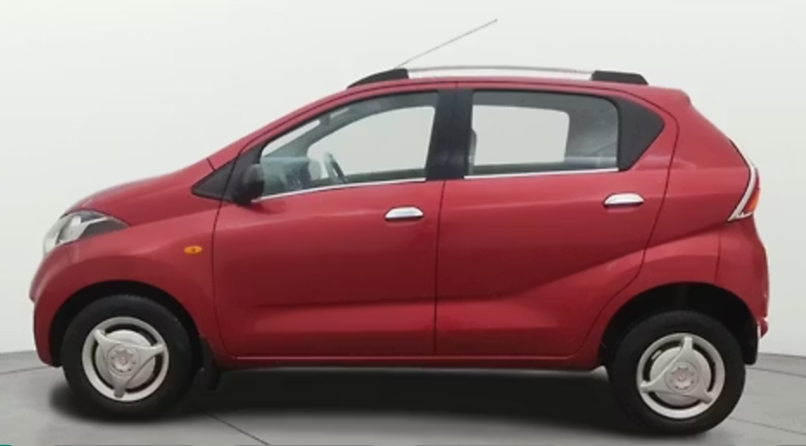
Dimensions and Styling: The first-generation Redi-GO measured 3,427 mm in length, 1,560 mm in width, and 1,545 mm in height, with a wheelbase of 2,348 mm. It boasted a segment-leading ground clearance of 185 mm. The design language was sharp, characterized by a trapezoidal grille, swept-back headlamps, and a distinct “floating roof” design (a result of blacked-out A and B pillars).
Powertrain: Under the hood, the Redi-GO launched with a singular engine option:
- Engine: 799cc D-Series (D-C gasoline) Inline-3.
- Power: 54 PS @ 5,678 rpm.
- Torque: 72 Nm @ 4,250 rpm.
- Transmission: 5-speed manual.
It utilized a cable-type gearshift mechanism, which was a highlight in marketing materials for its smoothness, though purists noted the lack of an automatic option at launch was a disadvantage compared to the AMT variants entering the market.
Trim Levels (2016 Launch): The initial lineup was strictly segmented to keep costs low:
- Datsun Redi-GO D (Base):
- Target: Commercial/Entry-level buyers.
- Features: Basic vinyl flooring, manual windows, black bumpers, 12-inch steel wheels with hubcaps, and a basic audio system without speakers (speaker sockets were optional).
- **Datsun Redi-GO A: (Often referred to as the A/O variant)
- Target: Budget-conscious families.
- Features: Upgraded fabric upholstery, body-colored bumpers (in some markets), and improved interior trim.
- Datsun Redi-GO T (Mid-Spec):
- Target: Aspirational youth.
- Features: This was the volume seller. It included a 2-DIN audio system with Bluetooth, front power windows, full wheel covers, and a rear parcel tray.
- Datsun Redi-GO L (Top-Spec):
- Target: Feature-focused buyers.
- Features: Added rear power windows, electrically adjustable ORVMs (Outside Rear View Mirrors), and body-colored door handles.
2017 Update: The Engine Transition In late 2017, Nissan faced a challenge. The older 799cc engine struggled to meet newer, stricter emission norms (BS-IV) without expensive re-engineering. Consequently, Datsun replaced the 799cc engine with a larger, more efficient 999cc unit.
- New Engine: 999cc D-Series Inline-3.
- Power: 68 PS (a significant jump).
- Torque: 91 Nm.
- Impact: This engine overhaul revitalized the car. The 1.0L variant offered much better drivability and highway capability. The trim levels remained the same, but badging was updated to reflect the new engine capacity.
Part III: The Mid-Life Facelift (2020) – The “Redi-GO Pro”
By 2020, the automotive industry was shifting rapidly. Safety norms were tightening (BS-VI emission standards and mandatory safety features like airbags and ABS), and consumer tastes were evolving. Datsun responded with a significant facelift launched on June 10, 2020.
This update was crucial as it marked the introduction of an automatic transmission, a vital requirement for the Indian city driving conditions.
Exterior Changes: The 2020 facelift, often dubbed the “Redi-GO Pro,” featured a major design overhaul.
- Front Fascia: The trapezoidal grille was enlarged and squared-off, flanked by new split headlamp units. The DRLs (Daytime Running Lights) were integrated into the grille, a first for the segment.
- Rear: New taillights and a redesigned bumper gave the car a wider stance.
- Wheels: The car moved to 14-inch wheels as standard on higher trims, improving stability.
Interior and Technology: The interior saw a complete refresh, moving away from the stark plastics of the 2016 model.
- Dashboard: A new dual-tone beige and black dashboard layout.
- Screen: An 8-inch touchscreen infotainment system (on top trims) with Apple CarPlay and Android Auto.
- Convenience: Keyless entry was introduced (on higher trims).
Powertrain and Transmission: The 1.0L engine was retained but updated to meet BS-VI norms.
- Engine: 999cc BS-VI compliant D-Series.
- Power: 68 PS / 91 Nm.
- Transmission Options:
- 5-speed Manual.
- 5-speed Automated Manual Transmission (AMT) – A first for the Redi-GO.
Trim Levels (2020–2022): The facelift simplified the lineup to four main variants, dropping the older A/D nomenclature in favor of a more structured approach:
- Redi-GO D (Base):
- Engine: 800cc (BS-VI) – Yes, Datsun re-introduced the smaller engine for the base variant to keep the entry price competitive, though it was detuned to roughly 54 PS.
- Features: Basic audio system (no radio, just USB/aux), manual mirrors, manual windows, 14-inch steel wheels.
- Redi-GO A (Mid-Low):
- Engine: 1.0L.
- Features: Added front power windows, remote keyless entry, and a music system with radio and USB.
- Redi-GO T (Mid-Spec):
- Engine: 1.0L (Manual & AMT available).
- Features: Added rear power windows, electrically adjustable ORVMs, body-colored bumpers, and 14-inch steel wheels with covers.
- Redi-GO L (Top-Spec):
- Engine: 1.0L (Manual & AMT available).
- Features: The full suite. 8-inch touchscreen infotainment, LED DRLs, diamond-cut alloy wheels, and a rear camera.
Part IV: Market Performance and Competitors
Throughout its lifecycle, the Redi-GO carved a niche for itself. While it never dethroned the Maruti Suzuki Alto (the segment king), it offered a distinct value proposition.
Key Competitors:
- Renault Kwid: Its platform sibling. The Kwid had a more rugged SUV look, while the Redi-GO opted for a sleeker, urban look.
- Maruti Suzuki Alto K10: The benchmark for reliability and resale value.
- Hyundai Eon (until 2019): Offered better build quality but at a higher price.
- Maruti S-Presso: Launched later, the S-Presso directly challenged the Redi-GO’s tall-boy design.
Strengths:
- Ride Quality: The Redi-GO was widely praised for its suspension setup. It absorbed potholes exceptionally well, making it ideal for rough city roads.
- Space: Despite its compact footprint, the flat roof and upright seating provided excellent headroom and shoulder room for four adults.
- Fuel Efficiency: The 1.0L manual variant returned approximately 20-22 km/l, a strong selling point.
Weaknesses:
- Build Quality: The interiors, particularly the hard plastics in the first generation, felt budget-oriented.
- Safety: While compliant with regulations, the car never achieved high safety ratings in global crash tests (such as Global NCAP), which became a growing concern for Indian consumers by 2020.
Part V: The Sunset (2022)
Despite the facelift in 2020, the Redi-GO faced an uphill battle. The global semiconductor shortage impacted production, and the entry-level hatchback segment itself was shrinking as buyers migrated to compact SUVs and premium hatchbacks.
Furthermore, Datsun’s global strategy was shifting. Nissan had announced plans to discontinue the Datsun brand in many markets to focus on Nissan and its premium “Ariya” and “Z” lineups.
In late 2021, rumors began to circulate about the Redi-GO’s discontinuation. On March 31, 2022, Nissan officially announced the end of production for the Datsun Redi-GO in India, its primary market.
Interestingly, the car continued to sell in other markets (like South Africa) for a short period using remaining stock, but by late 2022, the Datsun Redi-GO had effectively exited the global stage.
Part VI: Technical Specifications Summary
| Feature | 1st Gen (2016-2017) | 1st Gen 1.0L (2017-2020) | Facelift (2020-2022) |
|---|---|---|---|
| Engine | 799cc D-Series I3 | 999cc D-Series I3 | 999cc D-Series I3 (BS-VI) / 800cc (Base) |
| Power | 54 PS | 68 PS | 68 PS (1.0L) / 54 PS (0.8L) |
| Torque | 72 Nm | 91 Nm | 91 Nm |
| Transmission | 5-Speed MT | 5-Speed MT | 5-Speed MT / 5-Speed AMT |
| Length | 3,427 mm | 3,427 mm | 3,436 mm |
| Width | 1,560 mm | 1,560 mm | 1,574 mm |
| Ground Clearance | 185 mm | 185 mm | 187 mm |
| Fuel Tank | 35 Liters | 35 Liters | 35 Liters |
Part VII: Future Outlook and Legacy
With the Datsun Redi-GO now a vehicle of the past, its legacy is analyzed through the lens of Nissan’s strategy. The Redi-GO proved that a budget car could have crossover styling cues without exorbitant costs. It popularized the “tall-boy” stance in the entry segment, influencing the design of subsequent cars like the S-Presso.
Future Outlook: There is currently no direct successor planned for the Datsun Redi-GO. The Datsun brand has been largely retired globally. However, the technology underpinning the Redi-GO—the V-platform—lives on. We are likely to see a fully electric evolution of this platform in the future. Nissan has hinted at bringing more affordable EVs to emerging markets. Given the success of the Renault Kwid EV (the Dacia Spring) in Europe, it is plausible that a Nissan-badged city EV could emerge in the coming years, serving as a spiritual successor to the Redi-GO.
Conclusion: The Datsun Redi-GO was a product of its time. It emerged when the market demanded affordable mobility with a touch of style. Over its six-year lifespan, it evolved from a basic 799cc manual to a feature-rich 1.0L AMT crossover-hatch. While it is no longer in production, the Redi-GO remains a common sight on the roads of India, South Africa, and Russia—a testament to its reliability and the role it played in putting millions of first-time car buyers behind the wheel. It stands as a fascinating chapter in the history of the global automotive industry’s pursuit of the “people’s car.”