The Diamond’s Forgotten Edge: A History of the Mitsubishi Tredia
In the automotive landscape of the 1980s, a period defined by the dawn of electronic fuel injection, the rise of the hatchback, and the battle for the hearts of compact car buyers, Mitsubishi Motors was a formidable player. Known for its rally-bred Galant and the innovative Starion, the brand also had a deep bench of capable, if less celebrated, economy cars. Among them was a model that remains a curious footnote in the company’s North American history: the Mitsubishi Tredia.
For a brief window between 1982 and 1988, the Tredia served as Mitsubishi’s answer to the Toyota Corolla, Honda Civic, and Nissan Sentra. It was a product of its time—square, practical, and engineered with a focus on efficiency and reliability. Though it never achieved the legendary status of its rivals, the Tredia’s story is a fascinating look at a crucial, transitional era for both Mitsubishi and the global auto industry. This is the history of the Mitsubishi Tredia, a forgotten nameplate that was, in many ways, a diamond in the rough.
The Genesis: Born from the Mirage
The Tredia did not emerge from a vacuum. Its story begins with the 1978 Mitsubishi Mirage, a subcompact hatchback designed to combat the growing dominance of Japanese competitors in the global B-segment. The Mirage was a clever, frugal car that proved popular in its home market and across Asia.
When Mitsubishi prepared to formally enter the North American market in the early 1980s (moving beyond a limited number of Dodge-badged vehicles), it needed a lineup. The Mirage, renamed the Dodge Colt for US consumption, formed the base. However, a hatchback alone wasn’t enough; a traditional sedan was required to compete with the Corolla and Sentra directly.
Thus, in 1982, Mitsubishi introduced the Mitsubishi Starion (a performance coupe) and the Mitsubishi Tredia (a compact sedan). The name itself was a clever piece of marketing, suggesting “tread” and “dia” (perhaps for diamond, Mitsubishi’s logo), implying a car with a solid footprint and a diamond-like quality. The Tredia was essentially the four-door sedan version of the Mirage platform, sharing its chassis, mechanicals, and core design language.
First Generation (1982-1985): The Humble Arrival
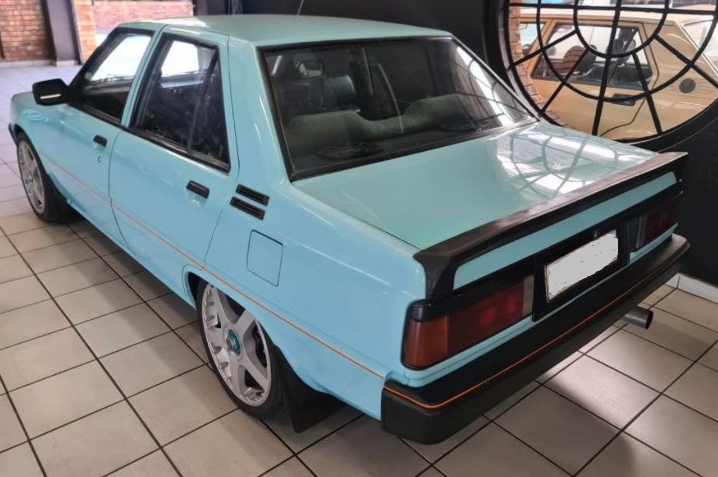
The first-generation Tredia launched in the US market for the 1983 model year. It was a classic 1980s three-box sedan: upright, angular, and modestly sized. Its design was a product of the “folded-paper” aesthetic popular at the time, featuring sharp creases, flat planes, and a simple, upright greenhouse. With a wheelbase of just 93.7 inches and an overall length of roughly 158 inches, it was firmly in the compact class, even smaller than today’s subcompacts.
The interior was equally spartan and utilitarian. High-trim models offered features like plush velour seats and a basic AM/FM radio, but the focus was on function over flair. The dashboard was a simple, horizontal design, and rear legroom was adequate but not generous. For its intended audience of young professionals and families seeking affordable transportation, this simplicity was a virtue.
Under the hood, the Tredia offered a straightforward range of engines that reflected Mitsubishi’s engineering priorities.
- Base Models (1.4-Liter): The entry-level Tredia came with a 1.4-liter inline-four engine (code: 4G12), producing a modest 68 horsepower. This engine was designed for maximum fuel economy, and paired with a 4-speed manual transmission, it could achieve over 30 MPG on the highway—impressive numbers for the era.
- GL Models (1.6-Liter): The more popular and desirable trim was the Tredia GL. It was powered by a larger 1.6-liter SOHC inline-four (code: 4G32), the same “Saturn” engine found in the Dodge Colt and Mitsubishi Starion. This engine was a key part of Mitsubishi’s lineup and was known for its durability. It produced 83 horsepower, which, while not exhilarating, provided a much-needed boost in performance for highway merging and climbing hills.
Transmission options were a classic 1980s affair: a 4-speed manual was standard on the base model, with a 5-speed manual available on the GL. The popular option was the 3-speed automatic, which, while efficient, did little to help the car’s acceleration.
Trim levels for the first generation were simple:
- Base: The no-frills model, often equipped with the 1.4-liter engine and rubber floor mats.
- GL: The volume seller, typically featuring the 1.6-liter engine, upgraded trim, a tachometer, and sometimes air conditioning as an option.
By 1984, Mitsubishi also introduced the Tredia 4WD, a unique and highly practical variant. This model featured a selectable four-wheel-drive system, activated by a floor-mounted lever. It was a rugged, go-anywhere sedan, perfect for snowy climates, and a precursor to the rise of crossover utility vehicles decades later.
Second Generation (1986-1988): The “Box-on-Wheels” and Turbo Ambitions
For 1986, Mitsubishi gave the Tredia a significant refresh, resulting in what is often called the second generation. While it rode on the same chassis and shared the same basic mechanicals, the car underwent a thorough visual and aerodynamic overhaul.
The primary goal of the redesign was to improve the car’s drag coefficient. The upright, boxy profile was softened with redesigned front and rear fascias. The front end featured a more integrated bumper and a larger, more aerodynamic grille. The headlights became flush-mounted composite units, a modern touch for the time. The rear was updated with a more sloped trunk lid and wraparound taillights. The result was a cleaner, more modern look that aligned with the softer, more rounded designs of the mid-to-late 1980s.
Inside, the updates were more substantial. The dashboard was redesigned with a more driver-focused, semi-instrumentation pod that wrapped around the main gauges. The materials saw a slight upgrade, and a new digital仪表仪表 (instrument cluster) was offered on high-end models, featuring an electronic tachometer and trip computer—a nod to the tech-forward ’80s. Ergonomics were also improved.
The engine lineup for the second generation remained centered on the 1.6-liter 4G32 engine, but with slight revisions. Base models continued with the 1.4-liter, but the 1.6-liter was the hero. Horsepower saw a minor bump to 88 hp in some markets, thanks to improved intake and exhaust.
However, the most exciting addition to the Tredia lineup in 1987 was the introduction of the Tredia Turbo.
This high-performance model was a true “sleeper.” It was powered by a 1.8-liter turbocharged inline-four (code: 4G62T), the same engine that powered the mighty Dodge Colt Turbo and Mitsubishi Starion. With the turbocharger and intercooler, this engine produced an impressive 143 horsepower and 152 lb-ft of torque.
The Tredia Turbo was a completely different animal.
- Appearance: It was visually distinct, featuring a deeper front air dam, flared wheel arches, integrated side skirts, a rear spoiler, and “Turbo” badging.
- Performance: Paired with a 5-speed manual transmission, the Turbo could sprint from 0-60 mph in just under 8 seconds, making it faster than many contemporary sports cars. It also came standard with a limited-slip differential (LSD) to put the power down effectively.
- Suspension: The Turbo model received a firmer, lower suspension and larger disc brakes.
The trim levels for the second generation were expanded:
- Base: Still the entry point, often with the 1.4L engine.
- GL: The standard 1.6L model, available with the 5-speed manual or 3-speed automatic.
- GLX: The top-of-the-line luxury trim. It typically included power windows, power locks, a sunroof, an upgraded audio system, and the more refined digital dashboard.
- Turbo: The performance-oriented model with the 1.8L turbo engine, manual-only, and unique styling.
Competition and Legacy
The Tredia entered a brutally competitive market. Its primary rivals were:
- Toyota Corolla (E30/E40): The undisputed king of reliability and resale value.
- Honda Civic: The champion of engineering efficiency, with its CVCC engine and nimble handling.
- Nissan Sentra (B11/B12): A tough, reliable, and well-rounded competitor.
- Ford Escort: The American champion of the segment, co-developed with Mazda.
Against these titans, the Tredia struggled to find a unique identity. It was reliable and economical, but it lacked the brand cachet of Toyota, the engineering flair of Honda, or the rugged simplicity of the Sentra. The Tredia Turbo was its saving grace, a cult classic that earned respect for its surprising performance, but it was a niche model that couldn’t carry the entire line.
The Tredia’s decline was swift. By 1988, Mitsubishi was shifting its focus. The Mirage platform was evolving, and the company was preparing to launch the more stylish and modern Mirage sedan (which would later be known as the Eagle Summit in the US). The Tredia nameplate was dropped after the 1988 model year, quietly exiting the stage.
The Tredia’s legacy is twofold. For the average buyer, it was an unremarkable but dependable appliance that served its purpose without fanfare. For enthusiasts, however, the Tredia Turbo remains a celebrated “sleeper,” a testament to the ingenuity of cramming a powerful turbo engine into a humble family sedan.
Today, the Tredia is an extremely rare sight on American roads. Its humble status meant most were used until they were worn out and sent to the scrapyard. The few surviving examples, especially the Turbo models, are prized by Mitsubishi collectors and fans of 80s Japanese iron.
Future Outlook
There is no future for the Mitsubishi Tredia as a nameplate. Mitsubishi has long since left the compact sedan market in North America, concentrating instead on crossovers like the Outlander and Eclipse Cross. The Tredia remains a historical footnote, a product of a specific time when a small, square, and simple sedan was a vital entry point for a brand.
However, its spirit endures in a different form. The modern Mitsubishi Mirage, a subcompact hatchback and sedan, is the direct philosophical descendant of the original Tredia and Mirage. It prioritizes fuel economy, a low purchase price, and straightforward transportation—a formula the company perfected with the Tredia.
The Mitsubishi Tredia was not a revolutionary car. It was, however, a competent and honest one. It was a crucial stepping stone that helped establish Mitsubishi’s presence in the North American market. It represented a brand finding its footing, and in the wild and woolly 1980s, it even offered a Turbo model that punched far above its weight class. For that reason alone, the Tredia deserves its place in the annals of automotive history—a forgotten name with a surprising edge.