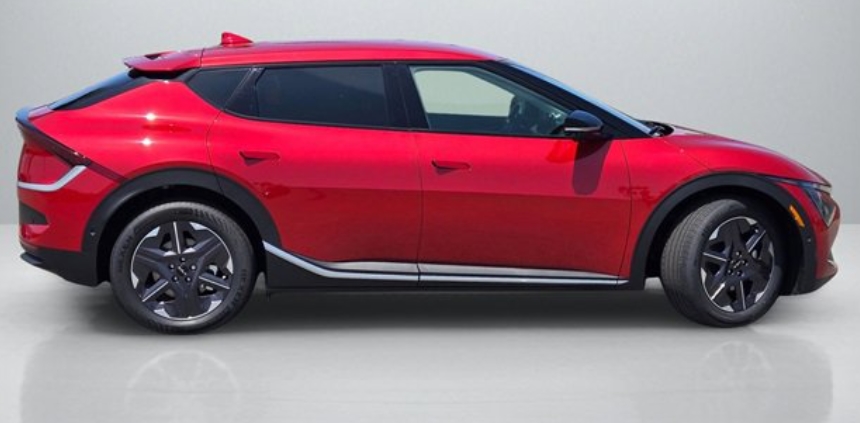
The Electric Jolt: How the Kia EV6 Charged a New Era for an Automotive Giant
In the annals of automotive history, certain vehicles arrive not merely as new products, but as seismic events that redefine a brand’s trajectory. The Ford Model T democratized motoring. The Toyota Prius made hybrid power mainstream. And in 2021, the Kia EV6 arrived to do for electric vehicles what the latter did for hybrids: it shattered perceptions, turning a brand once associated with sensible, budget-friendly transport into a purveyor of cutting-edge, desirable, and high-performance electric technology.
The EV6 was more than just Kia’s first dedicated battery-electric vehicle under its new “Opposites United” design philosophy; it was a declaration of intent. Built on the revolutionary Hyundai Motor Group Electric-Global Modular Platform (E-GMP), it was a showcase of speed, style, and staggering range that won the hearts of critics and consumers alike, culminating in the prestigious 2022 European Car of the Year award. This is the story of its evolution, from its groundbreaking launch to its current status as a benchmark in the competitive electric crossover segment.
The Genesis: A Platform for Revolution
To understand the EV6, one must first understand the E-GMP platform. Co-developed with its corporate sibling Hyundai (which used it for the Ioniq 5), E-GMP was a ground-up 800-volt architecture. This was a game-changer. While many competitors were still using 400-volt systems, the higher voltage allowed for significantly faster charging (up to 210 kW in ideal conditions), superior thermal management for sustained performance, and greater power efficiency.
The platform was also incredibly versatile, allowing for a “skateboard” design with a flat floor, which liberated interior space to an almost unbelievable degree. For Kia, E-GMP was the technological bedrock upon which the EV6 was built, a platform that enabled them to leapfrog many established players in a single bound. The brief history of the EV6, therefore, is intrinsically linked to the history of E-GMP—a platform designed from day one to be electric, not an adaptation of an existing internal combustion chassis.
.
RepairSurge Online Repair Manuals Replace Bulky Books With Reliable Digital Information!
Faster And Cheaper Than Traditional Printed Manuals, Users Get Instant Access To The Repair Information They Need For Any Car, Truck, Van or SUV:
.
The Initial Onslaught (2022 Model Year): Arrival and Dominance
The Kia EV6 made its market debut as a 2022 model year vehicle in the United States and other key global markets, with production beginning in mid-2021 at Kia’s Hwasung plant in South Korea. It arrived in a single bodystyle—a sleek, fastback crossover coupe with an aggressive stance and “tiger-nose” inspired lighting signatures. The initial lineup was thoughtfully structured, offering a compelling blend of range and performance.
Trims and Powertrains at Launch:
- EV6 Light (RWD): The entry point to the family. It featured a single, rear-mounted electric motor producing 167 horsepower and 258 lb-ft of torque. Its key draw was a 58.0 kWh battery pack, which provided a respectable EPA-estimated range of 232 miles. It was the most affordable way into the EV6 ecosystem.
- EV6 Wind (RWD): The range-focused workhorse. This trim utilized a larger 77.4 kWh battery pack paired with the same rear-wheel-drive motor. This combination was a masterstroke, delivering an impressive EPA-estimated range of 310 miles, making it a legitimate threat to longer-range rivals.
- EV6 Wind (AWD): This model added a second motor to the front axle, creating an all-wheel-drive system. Power jumped to 320 hp and 446 lb-ft of torque, with a slight reduction in range to an EPA-estimated 274 miles due to the added weight and power draw.
- EV6 GT-Line (RWD): This was less a performance trim and more an aesthetics and features package. Built on the Wind RWD powertrain, the GT-Line added unique 20-inch wheels, a body kit, premium “relaxation” front seats (with power leg rests), a heads-up display with augmented reality navigation, a panoramic sunroof, and distinctive exterior lighting elements.
- EV6 GT-Line (AWD): This model combined the AWD powertrain from the Wind AWD with all the aesthetic and technological enhancements of the GT-Line trim, becoming the de facto luxury and tech flagship of the initial lineup.
The response was immediate and overwhelmingly positive. The EV6’s combination of dramatic styling, a superb interior with dual 12.3-inch screens, the lightning-fast 800V charging, and its available long range set it apart. It didn’t just compete; it often led the pack.
Expansion and Electrification (2023 Model Year): The GT Arrives
For its second year, the EV6 lineup remained largely stable, with the core Light, Wind, and GT-Line trims carrying over largely unchanged. However, 2023 marked the arrival of the model the performance world had been waiting for: the EV6 GT.
This was not merely another trim level; it was the apex predator of the family, a direct challenger to the Porsche Macan EV and other performance-oriented electric crossovers.
The EV6 GT:
- Powertrain: Equipped with dual motors, one on each axle, but dialed up to extreme levels.
- Performance: Total system output was a staggering 576 horsepower and 545 lb-ft of torque (with a 10-second “Boost” mode that temporarily over-boosted power to 641 hp). This raw power propelled the EV6 GT from 0-60 mph in a manufacturer-claimed 3.5 seconds, with reviewers clocking it even faster.
- Drivetrain & Handling: In addition to the immense power, the GT featured an electronic Limited-Slip Differential (e-LSD) for better traction out of corners, and a unique “Drift Mode” for controlled, tire-smoking slides on closed courses. It also came standard with electronically controlled suspension with continuously adjustable dampers, allowing drivers to fine-tune the ride between comfort and track-ready stiffness.
- Aesthetics: Visually, the GT distinguished itself with unique 21-inch wheels, neon-green brake calipers, aggressive front and rear fascia elements, and “GT” badging.
The arrival of the GT solidified the EV6’s credentials. It was no longer just a stylish and efficient crossover; it was a legitimate performance machine capable of embarrassing supercars at a traffic light. The downside was a significant hit to range, with the GT rated at just 206 miles per charge—a testament to the energy required to move such a heavy vehicle with such ferocity.
Refinement and the Introduction of the GT-Line S (2024 Model Year)
As the EV6 matured, Kia focused on refining the package rather than making sweeping changes. The 2024 model year saw the lineup get a minor but significant reshuffle, particularly in North America. The “GT-Line” trim was split into two distinct sub-levels, offering clearer choices for buyers.
2024 EV6 Lineup:
- EV6 Light (RWD): The entry-level model remained, still equipped with the 58.0 kWh battery.
- EV6 Wind (RWD & AWD): The core trims continued as before, offering the best balance of range (RWD) and all-weather capability (AWD).
- EV6 GT-Line (RWD & AWD): These trims now became the mid-to-high-end luxury models. They included all the features previously associated with the GT-Line name, such as the relaxation seats, panoramic sunroof, and unique styling elements.
- EV6 GT-Line S (RWD & AWD): This was the new top-of-the-line, feature-packed trim. It built upon the GT-Line by adding a suite of advanced driver-assistance systems (like Highway Driving Assist 2), a premium Meridian sound system, a heat pump (for more efficient cold-weather operation), heated rear seats, and steering wheel, and other high-end amenities. It essentially consolidated the most desirable optional packages into a single trim designation.
- EV6 GT: The performance king remained, largely unchanged and still offering its jaw-dropping performance.
In mid-2023, Kia also began rolling out the EV6 with a minor “update” for 2024 models in some markets, which included a slightly revised front bumper design for better cooling and aerodynamics, new exterior color options, and—most importantly—a powertrain software update that slightly boosted the charging speed from 210 kW to a peak of 240 kW on DC fast chargers.
The 2025 Facelift: Subtle Changes, Continued Focus
The 2025 model year brings a mid-cycle refresh to the EV6. While it isn’t a complete redesign, the updates are meaningful and focus on retaining the model’s competitive edge. The changes are primarily aesthetic and technological:
- Exterior: A revised front bumper and a new full-width LED light bar at the rear modernize the look, bringing it in line with newer Kia EVs like the EV9. A new set of 19- and 20-inch wheel designs are also introduced.
- Interior: A new steering wheel design and upgraded materials and stitching are intended to enhance the premium feel.
- Technology: The infotainment system receives a welcome boost in processing power, making it snappier and more responsive. A new fingerprint authentication system allows the driver to start the car and personalize settings without a key fob.
- Range Boost (UK/Europe): In a significant move, the 2025 refresh sees the battery capacity for the 77.4 kWh models increase slightly to 84.0 kWh. This, combined with more efficient motors and aerodynamic tweaks, results in a notable range increase, with some models exceeding 360 miles on the WLTP cycle. It remains to be seen if this larger battery will be offered in North America.
The core trims (Light, Wind, GT-Line, GT-Line S, GT) are expected to carry over, with the GT-Line S remaining the feature-rich flagship and the GT continuing to be the ultimate performance variant.
The Future Outlook
The Kia EV6 has firmly established itself as a pillar of Kia’s electrification strategy. Its success has proven that a brand can rapidly transform its image and compete at the highest level of the automotive industry with the right technology, design, and ambition.
Looking forward, the EV6 is expected to continue its run with minor updates until it reaches the end of its lifecycle, likely around 2027 or 2028. The future of the “EV6” nameplate will eventually transition to a next-generation model built on an evolved version of E-GMP or an entirely new platform, potentially incorporating advancements in solid-state battery technology.
But the legacy of the current EV6 is already secure. It was the vehicle that proved Kia was no longer the “alternative” choice, but a primary one. It forced competitors to up their game in charging speed and interior design. It showed that electric vehicles could be thrilling, beautiful, and practical all at once. The Kia EV6 was the electric jolt that awoke the automotive world to a new, formidable player, and its evolution from a brilliant debutante to a refined and formidable performance icon is a masterclass in how to successfully launch and sustain a groundbreaking vehicle in the modern era.