The Enduring Charm of the Daihatsu Ceria: A Deep Dive into Indonesia’s Beloved City Car
In the vibrant and often congested urban landscapes of early 21st-century Indonesia, the need for a small, economical, and agile vehicle was paramount. While the market was dominated by larger MPVs and sedans, a niche existed for a car that could navigate narrow streets with ease, sip fuel conservatively, and offer the freedom of personal mobility at an accessible price point. Into this environment, in 2001, PT Astra Daihatsu Motor (ADM) introduced a car that would become a cult classic: the Daihatsu Ceria. Though its production run was relatively short, the Ceria’s story is a fascinating case study in automotive adaptation, market strategy, and the lasting appeal of simplicity.
Genesis: From the Japanese Kei Car to an Indonesian Icon
The story of the Daihatsu Ceria does not begin in Indonesia, but in Japan a decade earlier. Its foundation is the third-generation Daihatsu Mira (chassis code L200), a highly successful kei car produced from 1990 to 1994. Kei cars, or “light automobiles,” are a specific Japanese vehicle category defined by strict regulations on size and engine displacement, offering owners tax and insurance benefits. The L200 Mira was a paragon of this class: compact, ingeniously packaged for maximum interior space, and powered by a small but efficient engine.
By the late 1990s, the L200 platform was long since superseded in its home market. However, its core attributes—a robust and proven chassis, a simple mechanical design, and low production costs—made it an ideal candidate for introduction into developing automotive markets. This strategy, known as platform recycling, allows manufacturers to offer a new product without incurring the massive research and development costs of a ground-up design.
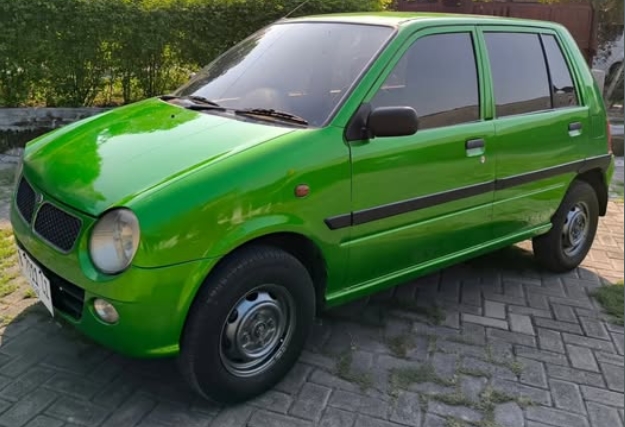
For the Indonesian market, Daihatsu saw an opportunity to create a new entry-level champion. They took the three-door hatchback variant of the L200 Mira, made necessary adjustments for local conditions and regulations, and christened it the “Ceria,” a name that translates to “Cheerful” in Indonesian—a perfect descriptor for the car’s plucky character and bright colour palette. Launched in 2001, the Daihatsu Ceria was positioned as an affordable first car for students, young professionals, and small families looking to graduate from two-wheeled transport.
.
NO MORE dead batteries with this:

.
The Heart of the Matter: Engine and Performance
Throughout its entire production life from 2001 to 2006, the Daihatsu Ceria was powered by a single engine option, the Daihatsu ED-10. This was a 3-cylinder, 847cc (often referred to as 850cc) SOHC 6-valve carbureted petrol engine. It was a simple, non-nonsense powerplant known for its reliability and ease of maintenance.
Key Specifications:
- Engine Code: ED-10
- Type: Inline 3-Cylinder, SOHC, 6-valve
- Displacement: 847 cc
- Fuel System: Carburetor
- Maximum Power: 36 PS (35.5 hp) @ 5,500 rpm
- Maximum Torque: 63 Nm @ 3,200 rpm
- Transmission: 5-speed manual
While these figures appear modest by modern standards, they were perfectly suited to the Ceria’s featherlight curb weight of around 650 kilograms. The car was not built for highway dominance but for city-dwelling agility. The torque delivery at low RPMs made it feel zippy and responsive in stop-and-go traffic, and its exceptional fuel economy—often exceeding 20 km/l—was its primary selling point. This combination of cheerful performance and frugal operation defined the Ceria’s appeal.
The Evolution of Simplicity: Models and Trim Levels (2001-2006)
The evolution of the Daihatsu Ceria was not marked by generational changes or major redesigns, but by the subtle addition and differentiation of trim levels to cater to varying consumer budgets and expectations. The lineup was consistently straightforward, focusing on providing value at every price point.
Phase 1: The Initial Launch (2001-2003)
Upon its debut in 2001, the Ceria was offered in two primary variants, establishing a clear hierarchy between a no-frills base model and a more comfortably equipped version.
- Ceria KL: This was the absolute entry point into the Ceria family and, for many, into car ownership itself. It was a study in automotive minimalism, designed to be as affordable as possible.
- Exterior: Unpainted, matte black front and rear bumpers; 12-inch steel wheels with no wheel covers (dog-dish style hubcaps covering the lug nuts); black side mirrors and door handles.
- Interior: Basic vinyl and fabric combination upholstery; no air conditioning; no radio or audio system (a blanking plate covered the slot); no tachometer; manual window winders.
- Target Audience: The KL was aimed squarely at the most price-sensitive buyers, offering the core Ceria experience of mobility and economy without any creature comforts.
- Ceria KX: Positioned as the “premium” model, the KX added a host of features that significantly enhanced comfort and aesthetics, making it the more popular choice for those who could stretch their budget.
- Exterior: Body-colored front and rear bumpers, door handles, and side mirrors, giving it a much more cohesive and upscale look; full plastic wheel covers for the 12-inch steel wheels.
- Interior: Factory-installed air conditioning (a crucial feature in Indonesia’s tropical climate); a single-DIN JVC cassette radio player; a tachometer integrated into the instrument cluster; slightly better quality fabric upholstery; a rear window wiper and defogger.
During this initial phase, the Ceria quickly established a reputation for being a reliable, economical, and incredibly easy-to-park vehicle. Its primary competitors were the “twin” city cars, the Hyundai Atoz and Kia Visto, and the taller, boxier Suzuki Karimun. The Ceria often undercut them on price, attracting buyers who prioritized cost above all else.
Phase 2: The Mid-Cycle Refresh and Expansion (circa 2003-2006)
Around 2003, Daihatsu gave the Ceria a minor facelift to keep it fresh in the market. The changes were subtle but noticeable to enthusiasts. The front grille was updated from a simple slatted design to a more modern honeycomb or mesh pattern. The taillights were also revised, often featuring clearer lenses for the turn signals and reverse lights, a style known locally as “crystal” taillights.
Alongside this visual refresh, Daihatsu expanded the trim lineup to offer more choice and bridge the significant gap that existed between the spartan KL and the well-equipped KX.
- Ceria KL Plus: Recognizing that many KL buyers desired air conditioning but did not need the other features of the KX, Daihatsu introduced the KL Plus. This model was essentially a KL with the single, crucial addition of a factory-installed A/C unit. It retained the black bumpers and basic interior of the standard KL, creating a perfect middle-ground option that proved very popular.
- Ceria KX Limited / Special Edition (SE): Towards the later years of its production, Daihatsu occasionally released limited or special editions of the KX model to stimulate sales. These were not distinct trim levels with mechanical changes but rather cosmetic packages. A KX SE might include special body decals or striping, a small roof-mounted spoiler, and sometimes, dealer-installed alloy wheels or a CD player instead of the standard cassette deck. These editions added a touch of sportiness and exclusivity to the top-tier model.
The expanded lineup for the Ceria’s final years looked like this:
- KL: The fundamental, no-frills base model.
- KL Plus: The base model with the essential addition of air conditioning.
- KX: The fully-equipped model with body-colored bumpers, A/C, audio system, and a tachometer.
- KX Special Edition: The top model with added cosmetic enhancements.
The End of an Era (2006)
In 2006, after a five-year production run, PT Astra Daihatsu Motor officially ceased production of the Ceria. Its demise was influenced by several factors. Firstly, the underlying L200 platform, by then over 15 years old, was showing its age in terms of safety and design. Secondly, tightening emissions regulations in Indonesia, which were moving towards the Euro 2 standard, posed a challenge for the Ceria’s simple carbureted engine. Re-engineering it to meet new standards would have been costly and defeated the car’s low-cost purpose.
Finally, consumer tastes were slowly shifting. While the demand for affordable cars remained, buyers were beginning to favor slightly larger vehicles with four doors, like the Suzuki Karimun or the Daihatsu Xenia, which offered more practicality for families. Daihatsu did not immediately replace the Ceria with a direct successor. The Daihatsu Sirion served a higher segment, and it wasn’t until the launch of the Ayla in 2013, under Indonesia’s Low Cost Green Car (LCGC) program, that Daihatsu would once again have a true entry-level champion.
Legacy: More Than Just a Car
Today, the Daihatsu Ceria is remembered with immense fondness. It has transcended its status as mere transportation to become a beloved cult classic. Enthusiast clubs are active across Indonesia, where owners share maintenance tips, organize gatherings, and celebrate their cheerful little cars.
The Ceria has also become a popular platform for modification. Its direct lineage to the JDM Daihatsu Mira L200 means a vast catalogue of aftermarket and performance parts is available. Many owners embark on “JDM conversions,” sourcing bumpers, lights, and interior parts from the high-performance Mira TR-XX Avanzato R, transforming their humble Cerias into aggressive-looking pocket rockets. Engine swaps, particularly to the Mira’s turbocharged 660cc EF-JL or JB-JL engines, are also common, creating sleepers that can surprise much larger and more powerful cars.
The Daihatsu Ceria’s evolution was one of careful, calculated simplicity. It never tried to be more than what it was: an honest, reliable, and incredibly economical city car. It democratized car ownership for thousands of Indonesians, providing a dependable and cheerful companion for their daily journeys. From the bare-bones KL to the comfortable KX, every Ceria offered a promise of freedom and fun, a promise that continues to resonate with its dedicated community of owners and admirers more than a decade after the last one rolled off the assembly line.