The Enduring Everyman: A Comprehensive History of the Toyota LiteAce
On the bustling streets of Manila, the dusty tracks of the Australian outback, or the narrow alleyways of a Japanese fishing village, you will find a common, unassuming hero. It’s not a flashy sports car or a commanding SUV, but a simple, boxy vehicle that has served as the backbone for small businesses, large families, and adventurous travelers for over half a century. This is the Toyota LiteAce, an icon of practicality and a testament to Toyota’s philosophy of building vehicles that are, above all else, reliable tools for daily life. Its story is one of evolution, adaptation, and quiet, unwavering service.
A Brief History: The Genesis of a Workhorse
The story of the LiteAce begins in the late 1960s, a period of explosive economic growth in Japan. As the nation rebuilt and modernized, a demand emerged for a new class of vehicle: a small, efficient, and versatile commercial carrier that could navigate congested urban environments while still offering significant cargo capacity. Toyota’s answer to this was the larger, well-established HiAce. However, there was a clear gap in the market below it.
In November 1970, Toyota unveiled the LiteAce. As its name suggests, it was conceived as a lighter, more compact companion to the HiAce. It was designed to fit within Japan’s stringent “small-size” vehicle class, which offered significant tax and insurance benefits. This positioning was crucial to its immediate success. The LiteAce wasn’t just a vehicle; it was an affordable, accessible business solution.
First Generation (M10): The Pioneer (1970-1979)
The original M10 series LiteAce was the epitome of function over form. Built on a simple ladder-frame chassis, it featured a cab-over-engine (COE) design, where the driver and front passenger sat directly above the front axle. This layout, common in Japanese commercial vehicles, maximized the vehicle’s load-carrying length relative to its overall footprint.
Initially powered by a modest 1.2-liter 3K inline-four engine, the LiteAce was never about speed, but about torque and tenacity. It was offered in three primary body styles that would define its legacy:
- Truck: A small, versatile pickup with a drop-side flatbed, perfect for tradespeople and farmers.
- Van: A windowless or two-window panel van, the quintessential delivery vehicle.
- Wagon: A passenger-oriented version with seating for up to eight or nine people. This model laid the groundwork for the modern minivan.
Trim levels were spartan, reflecting the vehicle’s utilitarian purpose. Basic models, often designated Standard or DX (Deluxe), featured vinyl seats, rubber floor mats, and minimal creature comforts. Higher-spec Wagon models might have offered cloth upholstery, a radio, and slightly more sound-deadening material, but luxury was not yet part of the LiteAce vocabulary.
.
NO MORE dead batteries with this:

.
Second Generation (M20): Refining the Formula (1979-1986)
The second-generation M20 LiteAce, launched in 1979, was an evolutionary step forward. While it retained the fundamental COE layout, its styling was updated with a more squared-off, contemporary 1980s look. More importantly, Toyota began to expand the LiteAce’s capabilities and appeal.
This generation saw the introduction of several key features. The most significant was the availability of a part-time four-wheel-drive (4WD) system, transforming the LiteAce Wagon into a surprisingly capable, go-anywhere family hauler or camper van. Passenger models became more ambitious, with high-roof “Skylite Roof” options featuring multiple sunroofs, creating a bright and airy cabin.
Engine choices expanded to include more powerful gasoline options and, crucially for commercial users, the famously durable 1.8-liter 1C diesel engine. This motor’s fuel efficiency and low-end torque made the LiteAce Van and Truck even more appealing as commercial workhorses.
Trim levels diversified further. In addition to the base DX, grades like GL and the more luxurious GXL and FXV appeared on passenger Wagons, offering features like air conditioning, power steering, better sound systems, and more comfortable seating arrangements, including swiveling second-row seats.
Third Generation (M30/M40): The Badge-Engineered Era (1985-1992)
By the mid-1980s, the Japanese domestic market was becoming increasingly sophisticated. To cater to different tastes and leverage its vast dealer network, Toyota began to create more closely related sibling models. The LiteAce was now heavily twinned with the slightly more upmarket Toyota TownAce. While they shared the same chassis and core body, they featured different headlights, grilles, and sometimes trim levels, and were sold through different Toyota dealership channels.
The M30/M40 generation moved to a semi-cab-over design, with the front wheels positioned slightly forward of the driver. This “mid-engine” layout improved stability, ride comfort, and crash safety. The styling became softer and more aerodynamic. The 4WD system was refined, and the passenger Wagons evolved into comfortable people movers. High-end trims like the Super Extra and the opulent Royal Lounge offered velour upholstery, advanced climate control, and even a small refrigerator/ice maker, blurring the lines between a commercial van and a luxury transport.
The truck models (M50/M60) continued in parallel, sticking with a more traditional and rugged design philosophy focused purely on utility.
Fourth Generation (R20/R30): The “Egg Van” (1992-1996)
The R20/R30 series represented the zenith of the LiteAce’s passenger-focused design. Launched into the “bubble economy” era, this generation adopted a highly aerodynamic, rounded, egg-like shape that was a hallmark of 1990s Japanese vehicle design. Safety and comfort took a huge leap forward. Driver-side airbags and anti-lock brakes (ABS) became available.
The interior design became much more car-like, with an ergonomic dashboard and higher-quality materials. The flagship passenger versions, often badged as the LiteAce Field Tourer or featuring trims like the GXL and Royal Lounge, were loaded with features. The “Crystal Lite Roof” option provided a panoramic glass-roof experience.
This generation solidified the LiteAce’s dual identity: the rugged, simple commercial Van and Truck models continued to serve businesses, while the sophisticated, comfortable Wagons competed directly with a new wave of dedicated minivans from Nissan and Honda. Engine options included the reliable 3Y-E gasoline engine and the celebrated 2C-T and 3C-T turbocharged diesel engines.
Fifth Generation (R40/R50): The Split (1996-2007)
In 1996, the LiteAce line underwent its most significant transformation. Recognizing the divergence in consumer and commercial needs, Toyota split the lineup.
The passenger model was spun off into a new, more refined front-wheel-drive (with optional AWD) minivan called the Toyota LiteAce Noah. It shared its platform with the TownAce Noah and was a direct precursor to today’s popular Toyota Noah and Voxy minivans. The LiteAce Noah was a modern family vehicle, leaving its commercial roots largely behind.
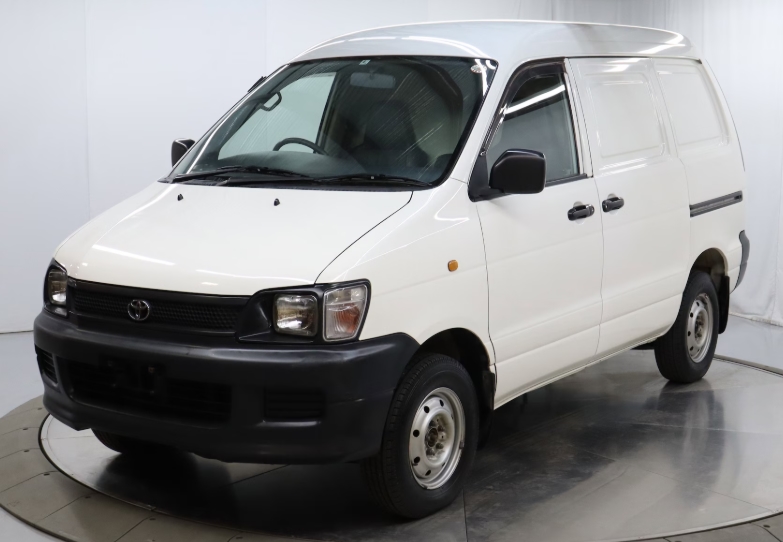
Meanwhile, the commercial LiteAce Van and Truck (R40/R50 series) continued on a separate, rear-wheel-drive semi-cab-over platform. These models were built for durability and low running costs. They retained the robust diesel engines and simple leaf-spring rear suspension perfect for heavy loads. This generation was a global workhorse, exported widely and cherished for its no-nonsense reliability.
Sixth Generation (S400): A New Partnership (2008-Present)
In 2008, facing a consolidating market for small commercial vehicles in Japan, Toyota made a strategic decision. Instead of developing an all-new LiteAce from scratch, it entered into an OEM agreement with its subsidiary, Daihatsu.
The current S400 series LiteAce (and its TownAce twin) is a rebadged version of the Daihatsu Gran Max. This move marked a return to the LiteAce’s origins. The design reverted to a pure cab-over-engine layout to maximize cargo space, and the vehicle is offered only as a Van or Truck. All pretense of being a passenger minivan was dropped.
Powered by a modern and efficient 1.5-liter 2NR-VE gasoline engine with VVT-i, the S400 is focused on emissions compliance, fuel economy, and safety features like vehicle stability control and airbags, meeting modern commercial standards. It is a simple, effective, and affordable tool designed for one purpose: to get the job done.
The LiteAce Legacy and Future Outlook
For over 50 years, the Toyota LiteAce has been the unsung hero of the automotive world. It has built businesses, transported families, enabled adventures, and served as a lifeline in developing nations. Its reputation is built not on performance figures or luxury appointments, but on the promise that it will start every morning and withstand years of hard use with minimal complaint.
The second-hand market for LiteAces, particularly the 4WD diesel models from the 1990s, remains incredibly strong. They are sought after by camper van converters, overlanders, and small business owners who value their mechanical simplicity and legendary durability over modern complexities.
What does the future hold? The current S400 generation will likely continue for the foreseeable future, as the demand for compact, affordable commercial vehicles remains constant. The most significant evolution on the horizon will undoubtedly be electrification. As urban centers worldwide move towards low-emission zones, an electric LiteAce seems not just possible, but inevitable. A small, battery-powered van and truck platform would be perfectly suited to the “last-mile” delivery and urban trade roles that the LiteAce has always fulfilled.
The name “LiteAce” may no longer be attached to a family-friendly minivan, but its spirit endures. It is a symbol of Toyota’s core strength: understanding what people truly need from a vehicle and building it to a standard that lasts a lifetime. In a world of fleeting trends, the LiteAce remains a constant—a humble, hardworking, and utterly dependable everyman.