The Enduring Legacy of the Jaguar C-Type
In the pantheon of automotive history, few machines evoke the raw, unadulterated thrill of mid-century racing quite like the Jaguar C-Type. A short, low-slung projectile of a car, it was the perfect synthesis of British engineering prowess and aerodynamic theory, a machine that won the 24 Hours of Le Mans on its debut and, in doing so, forever changed the face of sports car racing. It was a car born of a specific moment in time, when the line between what was raced on the track and what was sold to the public was both thin and tantalizingly blurred. The C-Type was not merely a racing car; it was the genesis of a legend that would see Jaguar dominate the world’s most prestigious endurance races for years to come. This is its story.
Part I: A Champion’s Progeny – The Birth of the C-Type
To understand the C-Type, one must first appreciate the triumph that preceded it: the Jaguar XK120. Introduced in 1948, the XK120 was a revelation. Its 3.4-litre dual-camshaft straight-six engine was a masterpiece, and its stunning good looks captured the post-war public’s imagination. The “120” in its name denoted its top speed in miles per hour, making it, for a time, the fastest production car in the world. But while the XK120 was a formidable road car, Jaguar founder Sir William Lyons envisioned a more focused, purpose-built machine to take the fight to the racetrack.
Thus, in 1950, the C-Type (for “Competition”) was born. It was, in essence, a racing chassis built around the heart and soul of the XK120—its engine, gearbox, and suspension components. The roadster’s elegant curves were shed in favour of a starkly functional design. Working with a team that included engineer Mike Hawthorn (who would later become Formula 1 World Champion), Lyons and chief engineer Walter Hassan created a car that was a significant leap forward.
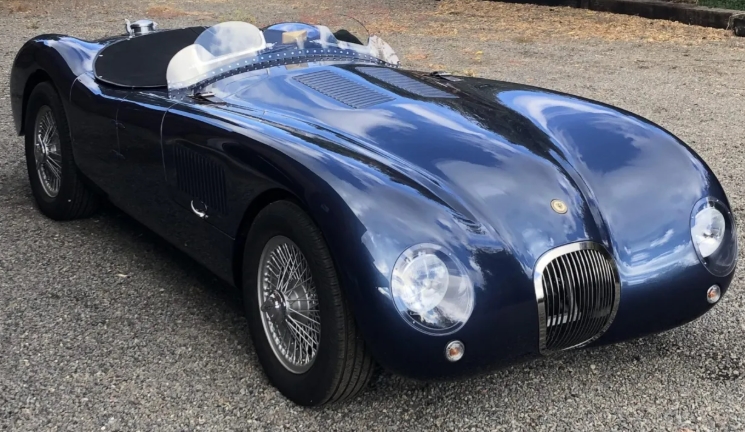
The C-Type’s most revolutionary feature was its chassis. While the XK120 used a traditional ladder frame, the C-Type adopted a lightweight tubular space frame. This design not only saved crucial weight but also formed the basis for its bodywork. The body, crafted from a combination of aluminium and magnesium panels, was an exercise in aerodynamic efficiency. Its iconic, low-drag “faux” grille (a clever duct that fed air to the carburettors while smoothing airflow) and teardrop-shaped tail were sculpted to slice through the air with minimal resistance. This obsessive attention to aerodynamics was a direct result of Jaguar’s use of a wind tunnel at the University of London to refine the design.
Powering the C-Type was a modified version of the XK engine. Tuned for competition with higher-lift camshafts, a revised intake manifold, and twin SU carburettors, it produced around 160 horsepower initially. This was enough to propel the lightweight racer to a top speed of over 130 mph.
.
THIS might be a great place to get your new car from!
Or for those who are into the “car flipping” business, here’s an excellent resource for you!

.
Part II: Le Mans Glory and the Dunlop Era (1951-1952)
The C-Type’s competitive story is one of immediate and resounding success. The car’s factory designation was the XK-SS when intended for public sale, but it is the C-Type name that has stuck in history.
The 1951 Debut: In 1951, three C-Types were entered in the 24 Hours of Le Mans. The car was a sensation. Its aerodynamic shape was immediately noticeable, and the Jaguar engineers had a secret weapon: Dunlop disc brakes. While discs had been used on a few specialized racing cars before, the C-Type was the first car to use them in a major endurance race and win. The superior stopping power of the discs gave the Jaguar drivers a massive advantage over their drum-braked rivals, particularly in the damp conditions. Peter Walker and Peter Whitehead piloted their C-Type to a stunning overall victory, a remarkable achievement for a car’s debut race.
For the 1951 season, a handful of these competition cars were also made available for private customers, configured to the same Le Mans-spec as the factory team.
The 1952 Evolution: Dunlop Brakes and Aerodynamics For the 1952 season, Jaguar sought to refine the formula. The most significant change was the switch to larger, 16-inch Dunlop disc brakes all around to better cope with the immense speeds being achieved. However, this change had a cascading effect on the design. The larger wheels and brakes required a body redesign.
The result was the 1952 C-Type, often referred to by enthusiasts as the “Dunlop” or “1952” model. This version is perhaps the most elegant and recognizable. The body was re-sculpted by aerodynamicist Malcolm Sayer, who would later design the iconic E-Type. The new body was even more aerodynamic, with a lower roofline, a fuller rear haunch, and exposed, streamlined headlamps. The rear was completely reworked, dropping the “faux” grille for a cleaner, more integrated look. The 1952 C-Type was a work of art, a perfect teardrop on wheels.
In this form, the factory team, now featuring the likes of Stirling Moss and Mike Hawthorn, again dominated Le Mans, securing a one-two finish. However, the 1952 season also exposed the car’s primary weakness. At speeds approaching 150 mph on the Mulsanne Straight, the C-Type’s aerodynamic lift and its swing-axle front suspension made it dangerously unstable. A series of horrific accidents, including one that claimed the life of driver Pete Walker, highlighted the car’s vulnerabilities at its operational limits.
Part III: The “XK-SS” – The Road-Legal Racer
The racing-focused C-Type had a brief but significant civilian afterlife. With the FIA’s new Appendix C regulations for 1953 limiting modifications to production cars, Jaguar found itself with a surplus of race-winning C-Type chassis and components. Rather than scrap them, Sir William Lyons decided to create a road-legal version for the American market, which had a voracious appetite for high-performance European cars.
This road-going version was named the XK-SS. Essentially a C-Type with a more upright windscreen, a full-width faux grille (a styling cue from the XK120), bumpers, road-going lights, and a slightly more relaxed engine tune, the XK-SS was the ultimate “factory hot rod.”
Of the planned 100 units, only 16 were ever built. In February 1953, a devastating fire at the Jaguar factory in Browns Lane destroyed the remaining 10 chassis set for conversion and halted production. The XK-SS would have been forgotten as a footnote were it not for the car’s immense desirability today. Its legend was cemented in 2015 when Jaguar’s Classic Works division re-created the remaining nine “missing” XK-SSes, known as the “Continuation” cars, to fulfil the original order. The XK-SS represents the ultimate expression of the C-Type philosophy: a car that was as brilliant on the road as it was on the track.
Part IV: The D-Type and the C-Type’s Enduring Influence
The C-Type’s racing career was effectively over after the 1953 season, having been superseded by the purpose-built, fundamentally different Jaguar D-Type. The D-Type was a masterpiece of aerospace engineering, featuring a monocoque central tub, a fully faired-in aerodynamic body, and a dominant engine that would power Jaguar to three consecutive Le Mans wins from 1955 to 1957.
While the D-Type was the C-Type’s successor, the C-Type was its undeniable foundation. The lessons learned in aerodynamics, the breakthrough success of disc brakes, and the fundamental reliability of the XK engine were all crucial building blocks for the D-Type’s dominance. The C-Type proved that Jaguar could win at Le Mans, and it created the winning blueprint.
C-Type Models and Specifications (Summary)
- 1951 C-Type (Le Mans Debut Model):
- Years Produced: 1951
- Chassis: Lightweight tubular space frame.
- Body: Simple, low-drag aluminium body with distinctive teardrop rear and “faux” grille.
- Brakes: Dunlop disc brakes (12-inch front, 11.5-inch rear).
- Engine: 3.4-litre XK straight-six, approx. 160 hp.
- Production: Approximately 12 factory competition cars for the team and a handful for private customers.
- 1952 C-Type (“Dunlop” Model):
- Years Produced: 1952
- Chassis: Modified to accommodate larger wheels and brakes.
- Body: Re-sculpted by Malcolm Sayer, featuring a lower roofline, exposed headlamps, and a cleaner rear profile. The most aerodynamically refined version.
- Brakes: Larger 16-inch Dunlop disc brakes all around.
- Engine: 3.4-litre XK straight-six, tuned to approx. 170-180 hp.
- Production: Approximately 19 factory competition cars for the team and private customers.
- Jaguar XK-SS (Road-Going Model):
- Years Produced: 1953 (only 16 completed before the factory fire).
- Chassis: Based on C-Type chassis.
- Body: Modified for road use with a higher windscreen, full-width XK-style grille, bumpers, and road lighting.
- Brakes: Dunlop discs.
- Engine: 3.4-litre XK straight-six, detuned slightly for road use (approx. 190 hp, though some were modified to higher outputs).
- Production: 16 original cars, plus 9 “Continuation” cars built by Jaguar Classic in 2015-2016.
There were no specific trim levels offered for the C-Type, as it was a pure competition car. The variations were purely evolutionary changes between model years.
Part V: The Modern Outlook and Enduring Legacy
Today, the Jaguar C-Type is one of the most coveted and valuable historic racing cars in the world. Original competition models, especially those with a proven Le Mans history, command multi-million-dollar auction prices. The XK-SS is even more valuable, representing the pinnacle of the Jaguar collector market.
The C-Type’s legacy is not just confined to the history books. It lives on in several ways:
- Influence on Jaguar’s DNA: The C-Type established a lineage of success and design philosophy that defined Jaguar for decades. Its balance of power, elegance, and aerodynamic grace can be seen in the E-Type and subsequent GT cars.
- The “Continuation” Programme: Jaguar’s decision to build the nine “missing” XK-SSes was a landmark in the classic car world. This program demonstrated a modern manufacturer’s commitment to preserving its heritage, not just by building replicas, but by meticulously recreating original cars using the original tooling and techniques. This was a precursor to similar programs for the Lightweight E-Type and the D-Type “Continuation” cars.
- Historic Racing: The C-Type remains a star of the historic racing circuit, where its distinctive engine note and beautiful lines thrill crowds at events like the Goodwood Revival and the Le Mans Classic.
Looking to the future, the C-Type’s star shows no sign of dimming. As a pure, analogue driver’s car from the dawn of a golden era, it represents everything that is cherished about motoring’s past. It is a tangible piece of engineering art, a testament to a time when a small team of dedicated engineers in Coventry could take a road car engine and, through intelligence and audacity, create a world-beater.
Conclusion
The Jaguar C-Type was a meteor. It streaked across the automotive landscape in a brief blaze of glory from 1951 to 1953, but its impact was profound and permanent. It was the car that brought disc brakes to the forefront of motorsport, the car that proved Jaguar’s engineering prowess on the world stage, and the car that laid the groundwork for one of racing’s most dominant dynasties. More than just a collection of steel tubes, leather, and engine parts, the C-Type is a rolling sculpture, a symbol of a daring and brilliant era in racing history. It remains, to this day, the quintessential Jaguar.