The Enduring Legacy of the Mazda Bongo: More Than Just a Van
On the bustling streets of Tokyo, the winding roads of the Scottish Highlands, or the dusty tracks of the Australian Outback, you might encounter a vehicle that defies easy categorization. It’s a boxy, unassuming van, often with a raised roof and a friendly-sounding name emblazoned on its side: Bongo. For over half a century, the Mazda Bongo has been a steadfast workhorse, a dependable family hauler, and, most famously, a gateway to adventure for countless individuals around the globe. It is a story not of high performance or luxury, but of unparalleled utility, clever design, and enduring charm.
A Humble Beginning: The First and Second Generations
The Bongo story began in May 1966. In an era of burgeoning economic growth in Japan, Mazda identified a need for a versatile and efficient light commercial vehicle. The first-generation Bongo (F800/F1000) was a unique proposition. Unlike its contemporaries, it featured a rear-mounted, water-cooled four-cylinder engine, positioned under the rear cargo floor. This cab-over design maximized interior space, creating a remarkably large and flat loading area for its compact footprint. Available as a truck, a van, and even a passenger-focused “coach” with seating for eight, the first Bongo established the core principles of space efficiency and versatility that would define the nameplate for decades. Production of this pioneering model ran until 1975.
After a two-year hiatus, Mazda launched the second-generation Bongo (model code BA2) in 1977. This iteration moved to a more conventional front-engine, rear-wheel-drive layout, a configuration that improved stability and simplified maintenance. While losing the novel rear-engine design, the BA2 Bongo gained practicality. It was offered with a range of small-displacement gasoline engines and, crucially, introduced a diesel option—the 2.2-litre S2 engine—which made it an exceptionally economical choice for commercial operators. This generation also began the Bongo’s global journey, often rebadged as the Ford Econovan and Ford Spectron in Asia-Pacific markets, cementing its reputation as a reliable and cost-effective tool of the trade. This successful model ran until 1983.
The Workhorse Era: The Long-Lived Third Generation (1983-1999)
In 1983, Mazda introduced the third-generation Bongo (SE/SR platform), a model that would become an icon of durability and see an incredible 16-year production run. This was the Bongo in its purest, most utilitarian form. Its clean, boxy design was dictated by function over fashion, creating a cavernous interior that could be configured in countless ways.
This generation diversified the lineup significantly, solidifying the core models that would define the Bongo family:
- Bongo Van: The standard commercial and passenger van, available with various window configurations and seating arrangements.
- Bongo Truck: A simple, robust light truck with a dropside flatbed, beloved by tradespeople and farmers.
- Bongo Brawny: A long-wheelbase version of the Van and Truck, offering significantly more cargo capacity and payload. This was the heavy-hauler of the family.
Trim levels were generally straightforward and focused on utility, ranging from a spartan base ‘DX’ (Deluxe) model with vinyl seats and minimal amenities, to a more comfortable ‘GL’ (Grand Luxe) and ‘GL Super’ which added features like cloth upholstery, power steering, and air conditioning. Engine options included reliable 1.8L and 2.0L gasoline engines and the workhorse R2 2.2L and RF 2.0L diesel engines. The availability of a selectable four-wheel-drive system, often paired with a low-range transfer case, made the Bongo a surprisingly capable off-road vehicle, popular in mountainous and snowy regions of Japan. This generation was the definitive workhorse, a common sight on roads across Asia, Australia, and New Zealand for decades.
.
NO MORE dead batteries with this:

.
The Game Changer: The Bongo Friendee (1995-2005)
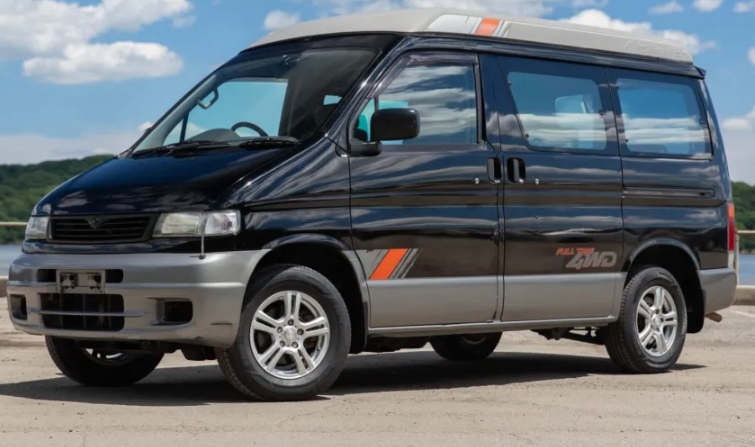
While the third-generation Bongo continued its service as a commercial vehicle, Mazda launched a revolutionary new model in 1995 that would forever change the West’s perception of the Bongo. Built on a new platform (SG), the Mazda Bongo Friendee was not just a van; it was a “multi-purpose friend,” a vehicle designed explicitly for leisure, family, and adventure.
The Friendee was a masterpiece of Japanese innovative packaging. Its standout feature, and the primary reason for its cult status today, was the Auto Free Top (AFT). With the press of a button, the roof would electrically elevate, revealing a spacious two-person sleeping loft complete with a mattress, zippered windows with bug screens, and even an escape hatch/sunroof. This integrated camper-top transformed the Friendee from a daily driver into a weekend adventure vehicle in seconds, offering a level of convenience and integration that aftermarket solutions couldn’t match.
The interior was equally clever. The eight-seater layout featured seats that could slide, recline, and fold completely flat to create a large sleeping area on the main floor. This meant a family of four (or more) could comfortably sleep inside. The list of clever features continued with electric window blinds, a sophisticated climate control system, and numerous storage compartments.
The Friendee was offered in a wide array of trim levels that catered to different buyers:
- RF-V: The base model, often equipped with the 2.0L four-cylinder gasoline engine and rear-wheel drive.
- City Runner: A popular, well-equipped mid-range model, often featuring the AFT and available in both 2WD and 4WD.
- RS-V: A slightly sportier trim that sometimes included subtle body kits and alloy wheels.
- Limited/Special Editions: Mazda produced numerous special editions with unique upholstery and features.
- Factory Camper Conversions: A small number of Friendees were sold with factory-fitted kitchen pods, known as “Camper” models, which are highly sought after today.
Engine choices were more powerful to suit its role as a passenger vehicle. Options included a 2.0L inline-four gasoline engine, a smooth 2.5L J5-DE V6 gasoline engine, and the hugely popular 2.5L WL-T turbodiesel. The diesel offered excellent torque and fuel economy, making it the preferred choice for long-distance touring. The Friendee was also available with a robust full-time 4WD system, making it a true all-seasons adventure mobile. Its production ran until 2005, overlapping with both the third and fourth Bongo generations.
Back to Basics: The Fourth and Fifth Generations (1999-Present)
In 1999, as the Friendee was catering to the leisure market, Mazda launched the fourth-generation Bongo (SK/SL platform), replacing the long-serving third-gen commercial models. This was a return to the Bongo’s utilitarian roots. The design was simple and durable, built to withstand the rigors of commercial use. This generation was also a prime example of badge engineering; it was developed in conjunction with Mitsubishi and was also sold as the Mitsubishi Delica Cargo and the Nissan Vanette. Production of this model continued for an astonishing 21 years, finally ceasing in 2020.
The current fifth-generation Bongo, introduced in 2020, signals a new era for the nameplate. It is a rebadged version of the Daihatsu Gran Max (also sold as the Toyota TownAce). This shift away from in-house development is a common trend in the Japanese commercial vehicle market, driven by the need to reduce development costs and consolidate platforms. While it carries the Bongo name, its soul is shared with its Toyota and Daihatsu cousins. It remains a capable and reliable light commercial vehicle, but it lacks the unique Mazda-engineered character of its predecessors.
The Bongo’s Lasting Appeal and Future Outlook
Today, the Mazda Bongo, particularly the Friendee, enjoys a thriving second life in countries far from Japan. Thanks to import regulations like the 25-year rule in the United States and similar schemes in Canada, the UK, and Australia, thousands of Bongos have found new homes with adventurous owners.
Their appeal is multifaceted. They offer the functionality of a much more expensive camper van—like a Volkswagen Westfalia—at a fraction of the cost. Their clever use of space is unmatched, and their reliable mechanicals (with the notable exception of the WL-T diesel engine, which can be prone to cylinder head issues if not carefully maintained) make them a sensible choice. The 4WD variants provide a level of off-road capability that opens up remote campsites and backcountry roads, creating a unique niche as an affordable, go-anywhere micro-RV.
The future of the Bongo nameplate appears to be one of practicality and badge-engineering rather than innovation. The days of Mazda designing a quirky, leisure-focused vehicle like the Friendee from the ground up seem to be over. However, the legacy of the Bongo is not defined by its current iteration but by the millions of miles traveled and adventures had in the older models.
The Mazda Bongo is more than just a vehicle; it’s an enabler. It has been a carpenter’s mobile workshop, a florist’s delivery van, a family’s transport to school and holidays, and a wanderer’s home on wheels. From the innovative rear-engine original to the iconic Auto Free Top of the Friendee, the Bongo has consistently delivered on a promise of maximum utility in a compact, friendly package. It stands as a testament to a design philosophy that prioritized people and their needs over fleeting trends, securing its place as a beloved and enduring icon of the automotive world.