The Enduring Workhorse: A Chronicle of the Isuzu P’up
In the pantheon of automotive history, some vehicles achieve fame through blistering speed, others through opulent luxury, and a select few through sheer, unadorned utility. The Isuzu P’up belongs firmly in the last category. It was never the fastest, the most powerful, or the most refined. Instead, its legacy was built on a foundation of reliability, affordability, and a simple, rugged honesty. For nearly a quarter-century, the P’up and its predecessors were the anonymous, dependable engines of commerce and recreation, a testament to the idea that a vehicle doesn’t need to be complicated to be effective. This is the story of the humble but mighty P’up, from its utilitarian origins to its lasting impact on the American truck landscape.
The Genesis: The LUV Era (1972-1981)
Before the P’up name graced American soil, its story began with a different moniker: LUV. Standing for “Light Utility Vehicle,” the Isuzu LUV was introduced in the United States in 1972 as a strategic counterpunch to the burgeoning dominance of the Toyota and Datsun (now Nissan) small pickups. At the time, the American “Big Three” had all but abandoned the small truck segment, creating a vacuum that Japanese manufacturers were eager to fill.
The first-generation LUV (1972-1980) was a study in minimalist functionality. It featured a compact 1.8-liter four-cylinder engine producing a modest 75 horsepower, paired with a four-speed manual transmission. It came in a variety of simple trim levels that catered to different needs:
- Standard: The base model, a bare-bones work vehicle with vinyl seats and hand-crank windows.
- Deluxe: Added niceties like a bumper chrome package, a more comfortable interior, and optional automatic transmission.
- 4×4: Introduced in 1974, this was a game-changer. It offered true four-wheel drive, making the small truck a formidable tool for farmers, ranchers, and construction workers in challenging terrain.
The LUV was an immediate success. It was cheap to buy, cheap to run, and surprisingly capable. Its car-like handling and compact dimensions made it easy to maneuver in tight city streets, while its sturdy frame and long-bed option gave it legitimate hauling credentials.
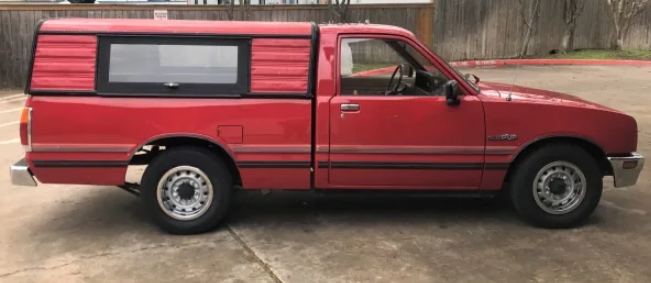
In 1981, Isuzu decided to align its American truck nomenclature with its global identity. The LUV name was retired, and the truck was reborn as the Isuzu P’up. Mechanically and cosmetically, it was a continuation of the LUV, but the name change marked a new chapter. These late-model LUVs and early P’ups are mechanically identical and are often collectively referred to by enthusiasts.
.
THIS might be a great place to get your new car from!
Or for those who are into the “car flipping” business, here’s an excellent resource for you!

.
The P’up Arrives: First Generation (1981-1987)
The first official Isuzu P’up, continuing from the 1981 model year, carried over the 1.8-liter engine but soon received a significant power boost. In 1984, the engine was enlarged to 1.9 liters, and more importantly, a fuel-injected version was introduced, raising horsepower to a more competitive 85. This model solidified the P’up’s reputation for being a reliable and durable worker.
The trim levels evolved to offer customers more choice:
- Standard: The workhorse, featuring a blacked-out grille, steel wheels, and a spartan interior.
- LS (Luxury Sport): This trim aimed for the burgeoning “lifestyle” truck market. It included color-matched bumpers and mirrors, a chrome grille, upgraded interior fabrics, a tachometer, and often featured aluminum wheels. The LS was the P’up you saw at the ski resort or the campsite.
- 4×4: The off-road specialist remained a core part of the lineup, now available in both Standard and LS trims.
A major turning point for the P’up came in 1985 with the introduction of the Space Cab model. This featured an extended cab section with small, rear-hinged “suicide” doors, revealing a small storage area behind the front seats. It was a brilliant compromise, adding much-needed interior volume for gear or occasional passengers without the length and weight penalty of a full crew cab. The Space Cab instantly broadened the P’up’s appeal.
The most significant innovation, however, arrived in 1986. The Isuzu P’up became the first Japanese pickup truck in America to offer a turbodiesel engine. This 2.2-liter “4EE1” engine produced 80 horsepower and, more importantly, a stump-pulling 125 lb-ft of torque. While not a speed demon, the diesel P’up was an efficiency and towing champion, capable of returning over 30 MPG and hauling heavy loads with ease. This option created a cult following and cemented the P’up’s identity as a frugal and formidable workhorse.
The Final Evolution: Second Generation (1988-1994)
For its second and final act, the P’up received a complete redesign for the 1988 model year. The rounded, soft contours of the previous generation were replaced by a sharper, more modern, and decidedly American-looking body with an upright grille and flatter panels.
The chassis remained robust, but the powertrain lineup was overhauled.
- Gasoline Engine: The base engine was now a 2.0-liter SOHC four-cylinder (the “4ZD1”), producing 97 horsepower. In 1990, this was enlarged to a 2.3-liter engine (the “4ZE1”) with 95 horsepower.
- Turbodiesel Engine: The beloved 2.2-liter turbodiesel was updated to a 2.8-liter unit (the “4FG1”) producing 84 horsepower and 143 lb-ft of torque, with an even stronger focus on fuel economy and low-end grunt.
The trim levels for this generation were:
- Standard: The base model, still offering incredible value.
- LS: The “Luxury Sport” trim continued, adding comfort and style features.
- LSX: A new, top-tier trim was introduced. The LSX was the “chrome and comfort” package, often featuring power windows, power locks, a upgraded stereo, and plush carpeting. It was Isuzu’s attempt to compete more directly with the higher-end offerings from Ford, Chevy, and Dodge.
This generation also saw the introduction of more advanced options like an anti-lock braking system (ABS) and air conditioning as standard on higher trims. The Space Cab remained the popular choice, offering improved rear access and storage.
The End of the Road and the ISUZU Impact (1995-2008)
In 1995, the Isuzu P’up nameplate was retired in the U.S. market. However, the truck itself did not disappear. It was simply rebadged as the Isuzu Hombre. The Hombre was a “badge-engineered” version of the Chevrolet S-10. This was a common practice in the 1990s, a result of the Isuzu-GM alliance.
While the Hombre shared its body and chassis with the S-10, it was strictly a lower-cost alternative. It was offered only with the 2.2-liter four-cylinder gasoline engine and was only available in a two-door regular cab configuration with either a short or long bed. It lacked the V6 engine option, four-wheel drive, and the extensive trim levels of the S-10. The Hombre was essentially a fleet vehicle, sold to budget-conscious buyers, and it was discontinued in 2004 without a direct successor.
Interestingly, Isuzu continued to use the “D-Max” name for its global pickup trucks, a lineage that continues to this day, though it is no longer sold in North America. After the Hombre, Isuzu briefly returned to the U.S. truck market with the 2006 i-350C, a crew-cab pickup based on the GM Colorado/Canyon platform. However, it was short-lived, ending in 2008 as Isuzu re-focused its efforts on commercial trucks and diesel engines.
The P’up’s Legacy and Future Outlook
Though it has long been absent from new car lots, the Isuzu P’up’s spirit endures. Its legacy is found in two key areas:
- The Cult of the Diesel: The 2.8-liter turbodiesel P’up is a highly sought-after classic by diesel enthusiasts. Its combination of incredible fuel economy and surprising durability in a lightweight package makes it a prized conversion candidate for “off-grid” living, overlanding, and custom builds.
- A Blueprint for Success: The P’up was one of the first to prove that a small, affordable, and reliable truck could be a massive commercial success in America. It paved the way for the explosion of the compact truck segment in the 1980s and 90s, a segment that, despite recent size inflations, remains a cornerstone of the American automotive market.
As for a future outlook, a return of the P’up name is highly unlikely. The modern automotive landscape, dominated by emissions regulations, safety standards, and the immense popularity of large, profitable trucks, leaves little room for a simple, unadorned small pickup. However, the idea of the P’up—a dependable, no-frills, and economical utility vehicle—is more relevant than ever. As consumers seek practical alternatives to oversized trucks and expensive EVs, the market for a simple, usable vehicle is ripe. While the name may be retired, the formula that made the Isuzu P’up an enduring workhorse remains a timeless recipe for success.