The European Dress: Charting the Evolution of the Holden-Badged Opel Calais
In the sprawling history of the Australian automotive industry, few chapters are as fascinating as the early 1990s. This was a period of radical change, where the locally built family car, a bastion of Aussie motoring, was forced to look to Europe for its future. The result was a unique fusion: a car with American “large car” underpinnings, a sophisticated German Opel-inspired design, and the heart and soul of a Holden.
For a brief, three-year window, one particular model encapsulated this transcontinental identity better than any other. It was sold on Australian soil not as a Holden, but as an Opel—the Calais. This is the story of that car, a tale of badge engineering, market positioning, and a vehicle that represented a pivotal turning point for an entire industry.
A Bold New Direction: The Genesis of the VN Commodore
To understand the Opel Calais, one must first understand its progenitor: the 1988 Holden Commodore VN. By the mid-1980s, the rear-wheel-drive Commodore (originally based on the German Opel Rekord E/E1) was feeling its age. It was smaller than its Ford Falcon rival and faced increasing pressure from more modern, front-wheel-drive Japanese sedans.
Holden’s solution was audacious. Instead of a costly, all-new platform, they took the chassis of the American GM10 platform (used for the Buick Regal, Oldsmobile Cutlass Supreme, and Pontiac Grand Prix) and extensively modified it for Australian conditions. This “W-body” platform was longer, wider, and engineered to accommodate larger, more powerful engines.
The resulting VN Commodore was a revelation. It was bigger, more comfortable, and more powerful than any Commodore before it. To appeal to a more premium market segment, Holden introduced the “Calais” nameplate, a tag previously used on the high-tech, four-cylinder VK Commodore of the early 1980s. The Calais was to be the technological and luxurious flagship of the VN range.
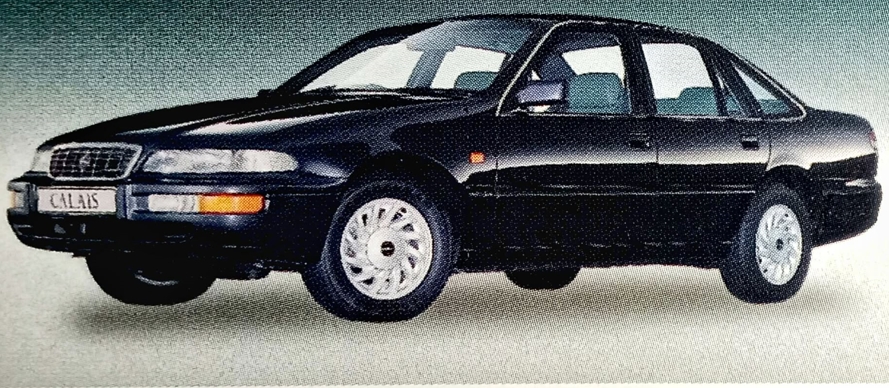
However, in a fascinating marketing twist, Holden decided not to launch the new luxury sedan as a Holden. For the first time, it would be imported and sold under the prestigious Opel badge. It was marketed as the Opel Calais, a name intended to evoke German engineering and sophistication. This move was designed to attract buyers who would have otherwise considered a Ford EL Ghia or a more expensive European import.
.
THIS is GOOD stuff if your car is in need:

.
The Opel Calais VN (1990-1991): A Singular Vision
For its initial two years on the market, the Opel Calais was a single, well-defined model. It was based on the top-tier VN Commodore Berlina but was presented with a distinct European identity.
Models and Trim Levels (VN):
- Opel Calais: The only variant offered.
Key Features and Specifications (VN):
- Body Style: Four-door sedan.
- Engine: The star of the show was the all-new 3.8-litre OHV V6 engine. This engine, designated LN3, was a significant upgrade over the older V6s, producing 125 kW of power and 298 Nm of torque. It was smooth, powerful, and became a beloved staple of Australian motoring. A 5.0-litre (5.0) Holden V8 engine was offered as a rare factory option.
- Transmission: A four-speed automatic transmission was standard, featuring a “power” mode and a “economy” mode. A five-speed manual was available for the V6.
- Exterior Styling: The Calais was distinguished from its Holden-badged siblings by a unique, body-colored “aero” body kit. This included a distinctive front bumper with integrated fog lights, side skirts, and a rear bumper with an integrated license plate surround. It also featured unique 15-inch “Directional” alloy wheels and smoked tail light clusters. It was the most aerodynamic and visually modern Australian car of its time.
- Interior and Technology: The cabin was a significant step up. The Berlina’s dashboard layout was retained, but the Calais featured a specific digital instrument cluster (the “Electronic Driver Information Centre”), a premium sound system, and velour trim. Key features included climate control, power windows (all four), power mirrors, and a trip computer. It was a comfortable, tech-forward environment designed to compete with the best of Japan and Europe.
- Market Reception: The Opel Calais was well-received for its spaciousness, comfortable ride, and powerful new V6. It won the prestigious Wheels magazine “Car of the Year” award in 1988 (shared with the Holden VN Commodore sedan). However, the “Opel” branding was met with some confusion. Most Australian buyers knew it was a Holden-built car, and the German badge didn’t carry the same weight as it did in Europe. It was a good car, but its identity was a complex sell.
The Opel Calais VP (1991-1993): Refinement and Consolidation
In late 1991, the VN range received a significant update, becoming the VP. The changes were more than just a facelift; they were a deep refinement based on customer feedback. For the Opel Calais, this was its second and final act.
The VP update saw the end of the Opel branding experiment. From this point forward, all variants, including the Calais, were sold as Holdens. The Holden Calais VP officially replaced the Opel Calais.
Models and Trim Levels (VP):
The Calais range was split into two distinct models, catering to different budgets and performance needs.
- Calais (Base Model): This effectively replaced the Berlina as the luxury V6 model.
- Calais V (The V8 Flagship): This became the new top-of-the-range model, explicitly named “V” to signify its V8 powertrain.
Key Specifications and Updates (VP):
- Engine:
- The Calais was powered by an improved version of the 3.8-litre V6 (LN3), now producing 130 kW.
- The Calais V was fitted with the Holden 5.0-litre V8 (LB9), producing 165 kW. This model was the true performance hero of the range.
- Brakes: A major safety upgrade was the standardization of ABS (Anti-lock Braking System) across the entire Calais range.
- Exterior Styling: The VP received a subtle but effective facelift. The most noticeable change was the front grille, which lost its complex multi-slot design in favour of a cleaner, horizontal two-bar style. The body-coloured bumpers and side skirts remained, but the rear featured new garnishes. The wheels were updated to a new 15-inch “Turbine” alloy design.
- Interior and Comfort: The interior saw a host of upgrades. The velour trim was improved, and leather trim became an option on the base Calais and standard on the Calais V. Power seats, a sunroof, and a CD player were available as options. Crucially, Holden addressed the VN’s somewhat “rubbery” gearshift feel with a new “Sentronic” four-speed automatic transmission that offered a manual-style gate for selecting gears.
- Driving Dynamics: The suspension was recalibrated for better handling and ride control. The Calais V, with its V8 and stiffer setup, was a genuinely enjoyable car to drive.
The End of an Era and the Birth of the VT
The Holden Calais VP ceased production in mid-1993. It was replaced by the VT Calais in 1997. The VT was another revolutionary car. Based on the Opel Omega, it was a complete departure from the “large car” formula. It featured independent rear suspension, a vastly more sophisticated interior, and a new range of engines.
Significantly, the VT marked the end of the Calais as a distinct model line with its own unique bodywork. The VT Calais was simply a high-spec version of the standard Holden Commodore sedan, sharing almost all its panels. The era of the Calais as a standalone “aero” design, born from the VN, was over.
Future Outlook and Legacy
Today, the concept of an “Opel Calais” or even a distinct “Holden Calais” is a relic of the past. The entire Australian car manufacturing industry, including Holden, was shuttered in 2017. There will be no future models.
However, the legacy of the VN/VP Calais remains significant.
- The Great Experiment: The Opel Calais VN was Holden’s boldest attempt at selling an Australian car with a European identity. While the experiment was short-lived, it paved the way for the later, more successful Statesman/Caprice models, which were also sold internationally under various GM brands (Buick, Chevrolet, Daewoo). It taught Holden valuable lessons in global platform sharing and marketing.
- A Bridge Between Worlds: The Calais represented a unique “Goldilocks” car. It had the size and V8 potential of an Australian muscle sedan, the comfort and features of a Japanese luxury car, and the styling cues of a European executive express. For a brief moment, it was everything to everyone.
- An Appreciating Classic: Today, both the VN and VP Calais are sought-after by collectors and enthusiasts. The V8-powered Calais V is particularly desirable. They represent the last of the truly unique, locally designed Australian luxury sedans before the global “badge engineering” era took over completely.
The Opel Calais was more than just a car with a German name. It was a symbol of a pivotal moment in Australian automotive history—a time of bold risks, transcontinental design, and the creation of a truly unique sedan that, for a short while, tried to be a Holden, an Opel, and a Holden all at once.