The Everyman’s Kei: A Chronicle of the Daihatsu Fellow’s Half-Century Journey
In the intricate tapestry of Japanese automotive history, few threads are as humble yet resilient as the Daihatsu Fellow. While the world looks to the futuristic specs of modern EVs or the roaring horsepower of supercars, the story of the Fellow offers a grounding lesson in practicality, efficiency, and the evolution of the Kei car class. Produced intermittently over a span of nearly five decades, the Daihatsu Fellow is not merely a vehicle; it is a cultural artifact, a testament to Japan’s post-war economic reconstruction, and a symbol of the country’s unique approach to micro-mobility.
To understand the Fellow, one must first understand the constraints and freedoms of the Kei car regulations. Born out of a government initiative to stimulate motorization among the masses while conserving resources, the Kei class (short for keijidōsha, or “light automobile”) imposes strict limits on engine displacement and dimensions. The Fellow’s evolution has always danced within these boundaries, expanding and contracting with the times, offering a fascinating case study in engineering adaptation.
The Genesis: The First Generation (1966–1970)
The Daihatsu Fellow made its debut in May 1966. At this point in history, Japan was preparing for the 1964 Tokyo Olympics, and the country was rapidly industrializing. The automobile was transitioning from a luxury item to a necessity.
The original Fellow (Chassis code BF) was designed to replace Daihatsu’s earlier Midget and Count models. It was a utilitarian, no-frills vehicle aimed squarely at the working class. Under the hood sat a 356cc air-cooled, two-stroke, two-cylinder engine. In the mid-60s, the Kei car engine limit was set at 360cc, so Daihatsu utilized the regulation to its absolute maximum.
Models and Trim Levels: The first-generation Fellow was offered in three body styles, a versatility that quickly became its trademark:
- Standard (Sedan): A two-door sedan with a distinct “three-box” design.
- Van: A two-door station wagon designed for commercial haulage.
- Truck: A dedicated pickup variant for light logistics.
Trim levels in this era were spartan. The distinction often came down to badging—simply “Fellow” for the base models and “Fellow Custom” for slightly improved interior finishes. The “Custom” trim offered vinyl seating and a basic heater, luxuries that were not yet standard in 1966. In 1968, Daihatsu introduced the Fellow 4, a revolutionary addition. While most Kei cars were rear-wheel drive, the Fellow 4 featured a 4WD system (a rare sight at the time), catering to rural Japan’s snowy winters and rough agricultural roads.
.
THIS might be a great place to get your new car from!
Or for those who are into the “car flipping” business, here’s an excellent resource for you!

.
The “Big” Fellow: The Second Generation (1970–1980)
If the first generation was a penny-pinching economy runabout, the second generation was a bold statement. Launched in May 1970, this model is often referred to as the “Big Fellow” due to a drastic change in dimensions.
The Great Expansion: In 1970, the Japanese government relaxed Kei car dimensions to allow a longer wheelbase (up to 3.2 meters) and a wider track. Daihatsu responded by creating a car that looked significantly larger than its predecessor, utilizing a “cab-forward” design (similar to modern minivans) to maximize interior space. However, the engine regulations remained at 360cc.
Powertrain Evolution: This generation marked the end of the two-stroke era for the Fellow. The engines were upgraded to:
- 356cc Air-Cooled Two-Cylinder (1970–1975): Reliable but noisy.
- 547cc Water-Cooled Two-Cylinder (1976–1980): Due to a regulatory change in 1976 allowing 550cc engines, Daihatsu introduced the water-cooled “EF” engine, which was smoother and more durable.
Trim Levels: The second generation saw a diversification of trims to appeal to a growing middle class:
- Standard/Van/Truck: Continued the utilitarian legacy.
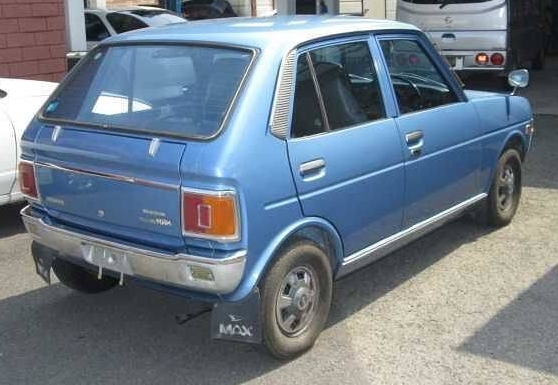
- Fellow Max: Introduced in 1972, this was the “sporty” trim. It featured a high-output version of the 360cc engine, sporty stripes, and often a tachometer—a rare feature for a Kei car.
- Fellow CM: The “Custom Mayfair.” This was the top-tier luxury trim. It featured two-tone paint, fabric upholstery, upgraded sound insulation, and often four-round headlights (giving it a distinct face).
- 4×4 Variants: The “4” badge remained prominent, particularly on the Van and Truck models, solidifying the Fellow’s reputation as a workhorse in rural Japan.
By the late 1970s, the Fellow was battling fierce competition from the Honda Life, Suzuki Fronte, and Mitsubishi Minica. The design, once modern, began to look dated, and the Daihatsu chassis was showing its age against the newer, more advanced competitors.
The Turbo Revolution: The Third Generation (1980–1985)
In October 1980, Daihatsu launched the third-generation Fellow, marking a shift from pure utility to technical innovation. This model arrived just as the Japanese economy was entering its “bubble” phase, and consumers wanted more excitement.
Design and Engineering: The boxy, upright design of the previous generation was replaced by a softer, more aerodynamic silhouette with sloping headlights and a curved windshield. The engine options were the 547cc two-cylinder and a new 547cc three-cylinder, both water-cooled.
The Turbo Era: The defining moment for this generation was the introduction of the Fellow Turbo in 1982. While Kei cars had seen minor performance tweaks before, the Fellow Turbo was a genuine “hot hatch” of the micro-car world. It utilized a turbocharged 547cc engine producing roughly 45 horsepower (in a time when standard Kei cars made 28-30 hp). This gave the tiny car a surprising turn of speed, making it a favorite among young drivers and tuning enthusiasts.
Trim Levels:
- Standard/Special: Base models with 3-speed automatic or 4-speed manual transmissions.
- Van/Truck: Continued the commercial lineage.
- Fellow Turbo: The performance king. Distinguished by aggressive wheels, a rear spoiler, and “Turbo” decals.
- Fellow LS: The luxury sport trim. It combined the Turbo’s engine tuning with better interior amenities, including power windows (a novelty) and a more refined cabin.
This generation was also the first to see serious safety improvements, including energy-absorbing structures and optional seatbelts, aligning with stricter safety standards introduced by the Japanese Ministry of Land, Infrastructure, Transport and Tourism.
The Final Chapter: The Fourth Generation (1985–2024?)
The fourth generation launched in January 1985, and it was the most radical departure yet. The name “Fellow” was no longer the primary moniker; instead, it became a trim level suffix for the new Daihatsu Mira (known domestically as the Mira).
The Rebranding: Daihatsu shifted strategy. Rather than selling a car called the “Fellow,” they created a platform (the Mira) and offered different body styles. The “Fellow” designation was applied specifically to the:
- Fellow Max: The 3-door hatchback coupe variant of the Mira.
- Fellow Van: The 5-door wagon variant.
Technical Leap: The engine was now the 547cc EF-JL three-cylinder, which eventually gained electronic fuel injection (EFI) in 1989, a first for the series. This generation also saw the introduction of the Fellow Max Wide 55, which featured a wider track and fender flares, giving the Kei car a more aggressive stance.
The Long Tail: While production of the “Fellow” branded passenger cars (sedans/hatchbacks) largely ceased in the 1990s as Daihatsu streamlined its lineup under the Mira and Cuore names, the Van and Truck variants continued with minimal changes for an incredibly long time. Production of the Fellow Van (based on the Mira cargo) continued largely unchanged until April 2024. Due to new safety regulations requiring advanced collision avoidance systems and automatic emergency braking (AEBS), which were cost-prohibitive on such an old platform, Daihatsu finally ceased production of this commercial workhorse.
Market Reception and Cultural Impact
Throughout its history, the Fellow was praised for its reliability and packaging. The air-cooled engines of the 60s and 70s were simple to maintain, making the Fellow a favorite in rural areas where mechanic access was limited.
The Fellow also played a significant role in Japan’s K-car racing culture. In the 1970s and 80s, the Fellow—particularly the Max and Turbo variants—was a staple in amateur racing and rallying. Its lightweight chassis and tunable engines made it a formidable competitor against the Honda Life and Suzuki Fronte.
However, the Fellow was not without its critics. In its later years, especially during the 1990s and 2000s, the commercial Van variant was criticized for lacking modern amenities. It remained a bare-bones vehicle: crank windows, manual locks, and a radio that was often an optional extra. But for businesses in Japan’s dense urban centers, this lack of complexity was a selling point. It was cheap to buy, cheap to run, and could navigate the narrowest of alleyways.
Future Outlook and Legacy
The cessation of the Fellow Van in 2024 marks the end of an era for the “Fellow” nameplate. Daihatsu is now focusing on its modern lineup, including the Tanto, Cast, and Rocky. The company is also heavily investing in hybrid technology and electric powertrains for its Kei cars.
However, the legacy of the Fellow is secure. It laid the groundwork for Daihatsu’s current dominance in the Kei car market. The principles established by the Fellow—maximum interior space within minimal external dimensions, high versatility, and affordability—define the modern Kei car.
Today, the early Fellow models are sought-after classic cars. Restorers prize the 1966 BF models for their chrome bumpers and simple mechanics, while the 1980s Turbo models are becoming collector’s items for JDM (Japanese Domestic Market) enthusiasts.
Conclusion The Daihatsu Fellow is a chronicle of Japan’s modernization. It began as a humble, two-stroke runabout in a country struggling to rebuild, evolved into a high-tech turbocharged pocket rocket during the nation’s economic peak, and served as a reliable commercial delivery vehicle well into the 21st century. It never pretended to be a luxury liner; its purpose was to move people and goods efficiently, and it did so with a smile-inducing charm. As the last Fellow Vans roll off the assembly line, they leave behind a blueprint of how to build a car that truly serves the people—proof that sometimes, the smallest vehicles leave the biggest footprints.